
Free DBT Radical Acceptance Worksheet
Accepting a painful fact is not approving of it. This free DBT worksheet walks you through six guided steps: the fact you keep fighting, how you fight it, what is true and cannot change right now, acceptance with the body, what you can still choose, and the sentence you will use when the fact comes back.
neuroviaxacademy.com/tools/radical-acceptance-worksheet.html
Radical Acceptance Report
Cite this worksheet
Neuroviax Academy. (2026). Radical acceptance worksheet: Free DBT skill practice [Online worksheet]. https://neuroviaxacademy.com/tools/radical-acceptance-worksheet.html
How to Use This Radical Acceptance Worksheet
Name one fact
Choose one painful fact you keep pushing against. Write it as plain description, not as a verdict. "I was not offered the job" is a fact. "It is unfair" is a judgement about the fact.
Notice the fight
Notice how you argue with the fact: replaying it, blaming yourself, blaming others, staying angry, or numbing it. Then rate how much the fight is costing you from 0 to 10.
Come back to the body
Acceptance happens in the body as well as in the mind. Try a half-smile, willing hands, a slow breath out, or relaxed shoulders. Tick what you tried and note what you noticed.
Choose the next step
Write what you can still choose, what you are grieving, and the sentence you will tell yourself when the fact comes back. Print the page and keep it somewhere you will see it.
What is radical acceptance?
Radical acceptance is a distress tolerance skill in dialectical behavior therapy, developed by Marsha Linehan. It means accepting reality as it is, fully, with mind, body and heart, when you cannot change it right now. The word radical is used because the acceptance is complete. You stop arguing with what has already happened.
Pain is part of being alive. People lose jobs, relationships end, bodies get ill, and decisions are made without asking us. DBT makes a plain distinction: pain plus non-acceptance becomes suffering. The first part may not be in your control. The second part often is, and that is where this worksheet works.
Acceptance is not approval. You can accept that a decision was made and still think it was wrong. You can accept that a relationship has ended and still feel sad about it. Acceptance is not giving up either, and it is not staying in harm. It is seeing the situation clearly enough to choose what you do next.
What radical acceptance is not
| Acceptance is | Acceptance is not |
|---|---|
| Seeing the fact clearly, as it is | Saying the fact is right or fair |
| A choice you can make again each day | A one time decision you make and forget |
| Making room for pain so it can move through | Pushing pain down or pretending it is not there |
| A way to stop adding suffering | Giving up on a change that is still possible |
| Something you do with your body as well as your mind | Staying in abuse, danger or ongoing harm |
Radical acceptance for grief, health and relationships
Grief is one of the clearest places to practise. A person has died, and no amount of protest will bring them back to the room. Acceptance does not mean you stop missing them. It means you stop spending your energy arguing with the fact of the death, so that the missing can be felt and carried.
Health is another. A diagnosis is a fact about the body, not a failure of will. Accepting that the diagnosis is real can free you to take the appointments, change what is changeable, and rest where rest is needed. Fighting the fact can keep a person stuck in a search for a different answer.
Relationships bring their own facts. Someone ended things. A friend moved away. A family member cannot give what you hoped for. Acceptance means letting the relationship be what it is, while you decide what contact, if any, you can live with. That decision stays yours.
Turning the mind
Linehan's skills include turning the mind. Acceptance is rarely a single moment. You choose it, then notice yourself arguing again an hour later, and you choose it again. Each return is not a failure. It is the skill being practised.
Two more ideas from the same skills are worth plain words. Willingness is doing what the situation needs, like putting on a coat in the rain. Wilfulness is refusing, like standing in the rain to prove a point. The half-smile and willing hands are body positions that can soften a moment: relax the face, turn the corners of the lips up slightly, open the hands with the palms up on your lap.
A worked example
Hana had worked at the same company for three years. In November her manager told her the contract would not be renewed, and that the job would end on 31 December. Her first reaction was to argue with the fact. She replayed the meeting every night and told herself she had been blamed for budget cuts she did not cause.
She filled in this worksheet. The fact was written plainly: the contract was not renewed and the job ends on 31 December. The causes were budget cuts in the department. Her body settled when she tried willing hands and a slow breath out. Then she wrote what she could still choose: update her CV that week and tell two former colleagues she was looking. She wrote the sentence she would use when the argument came back: this happened, it hurts, and I can still take the next step. The cost of fighting it dropped from 8 to 5. The sadness did not vanish. It became something she could carry while she acted.
Frequently Asked Questions
What is radical acceptance?
Does radical acceptance mean giving up?
Who created radical acceptance?
What are examples of radical acceptance?
What if I cannot accept it?
Is my worksheet saved?
Sources and credits
- Linehan, M. M. (2015). DBT skills training manual (2nd ed.). Guilford Press.
- Linehan, M. M. (1993). Cognitive-behavioral treatment of borderline personality disorder. Guilford Press.
Credit: Radical acceptance, turning the mind, willingness and the half-smile and willing hands are described in DBT skills training (Linehan, 1993, 2015). Our worksheet layout is our own.
This page is an educational self-help aid. It does not provide therapy, and the sources cited concern structured treatment and skills training, not this worksheet itself.
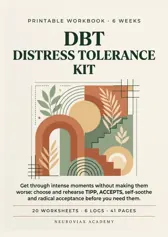
Go further: the printable DBT Distress Tolerance Kit
A printable PDF workbook with fill-in worksheets, trackers and a reading guide, in A4 and US Letter. Look inside before you decide.
See what is insideOr save 51% with the DBT Skills Workbook Bundle: 5 workbooks for $16.99 instead of $34.95.