
Circle of Control Worksheet
The circle of control is a teaching picture for sorting concerns into what you can control, what you can influence, and what you cannot. A similar idea, the circle of influence and circle of concern, was popularised by Stephen Covey in The 7 Habits of Highly Effective People (1989). The picture is a way to sort, not a test, and it does not score you.
Research on coping supports the idea of matching the coping to the situation. Folkman and Lazarus (1980) found that people used more problem-focused coping in situations they judged changeable and more emotion-focused coping where they felt they had to accept the situation. This worksheet gives you a place to put each concern, then one line for what you will do about it.
The Three Rings
Build Your Circles
Write what is on your mind, choose the ring for each item, then add one line for what you will do. Labels appear in the picture as you type, and you can tap a label to move it to the next ring. Auto-saved.
neuroviaxacademy.com/tools/circle-of-control-worksheet.html
Your Circle of Control
Each item sits in the ring you chose. The lists below repeat every item with the line you wrote for it. Read the pattern, then choose one next step.
Your pattern
Your next step
Cite this worksheet
Neuroviax Academy. (2026). Circle of control worksheet: Free interactive and printable [Online worksheet]. https://neuroviaxacademy.com/tools/circle-of-control-worksheet.html
How to Use This Circle of Control Worksheet
List what is on your mind
Write each worry, task or decision on its own row, up to twelve. Keep each one short enough to read at a glance.
Choose a ring
Decide whether you control the item, can influence it, or cannot change it. You can tap a label in the picture to move it to the next ring.
Add one line for each item
Write one step you will take, one way you can influence it, or one thing you can accept or let go of. The line follows the ring you chose.
See your circles and print
Press See my circles, read the pattern line, then print or save the page. Use the worry tree if one item keeps pulling your attention.
Circle of Control Worksheet: Sorting What You Can and Cannot Change
A circle of control worksheet asks you to put each concern into one of three rings. The inner ring is what you control, the middle ring is what you can influence, and the outer ring is what is outside your control. The point is not to label things perfectly. The point is to see where your effort can actually land, and to stop spending energy on the ring where nothing you do will change the result.
What is the circle of control?
The circle of control is a teaching picture for sorting concerns into what you can control, what you can influence, and what you cannot. A similar idea, the circle of influence and circle of concern, was popularised by Stephen Covey in The 7 Habits of Highly Effective People (1989). Research on coping supports the idea of matching the coping to the situation. Folkman and Lazarus (1980) found that people used more problem-focused coping in situations they judged changeable and more emotion-focused coping where they felt they had to accept the situation. The worksheet is a way to make that sort visible, and it may help you choose a response that fits the ring an item sits in.
Circle of control vs circle of influence
Control is what you decide directly. Your own words, your own actions, and how you spend your evening sit here. Influence is what you can affect but not decide. Your manager's decision, your teenager's choices, and whether a group meets are examples. You can make a request, offer information, or set a time, and the other person still decides. The outer ring holds what you cannot change at all, such as the weather, the news, or other people's past actions. When an item feels stuck, check which ring it truly belongs in. Many worries move from the outer ring to the middle ring once you name the one thing you can still do.
Using it with students and teams
The picture works well as a short classroom or team activity. Draw three circles on a board, then sort example cards together before anyone writes about their own week.
Draw the three rings and name them out loud. Hand out example cards, one concern per card, and sort them into the rings as a group. Discuss any card that could sit in two rings, then ask each person to add one item of their own and one line for what they will do.
Keep the examples light at first. Children can draw the circles and sort example cards before they add their own worries, and a team can use the same sort to separate what needs a decision from what needs a request.
A worked example: Sara's exam week
Sara has exams in two weeks and cannot sleep. She writes six items. "How I prepare for the exam" goes in the inner ring, with the step "Two past papers this week". "My sleep schedule" also goes in the inner ring, with "Phone out of the bedroom at 23:00". "Whether my study group meets" goes in the middle ring, with "Suggest a fixed time in the group chat". "The exam questions" goes in the outer ring, with "I cannot know them; I can prepare". "The marking" and "Other students' results" also sit in the outer ring. Her pattern line reads: most of your items are outside your control (3 of 6). She keeps the two steps, sends the group message, and practises letting the outer ring be.
| Ring | Examples | What helps |
|---|---|---|
| In my control | My own words and actions, how I spend my evening | One step I will take |
| I can influence | My manager's decision, my teenager's choices, whether the group meets | One way I can influence it |
| Outside my control | The weather, the news, other people's past actions, the marking | What I can accept or let go of |
Limits
Limits of this worksheet
This worksheet is for self-help and learning. It is not a diagnosis or a treatment. If worry or stress feels too much to manage, talk to a doctor, therapist or someone you trust.
Frequently Asked Questions
What is the circle of control?
What is the difference between the circle of control and the circle of influence?
Who created the circle of control?
How do I use a circle of control worksheet?
Can I use it with children or a class?
Is my worksheet saved?
Sources and credits
- Folkman, S., & Lazarus, R. S. (1980). An analysis of coping in a middle-aged community sample. Journal of Health and Social Behavior, 21(3), 219–239. doi.org/10.2307/2136617
- Covey, S. R. (1989). The 7 habits of highly effective people. Free Press.
Credits: The circle of influence and circle of concern model was popularised by Stephen Covey; the coping study cited above is by Folkman and Lazarus. The citations describe the ideas and research, not this worksheet.
This page is an educational worksheet. It does not provide therapy, diagnosis or a treatment plan.
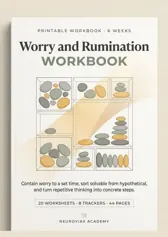
Go further: the printable Worry and Rumination Workbook
A printable PDF workbook with fill-in worksheets, trackers and a reading guide, in A4 and US Letter. Look inside before you decide.
See what is insideOr save 50% with the Anxiety Toolkit Workbook Bundle: 4 workbooks for $13.99 instead of $27.96.
Print Your Worksheet
Enter your email to generate and print your circle of control worksheet with its three rings and next step.