
Free DBT Crisis Survival Skills Planner — 6-Step Distress Tolerance Framework
This free interactive planner helps you choose TIPP, ACCEPTS and self-soothe skills before a crisis, so they are ready when intense distress hits. Adapted from DBT distress tolerance concepts described in clinical research, this educational tool organises your personal skills into six guided steps and exports a printable crisis skills card.
neuroviaxacademy.com/tools/dbt-crisis-survival-skills.html
Crisis Skills Card
Academic Citations
Neuroviax Academy. (2026). DBT crisis survival skills planner: TIPP, ACCEPTS and self-soothe [Online worksheet]. https://neuroviaxacademy.com/tools/dbt-crisis-survival-skills.html
How to Use This Free DBT Crisis Survival Skills Planner
Warning Signs
Describe how you know distress is building — thoughts, feelings and body signs — and rate how intense it usually gets from 0 to 10.
TIPP Skills
Select any of the four TIPP skills (Temperature, Intense exercise, Paced breathing, Paired muscle relaxation) and note how you will do each one.
ACCEPTS Distract
Choose from seven ACCEPTS distraction categories and write a short plan for each one you pick.
Self-Soothe
Plan at least one self-soothe action for each of the five senses: Vision, Hearing, Smell, Taste and Touch.
People & Places
Note who you can contact and a safe place you can go when distress feels overwhelming.
Practice & First Skill
Decide when you will practise one skill while calm, and choose which skill you will try first in a crisis.
DBT Crisis Survival Skills: The Distress Tolerance Framework Explained
Crisis survival skills are distress tolerance skills from Dialectical Behavior Therapy (DBT) designed to help you get through an intense moment without making the situation worse (Linehan, 2015). TIPP changes body chemistry quickly, ACCEPTS distracts attention, and self-soothe uses the five senses to calm. Research suggests that using DBT skills is associated with better outcomes (Neacsiu, Rizvi & Linehan, 2010); those findings concern structured treatment and do not establish benefits from this worksheet. This page is an educational self-reflection planner that organises your personal skills into a portable crisis card.
Why Choose Skills Before a Crisis?
It is hard to think clearly when distress is intense. Deciding in advance which TIPP, ACCEPTS and self-soothe skills you will use means they are ready when you need them, rather than trying to invent a plan in the moment. This planner records your choices so you can print or save them on your phone.
TIPP: Changing Body Chemistry Fast
TIPP stands for Temperature, Intense exercise, Paced breathing and Paired muscle relaxation. Cold water on the face and short bursts of intense exercise can change heart rate quickly; if you have a heart condition, low blood pressure, an eating disorder or another medical condition, check with a doctor before using them. Paced breathing and paired muscle relaxation are generally gentler options.
ACCEPTS: Distraction Skills
ACCEPTS stands for Activities, Contributing, Comparisons, Emotions, Pushing away, Thoughts and Sensations. These skills shift attention away from distress temporarily so that the intensity can decrease before you address the problem.
Self-Soothe: The Five Senses
Self-soothe uses Vision, Hearing, Smell, Taste and Touch to create a calming sensory experience. At least one sense is required in this planner so that you leave with a concrete soothing action.
| Feature | DBT Crisis Survival Skills | General Coping |
|---|---|---|
| Origin | Dialectical Behavior Therapy (Linehan) | Various traditions |
| Purpose | Get through intense distress without making it worse | Manage stress or low mood |
| Structure | TIPP, ACCEPTS, self-soothe, plus people/places | Often unstructured |
| Output | Portable crisis skills card | Varies |
Frequently Asked Questions
What does TIPP stand for?
What does ACCEPTS stand for?
Is my plan saved?
Is this a safety plan?
Sources and credits
- Linehan, M. M. (2015). DBT skills training manual (2nd ed.). Guilford Press.
- Neacsiu, A. D., Rizvi, S. L., & Linehan, M. M. (2010). Dialectical behavior therapy skills use as a mediator and outcome of treatment for borderline personality disorder. Behaviour Research and Therapy, 48(9), 832–839. doi.org/10.1016/j.brat.2010.05.017
- Gross, J. J. (1998). The emerging field of emotion regulation: An integrative review. Review of General Psychology, 2(3), 271–299. doi.org/10.1037/1089-2680.2.3.271
- Craske, M. G., Treanor, M., Conway, C. C., Zbozinek, T., & Vervliet, B. (2014). Maximizing exposure therapy: An inhibitory learning approach. Behaviour Research and Therapy, 58, 10–23. doi.org/10.1016/j.brat.2014.04.006
Credit: Crisis survival skills are part of Dialectical Behavior Therapy developed by Marsha M. Linehan. This page is an educational self-reflection worksheet. It does not provide therapy, and the research cited concerns structured treatment or general findings, not this worksheet itself.
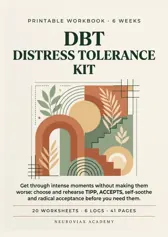
Go further: the printable DBT Distress Tolerance Kit
A printable PDF workbook with fill-in worksheets, trackers and a reading guide, in A4 and US Letter. Look inside before you decide.
See what is insideOr save 51% with the DBT Skills Workbook Bundle: 5 workbooks for $16.99 instead of $34.95.