
DBT Diary Card
Fill in one card a day: rate your emotions and urges, note what you did and which DBT skills you used, then look at the week as a whole.
Privacy: Your entries are saved in this browser on this device so you can continue later; they are not sent to Neuroviax Academy. Use Start fresh to clear them.
neuroviaxacademy.com/tools/dbt-diary-card.html
DBT Diary Card
Weekly summary
The summary covers the seven most recent days by date. Days with an older date stay saved but are not counted here.
| Emotion | Average | Highest day value |
|---|
Printable log preview
Cite this worksheet
Neuroviax Academy. (2026). DBT diary card: Free printable and fillable template [Online worksheet]. https://neuroviaxacademy.com/tools/dbt-diary-card.html
How to use it
Fill it in once a day, at about the same time each day.
Rate honestly. There are no good or bad numbers, only what the day was like.
Bring the weekly summary to your therapist or skills group if you have one.
What is a DBT diary card?
A diary card is a one-page daily record used in dialectical behaviour therapy (DBT). People rate their emotions and urges, note what they did, and mark which skills they practised. Over a week it shows patterns that are hard to see day by day, and it gives a therapist and client a shared starting point for each session.
Limits
This diary card is a self-monitoring aid for education and practice. It is not a diagnosis or a treatment, and it does not replace DBT with a trained clinician. Our layout is our own, based on the structure described in DBT skills training; it is not the official card from the DBT manual.
Frequently Asked Questions
What is a DBT diary card used for?
How often should I fill in a diary card?
Is my diary card saved?
Is this the official DBT diary card?
Sources and credits
- Linehan, M. M. (2015). DBT skills training manual (2nd ed.). Guilford Press.
- Neacsiu, A. D., Rizvi, S. L., & Linehan, M. M. (2010). Dialectical behavior therapy skills use as a mediator and outcome of treatment for borderline personality disorder. Behaviour Research and Therapy, 48(9), 832–839. https://doi.org/10.1016/j.brat.2010.05.017
This page is an original educational self-monitoring tool written for Neuroviax Academy. It does not reproduce the official diary card from the DBT manual.
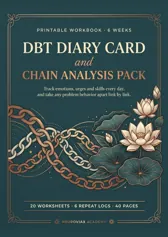
Go further: the printable DBT Diary Card and Chain Analysis Pack
A printable PDF workbook with fill-in worksheets, trackers and a reading guide, in A4 and US Letter. Look inside before you decide.
See what is insideOr save 51% with the DBT Skills Workbook Bundle: 5 workbooks for $16.99 instead of $34.95.