
Free Check the Facts Worksheet
A DBT emotion regulation skill in six guided steps: name the emotion and how strong it is, write only the facts, catch the interpretations you added, test the threat and the worst case, and then judge whether the emotion and its intensity fit.
Your answers are saved in this browser on this device so you can continue later; they are not sent to Neuroviax Academy. Use Start fresh to clear them.
neuroviaxacademy.com/tools/check-the-facts-worksheet.html
Check the Facts Report
Cite this worksheet
Neuroviax Academy. (2026). Check the facts worksheet: Free DBT emotion regulation tool [Online worksheet]. https://neuroviaxacademy.com/tools/check-the-facts-worksheet.html
How to Use This Check the Facts Worksheet
Name the emotion, then the facts
Pick the emotion that is loudest right now and rate how strong it is from 0 to 100. Then describe what happened as a camera would record it: what was said, what was done, where and when.
Interpretation and threat
Write what you are assuming or adding to the facts, and at least one other way to read the situation. Then name the harm you expect and how likely it really is.
Test the worst case
Ask how you would actually cope if the worst happened. A concrete coping plan usually lowers the threat more than reassurance does.
Judge the fit, then re-rate
Ask whether the emotion fits the facts and whether its intensity fits. Re-rate the emotion from 0 to 100 and follow the next step that matches your answers.
What Is Check the Facts?
Check the facts is a DBT emotion regulation skill. Emotions often respond to our interpretations of an event rather than to the event itself. By separating facts from assumptions, testing the expected threat, and asking whether the emotion and its intensity fit, you can lower emotions that do not fit and act on those that do.
Where the skill comes from
Check the facts sits in the emotion regulation module of Dialectical Behavior Therapy skills training (Linehan, 2015). The skill does not ask you to argue with a feeling. It asks you to look at the evidence first, then decide whether the feeling and its strength belong to the situation or to the story you added to it.
Facts versus interpretation
The dividing line is simple: what could a camera record? In the example below, the camera can record the meeting request. It cannot record the conclusion.
| Facts a camera could record | Interpretation added |
|---|---|
| "My manager asked me to come to her office at 3 pm." | "I'm going to be fired." |
| No other information had been received at that point. | An expectation of harm, held as if it were already true. |
Why the intensity question matters
Two questions decide the next step. First, does the emotion fit the facts? Second, does its intensity fit? Fear at 80 out of 100 before a routine meeting usually fits neither. When the emotion does fit the facts, the useful move is to solve the situation; when it does not, the useful move is opposite action, acting opposite to the urge the emotion brings.
Frequently Asked Questions
What does check the facts mean in DBT?
What if my emotion does fit the facts?
Is my worksheet saved?
Is check the facts the same as CBT thought records?
Sources and credits
- Linehan, M. M. (2015). DBT skills training manual (2nd ed.). Guilford Press.
- Gross, J. J. (1998). The emerging field of emotion regulation: An integrative review. Review of General Psychology, 2(3), 271–299. doi.org/10.1037/1089-2680.2.3.271
Credit: Check the facts is a skill from Dialectical Behavior Therapy, developed by Marsha M. Linehan and described in the DBT skills training manual (2015).
This page is an educational self-reflection worksheet. It does not provide therapy, and the research cited concerns structured treatment or general findings, not this worksheet itself.
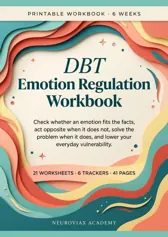
Go further: the printable DBT Emotion Regulation Workbook
A printable PDF workbook with fill-in worksheets, trackers and a reading guide, in A4 and US Letter. Look inside before you decide.
See what is insideOr save 51% with the DBT Skills Workbook Bundle: 5 workbooks for $16.99 instead of $34.95.