
Free DBT Opposite Action Worksheet — 6 Steps
This free interactive worksheet walks you through the DBT emotion regulation skill of opposite action. Name the emotion and its urge, check whether the emotion or its strength fits the facts, plan an opposite action, and record how the emotion changes afterwards. Export your notes as a PDF report.
neuroviaxacademy.com/tools/opposite-action-worksheet.html
Opposite Action Report
Cite this worksheet
Neuroviax Academy. (2026). Opposite action worksheet: Free DBT emotion regulation tool [Online worksheet]. https://neuroviaxacademy.com/tools/opposite-action-worksheet.html
How to Use This Free DBT Opposite Action Worksheet
Emotion
Name the emotion you are having and rate how strong it is from 0 to 100. Naming it clearly makes the next steps easier.
Urge
Write what the emotion pushes you to do. Each emotion tends to come with a typical urge, such as escape for fear or attack for anger.
Fit the Facts
Ask whether the emotion, or its strength, fits the facts of the situation. If it does, problem solving may help more than opposite action.
Opposite Action
Write the action that is opposite to the urge. Suggestions are offered for common emotions, and you can edit or replace them.
All the Way
Plan the action in body posture, face, voice and thoughts, and set a time. Acting opposite all the way matters more than a half action.
After
Record whether you did it, how strong the emotion is now, and what you noticed. The report compares before and after.
What Is Opposite Action?
Opposite action is a DBT emotion regulation skill. Each emotion comes with an urge to act; when the emotion or its strength does not fit the facts, acting opposite to that urge, fully, in body, face, voice and thoughts, can reduce the emotion over time.
Why the Facts Come First
Emotions are not wrong or bad. The skill asks a practical question: does this emotion, at this strength, fit what is actually happening? When it does, acting on it may be useful, and problem solving the situation is often the better skill. When it does not fit, or acting on it would not help, opposite action offers a different route.
Acting Opposite All the Way
DBT teaches acting opposite all the way, because a half action, such as approaching while still hiding, keeps the emotion going. Posture, face, voice and thoughts are part of the action, not extras. The worksheet asks for each of them so the plan is specific enough to try.
Tracking the Change
The worksheet records the strength of the emotion before and after the action, so you can see the direction and size of any change. A small change is still information; the skill is practised over time rather than proved in one attempt.
Frequently Asked Questions
What is opposite action in DBT?
When should I not use opposite action?
Is my worksheet saved?
Why do body posture and voice matter?
Sources and credits
- Linehan, M. M. (2015). DBT skills training manual (2nd ed.). Guilford Press.
- Gross, J. J. (1998). The emerging field of emotion regulation: An integrative review. Review of General Psychology, 2(3), 271–299. doi.org/10.1037/1089-2680.2.3.271
Credit: Opposite action is a dialectical behaviour therapy (DBT) emotion regulation skill developed by Marsha M. Linehan. The emotion regulation framing also draws on James J. Gross's work on emotion regulation.
This page is an educational self-reflection worksheet. It does not provide therapy, and the research cited concerns DBT skills training and emotion regulation in general, not this worksheet itself.
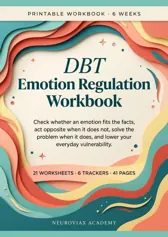
Go further: the printable DBT Emotion Regulation Workbook
A printable PDF workbook with fill-in worksheets, trackers and a reading guide, in A4 and US Letter. Look inside before you decide.
See what is insideOr save 51% with the DBT Skills Workbook Bundle: 5 workbooks for $16.99 instead of $34.95.