
Free CBT Triangle Worksheet
A CBT triangle is a simple picture from cognitive behavioural therapy. It shows how a situation links to your thoughts, your feelings and your actions, and how each corner feeds the other two. This interactive version walks you through 6 guided steps, then draws your triangle before and after you change one corner.
neuroviaxacademy.com/tools/cbt-triangle.html
CBT Triangle Report
Cite this worksheet
Neuroviax Academy. (2026). CBT triangle worksheet: Free cognitive triangle tool [Online worksheet]. https://neuroviaxacademy.com/tools/cbt-triangle.html
How to Use This CBT Triangle Worksheet
Pick one situation
Choose one moment from the last few days or weeks. One situation per triangle keeps the picture clear and easy to read.
Describe it like a camera
Write where you were, when it happened and who was there. Stick to what a camera would have seen, not what you decided it meant.
Name the thought and feeling
A thought is a sentence. A feeling is usually one word. Rate how much you believe the thought and how strong the feeling is.
Change one corner
Change the thought or the action, then look at the new triangle. Notice how the expected feeling strength may shift.
What is the CBT triangle?
The CBT triangle, also called the cognitive triangle, is a teaching picture from cognitive behavioural therapy. It shows that thoughts, feelings and behaviours are linked, so a change in one can change the others. You do not have to take the picture on trust. You can test it on one real moment from your week, and the worksheet below will draw the result for you.
The three-part picture is drawn from the cognitive model described by Aaron Beck and colleagues in Cognitive Therapy of Depression (1979). In that model, the way a person reads a situation shapes what they feel and what they do, and those reactions feed back into the next thought. Beck's later book for practitioners sets out the same idea in more detail. The triangle is a plain-language version of that model, made for learning rather than for treatment.
Some versions add body sensations as a fourth part, and the five-part model often drawn by Christine Padesky adds a fifth. That wider picture is sometimes called the hot cross bun, because five parts meet in the middle. This worksheet keeps to the three corners so the shape stays simple, and asks about the body in one optional box instead.
Thought, feeling or action: how to tell them apart
People often mix the three corners together, especially when a thought arrives dressed as a feeling. The sentence "I feel that she hates me" sounds like a feeling, but it is a thought, because it is an idea about another person's mind rather than one word for an emotion. The table below gives a plain way to sort them.
| Corner | What it is | Example | Common mix-up |
|---|---|---|---|
| Thought | A sentence or a short idea in your mind | "She is annoyed with me" | "I feel that she hates me" is a thought, not a feeling |
| Feeling | One word for an emotion, with a strength from 0 to 10 | Anxious, strength 7 | Writing a whole sentence instead of one word |
| Action | Something you did, or an urge you acted on | Went home and avoided texting her | Describing the reason instead of the behaviour |
A quick test helps. If you can put "that" in front of it and it still makes sense, as in "I think that she is annoyed with me", you are looking at a thought. If it is a single word such as sad, angry or ashamed, you are looking at a feeling. If another person could film it, you are looking at an action.
Which corner to change first
Any corner can be a starting point, but some are easier to reach in the moment. Thoughts are often the quickest to test, because you can ask what evidence supports them and what evidence does not. Actions are useful when a small behaviour change is within reach, such as sending one short message instead of waiting. Feelings are harder to change directly, so they tend to move when a thought or an action shifts.
There is no single right order. Some people start with the action because it is the most concrete, then notice the thought that followed. Others start with the thought because the feeling is too strong to think clearly. The useful question is which corner you can reach today. Pick that one, rate the feeling before and after, and let the triangle show you the rest.
A worked example
Layla is in the supermarket and sees a friend walk past without saying hello. Her thought is "She is annoyed with me", and she believes it about 80 out of 100. She feels anxious and sad, and rates the strength at 7 out of 10. She goes home and avoids texting her, and notices a tight stomach.
In the second triangle she changes the thought to "She may not have seen me; she looked busy", and believes it about 60 out of 100. She expects the feeling strength to drop to 4. She also plans to send a short message. The picture makes the link visible: one changed thought, and the feeling and the action have room to move. Nothing here is a cure, and the numbers are only Layla's own ratings on that day.
Frequently Asked Questions
What is the CBT triangle?
Is the cognitive triangle the same as the CBT triangle?
How do I fill in a CBT triangle worksheet?
What is the difference between a thought and a feeling?
Can I use the CBT triangle with children?
Is my worksheet saved?
Sources and credits
- Beck, A. T., Rush, A. J., Shaw, B. F., & Emery, G. (1979). Cognitive therapy of depression. Guilford Press.
- Beck, J. S. (2020). Cognitive behavior therapy: Basics and beyond (3rd ed.). Guilford Press.
Credit: The cognitive triangle is drawn from the cognitive model described by Aaron Beck and colleagues (1979). Our worksheet layout is our own.
This page is an educational self-help aid. It does not provide therapy, and the research cited concerns structured treatment or general findings, not this worksheet itself.
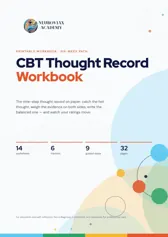
Go further: the printable CBT Thought Record Workbook
A printable PDF workbook with fill-in worksheets, trackers and a reading guide, in A4 and US Letter. Look inside before you decide.
See what is insideOr save 46% with the CBT Worksheets Bundle: 6 workbooks for $18.99 instead of $34.94.