
Feelings Wheel
A feelings wheel puts emotion words in rings: a few broad feelings in the middle and more exact words toward the edge. Moving from the centre outward helps you go from “I feel bad” to “I feel disappointed” or “I feel lonely”. The best-known version, The Feeling Wheel, was created by Gloria Willcox in 1982. The wheel on this page is our own: its six core feelings and the families around them follow the emotion word study of Shaver and colleagues (1987), who asked people to sort emotion words and found six broad groups: love, joy, surprise, anger, sadness and fear.
Tap a core feeling, then a family, then the word that fits best. Rate how strong it is from 0 to 10 and note where you feel it in your body. You can name up to three feelings, from any part of the wheel, and then print your own emotion wheel with those words marked.
Build Your Feelings Map
Pick the core feeling that is closest, then move outward to the exact word. Add up to three feelings, rate each one and note where it sits in your body. Auto-saved.
neuroviaxacademy.com/tools/feelings-wheel.html
Your Feelings Map
Your chosen words are marked on the wheel below. Each word is shown with its family, its core feeling, how strong it is, where you feel it and what happened just before.
Chosen
| Feeling | Family | Core | Strength | Where in the body | What happened before |
|---|
Cite this tool
Neuroviax Academy. (2026). Feelings wheel: Free interactive emotion wheel and list [Online tool]. https://neuroviaxacademy.com/tools/feelings-wheel.html
How to Use This Feelings Wheel
Start in the middle
Pick the core feeling that is closest, even if it is only a rough guess. Six broad feelings sit in the centre ring: love, joy, surprise, anger, sadness and fear.
Move outward
Choose the family, then the word that fits best; read two or three before you choose. The outer ring holds the more exact words.
Rate it
0 is not at all, 10 is the strongest you can imagine; note where you feel it in your body. The rating is yours alone; there is no correct number.
Read your map
Print it or bring it to a session; come back later and see whether the words change. Naming a feeling precisely is the skill the wheel trains.
Feelings Wheel: Free Interactive Emotion Wheel and List
A feelings wheel is a map of emotion words. Broad feelings sit in the centre, and more exact words sit toward the edge, grouped into families. The point is not to find the one right word. The point is to move from a vague “I feel bad” to a word that fits, because a precise word tells you more about what you might need.
Why naming the exact feeling helps
Research on emotion differentiation suggests that people who describe unpleasant feelings in precise words, not just “bad” or “stressed”, tend to cope with those feelings better (Kashdan, Barrett and McKnight, 2015). A precise word also tells you more about what you might need: disappointment calls for something different from fear.
Other models exist. Robert Plutchik (2001) proposed eight basic emotions arranged in a circle, with blends between neighbours. Different wheels use different words; none is the one correct list. Use the words that fit you.
List of emotions in this wheel
All 82 words of the wheel, grouped by core feeling.
Love
Joy
Surprise
Anger
Sadness
Fear
A worked example
Sam started with “I just feel off”. Sam chose Fear, then Nervousness, then Worry, and rated it 7 in the chest. Reading on, Sam noticed Hurt at 7 about a friend who had not replied. The map showed two strong feelings from two different cores, both at 7, so there was no single strongest feeling. Sam chose to write a thought record about the meeting the next day and to message the friend.
Feelings wheel for kids and teens
Younger children do better with fewer words. Start with the six core feelings only, and add one family at a time. A child version of this wheel is planned.
Frequently Asked Questions
What is a feelings wheel?
Who created the feelings wheel?
What are the six core emotions on this wheel?
How do I use a feelings wheel?
Can I print the feelings wheel?
Is my answer saved?
Sources and credits
- Willcox, G. (1982). The Feeling Wheel. Transactional Analysis Journal, 12(4), 274–276. doi.org/10.1177/036215378201200411
- Shaver, P., Schwartz, J., Kirson, D., & O'Connor, C. (1987). Emotion knowledge: Further exploration of a prototype approach. Journal of Personality and Social Psychology, 52(6), 1061–1086. doi.org/10.1037/0022-3514.52.6.1061
- Kashdan, T. B., Barrett, L. F., & McKnight, P. E. (2015). Unpacking emotion differentiation: Transforming unpleasant experience by perceiving distinctions in negativity. Current Directions in Psychological Science, 24(1), 10–16. doi.org/10.1177/0963721414550708
- Plutchik, R. (2001). The nature of emotions. American Scientist, 89(4), 344–350. doi.org/10.1511/2001.28.344
Credits: The Feeling Wheel is the work of Gloria Willcox (1982). This page does not copy her wheel; its words and layout are our own, organised by the emotion groups of Shaver et al. (1987).
This page is an educational tool. It does not provide therapy, diagnosis or a treatment plan.
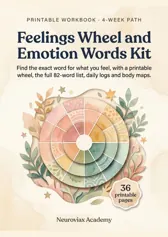
Go further: the printable Feelings Wheel and Emotion Words Kit
A printable PDF workbook with fill-in worksheets, trackers and a reading guide, in A4 and US Letter. Look inside before you decide.
See what is insideOr save 46% with the Calm and Cope Workbook Bundle: 4 workbooks for $14.99 instead of $27.96.
Print Your Feelings Map
Enter your email to generate and print your emotion wheel with your chosen words marked.