
Free Socratic Questioning Worksheet
A Socratic questioning worksheet gives you 30 questions in 6 groups to test one upsetting thought. This interactive version walks you through 4 guided steps: write the thought and rate how much you believe it, choose 3 to 6 questions, answer them, then write a more balanced thought and rate your belief again.
neuroviaxacademy.com/tools/socratic-questioning-worksheet.html
Socratic Questioning Report
Cite this worksheet
Neuroviax Academy. (2026). Socratic questioning worksheet: 30 questions to test a thought [Online worksheet]. https://neuroviaxacademy.com/tools/socratic-questioning-worksheet.html
How to Use This Socratic Questioning Worksheet
Write the thought
Start with one upsetting thought in its own words, then rate how much you believe it from 0 to 100. Add the situation if it helps, and name the feeling if there is one.
Choose 3 to 6 questions
Open the six groups and tick three to six questions that fit the thought. You do not need every question. Fewer, well-chosen ones usually work better.
Answer them honestly
Write a short answer to at least three of your chosen questions. Look for facts, other views and what is most likely, not for a quick win.
Write a balanced thought
Put the answers together into a fairer thought, then rate your belief in the original thought again so you can see what shifted.
What is Socratic questioning?
Socratic questioning is the way a cognitive therapist uses careful questions to help a client look at the evidence and other views of a thought, instead of being told what to think. The name comes from the questioning method of the philosopher Socrates, who asked people to explain what they believed and then to check it against the facts. In cognitive behavioural therapy the same idea is called guided discovery. The therapist does not argue with the thought or replace it with a better one. They ask open questions, and the client does the looking.
In a study of cognitive therapy for depression, sessions in which therapists used more Socratic questioning were followed by greater symptom improvement by the next session (Braun, Strunk, Sasso and Cooper, 2015). That is one finding from one study, not a promise, but it suggests the questions are worth taking seriously.
What makes a good Socratic question
A good Socratic question is open, curious and not leading. It invites you to look rather than pushing you to a particular answer. Compare "What is the evidence for and against this thought?" with "Surely you can see this thought is wrong?". The first leaves room for the thought to be partly true. The second tells you the answer before you have looked. Curiosity is the point. If a question has only one acceptable answer, it is not really a question.
This is why the questions here are spread across six groups. A thought rarely gives way to one clever question. It softens when you look at the evidence, then at other views, then at what is most likely, then at what you can actually do. The therapist's job in guided discovery is to keep the looking open and to follow where the client's own answers lead.
Socratic questions for CBT, therapists and teachers
Therapists use Socratic questioning in CBT to help clients test their own thoughts rather than accept a reassurance from someone else. A thought a client reaches on their own tends to be more convincing than one they are handed. A study by Braun and colleagues (2015) found more of this questioning was followed by more improvement in depression symptoms. The same style works in a classroom or a supervision group, where a teacher can ask a learner to lay out the evidence for a claim instead of marking it right or wrong.
In practice the questions stay short and ordinary. What is the evidence? Is there another way to see it? What would you tell a friend? What is most likely to happen? None of these needs a technical word, which is part of why they travel well from the therapy room to everyday use.
The six groups at a glance
The table below lists each group of questions and one example, so you can see the range before you begin.
| Group | Example question |
|---|---|
| Evidence | What is the evidence that this thought is true? |
| Other views | Is there another way to see this? |
| Worst, best, most likely | What is most likely to happen? |
| Effect of the thought | What happens when I believe this thought? |
| A friend's view | What would I tell a friend who had this thought? |
| What I can do | What is in my control here? |
A worked example
Omar has a driving test on Friday. The thought "I will fail the driving test and everyone will think I am useless" arrives with a belief rating of 90 out of 100 and a strong wave of anxiety, about 8 out of 10. He writes the situation as "Test is on Friday" and picks three questions. To "What is the evidence against it?" he answers that he passed his mock test last week and his instructor says he is ready. To "What is most likely to happen?" he writes that he will be nervous, make a small mistake or two, and probably pass. To "What would I tell a friend who had this thought?" he says that lots of people fail the first time and nobody thinks they are useless. He writes a more balanced thought: "I am ready enough; if I fail I can retake it, and it says nothing about my worth." His belief in the original thought falls to 40, and the anxiety eases to 4.
Frequently Asked Questions
What is Socratic questioning?
What are examples of Socratic questions?
How is Socratic questioning used in CBT?
How many questions should I answer?
What if I still believe the thought?
Is my worksheet saved?
Sources and credits
- Braun, J. D., Strunk, D. R., Sasso, K. E., & Cooper, A. A. (2015). Therapist use of Socratic questioning predicts session-to-session symptom change in cognitive therapy for depression. Behaviour Research and Therapy, 70, 32–37. doi.org/10.1016/j.brat.2015.05.004
- Beck, J. S. (2020). Cognitive behavior therapy: Basics and beyond (3rd ed.). Guilford Press.
Credit: The Socratic questioning method is described in cognitive therapy texts (Beck, 2020). Our worksheet layout is our own.
This page is an educational self-help aid. It does not provide therapy, and the research cited concerns structured treatment or general findings, not this worksheet itself.
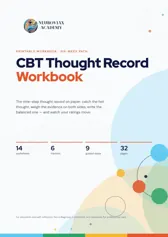
Go further: the printable CBT Thought Record Workbook
A printable PDF workbook with fill-in worksheets, trackers and a reading guide, in A4 and US Letter. Look inside before you decide.
See what is insideOr save 46% with the CBT Worksheets Bundle: 6 workbooks for $18.99 instead of $34.94.