
Plan Ahead for Your Next Exam
Walk through 9 short steps to name your worries, spread study topics onto a live mini calendar with practice tests, try a quiet 10-minute worry-writing exercise, and build a clear exam-day checklist you can print.
neuroviaxacademy.com/tools/test-anxiety-worksheet.html
Your Exam Stress Plan
Research Citations
von der Embse, N., Jester, D., Roy, D., & Post, J. (2018). Test anxiety effects, predictors, and correlates: A 30-year meta-analytic review. Journal of Affective Disorders, 227, 483-493. https://doi.org/10.1016/j.jad.2017.11.048 Ramirez, G., & Beilock, S. L. (2011). Writing about testing worries boosts exam performance in the classroom. Science, 331(6014), 211-213. https://doi.org/10.1126/science.1199427
For professionals: notes for teachers, counsellors, and school staff
This worksheet is a practical psychoeducational planning aid for students aged 13 and up. It combines cognitive reflection (naming worry thoughts and writing a fairer alternative), spaced study planning with practice-test retrieval, an expressive 10-minute worry-writing prompt based on Ramirez and Beilock (2011), and an exam-day behavioural routine.
It produces no clinical score, cutoff, or diagnosis. When using it in pastoral care, study skills sessions, or counselling, invite the student to keep Step 6 private if they prefer and focus shared review on the study calendar (Step 5) and exam-day reset (Step 7). All data remains in the local browser only.
How to Use This Test Anxiety Worksheet
Name the exam and worries
Enter your subject and exam date to see how many days are left, then write out the worry thoughts on your mind in your own plain words.
Rate stress and spot body signs
Set the 0 to 100 gauge for how strong the worry feels right now, and tap any body signals you notice so they feel less surprising on exam day.
Plan study days and write worries out
Place topics onto the live mini calendar with spaced practice tests, then try the quiet 10-minute worry-writing ring to clear space in your mind.
Set your exam-day plan and re-rate
Plan sleep, breakfast, items to pack, and your in-exam reset, write a fairer thought, and compare your before and after gauges on one printable card.
Understanding Test Anxiety and How to Prepare
Feeling nervous before a big test is normal. A little tension can even help you stay alert. Test anxiety is stronger than everyday pre-exam nerves. It is a mix of worried thoughts, uncomfortable body feelings, and habits like putting off revision that make it harder to show what you actually know. Students in middle school, high school, and college can all experience it, even when they have studied well.
Common Signs of Test Anxiety
Test anxiety usually shows up in three places: your thoughts, your body, and your study habits. Worry thoughts often sound harsh and all-or-nothing, such as thinking your mind will go blank or that one grade will ruin your future. In the body, stress hormones can bring on a fast heartbeat, shallow breathing, a tight chest, sweaty hands, headaches, stomach aches, or trouble sleeping the night before an exam. In daily habits, some students avoid opening their books because studying reminds them of the test, while others re-read the same notes late into the night without really taking them in.
How Test Anxiety Affects Exam Results
Research shows that strong test anxiety is not just uncomfortable; it is linked with lower marks. In a 30-year meta-analytic review, von der Embse, Jester, Roy, and Post (2018) found that higher test anxiety was linked with lower performance on standardised tests, entrance exams, and grade averages. The same review found that self-esteem was a strong predictor of test anxiety. When a student already doubts their own ability, an exam can start to feel like a verdict on who they are rather than a check on one topic. Worry also takes up space in working memory, leaving less room to recall facts or work through multi-step problems.
Why 10-Minute Worry Writing Helps
Trying to force yourself to stop worrying right before a test rarely works and often makes the thoughts louder. A simple writing exercise can help instead. In a study published in Science, Ramirez and Beilock (2011) found that students who spent about 10 minutes writing openly about their worries just before an important test did better than students who did not write about them. Putting the worries onto paper or a private screen gives your mind a place to offload them, so they do not keep interrupting while you read exam questions. Step 6 of this worksheet gives you a quiet, sound-free 10-minute timer to try that method before a practice test or the real exam.
Practical Study and Exam-Day Habits
Good preparation lowers the unknown. Instead of cramming the night before, break the syllabus into small topics and spread them across the days you have left. This spaced practice helps your brain store material more reliably. Mix in short practice tests or self-quizzes where you close your notes and try to recall answers from memory. Practice tests also help your body get used to exam conditions in a low-stakes setting. If you want help turning a large revision goal into small, realistic milestones, the SMART Goal Planner works well alongside this worksheet.
Your routine around the exam matters just as much as your notes. Sleep helps memory settle, so aim for a full night of rest rather than a late cramming session. Eat a steady breakfast, pack pens, ID, water, and allowed equipment the evening before, and plan to arrive early so you are not rushing into the room. During the exam, keep a simple three-step reset ready if your mind freezes: take four slow breaths, read the question again carefully, and skip a tough item to return to later. If your thoughts race in the hallway or during revision, you can pair this plan with quick physical calm-down steps from the Grounding Techniques tool or challenge harsh predictions with the CBT Thought Record. After the exam finishes, step back from harsh self-attack. Give yourself a break before deciding what to keep or adjust for next time.
| Area | Last-Minute Cramming | Structured Exam Plan |
|---|---|---|
| Study schedule | Long sessions packed into one or two nights | Topics spread over several days with spaced practice |
| Checking knowledge | Re-reading highlights without testing recall | Short practice tests and self-quizzes from memory |
| Pre-exam worries | Trying to push anxious thoughts away | 10 minutes of private worry writing and a fairer thought |
| In the exam room | Getting stuck on one hard question | Breathe, re-read the prompt, skip and return later |
| Night before | Late-night studying and lost sleep | Bag packed early, wind-down routine, and steady sleep |
When to Talk to a Teacher, Counsellor, or Doctor
A worksheet is a helpful planning tool, not a replacement for support from people around you. Consider talking to a teacher, school counsellor, parent, carer, or doctor if test anxiety causes panic attacks, regular stomach aches or headaches, weeks of poor sleep, or an urge to skip school on exam days. Schools can often help with study support or quiet testing arrangements, and a doctor or counsellor can help you sort out what else might be going on. Tell a trusted adult if exam stress feels too heavy to carry on your own. If you are in danger or thinking about harming yourself, call your local emergency number now, or find a free crisis line in your country at findahelpline.com.
Frequently Asked Questions
Who is this test anxiety worksheet made for?
Does this worksheet give me a test anxiety score or diagnosis?
How does the 10-minute worry-writing exercise work?
Why should I spread topics over several days and add practice tests?
What is the in-exam reset if my mind goes blank during the test?
Are my answers and worry-writing notes kept private?
When should a student ask an adult or professional for extra help?
Sources and Credits
- von der Embse, N., Jester, D., Roy, D., & Post, J. (2018). Test anxiety effects, predictors, and correlates: A 30-year meta-analytic review. Journal of Affective Disorders, 227, 483-493. https://doi.org/10.1016/j.jad.2017.11.048
- Ramirez, G., & Beilock, S. L. (2011). Writing about testing worries boosts exam performance in the classroom. Science, 331(6014), 211-213. https://doi.org/10.1126/science.1199427
This page is an educational planning and self-reflection worksheet. It does not provide therapy or clinical care, and the research cited describes general findings rather than this webpage itself.
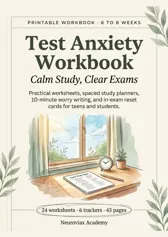
Go further: the printable Test Anxiety Workbook
A workbook with spaced study planners, practice test logs, worry writing, an in-exam reset card and results day pages, in A4 and US Letter. Look inside before you decide.
See what is insideOr save 46% with the Teen Wellbeing Pack: 4 workbooks for $12.99 instead of $23.96.