
Free 5-4-3-2-1 Grounding Exercise for Anxiety
Grounding means using your senses and simple actions to bring your attention back to the present when feelings, memories or panic pull you away. This page walks you through naming 5 things you see, 4 you can touch, 3 you hear, 2 you smell and 1 you taste, then lets you try eight other grounding skills. You rate your distress before and after, and print a grounding menu you can keep.
5 things
Look around slowly and name five things you can see.
4 things
Notice four things you can touch or feel.
3 things
Listen and name three things you can hear.
2 things
Name two things you can smell, or two you like.
1 thing
Name one thing you can taste, or take a sip of water.
Choose one number from 0 to 10. 0 is settled and present, 10 is the most distressed or far away.
Breathe in slowly, and out.
neuroviaxacademy.com/tools/grounding-techniques.html
Your Grounding Report
What you named
You named 0 of 15 things.
Before and after
Skills you tried
My grounding menu
Your log
Your next step
Cite this worksheet
Neuroviax Academy. (2026). Grounding techniques: Free 5-4-3-2-1 exercise [Online tool]. https://neuroviaxacademy.com/tools/grounding-techniques.html
How to Use This Grounding Exercise
Rate how you feel
Before you begin, choose a number from 0 to 10 for how distressed or far away you feel. There is no right answer, and no one else sees it.
Name your senses
Work through five short screens. Name 5 things you see, 4 you can touch, 3 you hear, 2 you smell and 1 you taste. Every field is optional.
Try other skills
On the sixth screen, eight grounding skills are listed with a one-line how-to. Mark each one as helped, not much, or not now.
Rate again and keep your menu
Choose a number again, then read your results. Your grounding menu and a short log are saved in this browser so you can build a menu that fits you.
Grounding Techniques for Anxiety, Panic and Feeling Far Away
Grounding means using the senses and simple actions to bring attention back to the present when feelings, memories or panic pull you away. It is a coping skill you can use in the moment. It is close to mindful attention to the present, where you notice what is here now rather than what might happen next. This free exercise offers a short 5-4-3-2-1 sequence and eight other skills, so you can find the ones that suit you.
Types of grounding
Grounding skills are often grouped into three types. Mental skills use the mind, physical skills use the body, and soothing skills use comfort. The table below gives two examples of each. You can mix types, and you can switch if one does not help.
| Type | Example 1 | Example 2 |
|---|---|---|
| Mental | Name 5 animals, then 5 cities | Count objects in the room |
| Physical | Press both feet into the floor | Run cold water over your hands |
| Soothing | Breathe out longer than you breathe in | Hold an object and notice its texture |
When grounding helps
People often reach for grounding during panic, when the body races and thoughts speed up. It can also be used during flashbacks, when a memory feels like it is happening now, and during dissociation, when you feel numb or far away. Some people use it for strong cravings, to step back from an urge for a moment. Grounding does not remove the feeling, and it does not treat the cause. It gives your attention somewhere steady to land while the feeling passes.
When to get more help
Grounding is a coping and learning tool. It is not a treatment for trauma, panic disorder or dissociation. If you often lose time, feel detached from yourself, or have flashbacks, a trauma-informed professional can help you work through what is underneath. If a feeling does not shift, or if grounding leaves you more upset, stop and try something else, or reach out to someone you trust. You deserve support that fits your situation.
A fictional worked example
Mariam is at her desk when her chest tightens and the room seems to tilt away. She rates her distress at 7 out of 10. She starts the exercise and names a green mug, a window blind, her phone case, a plant, and rain on the glass. She feels the wool of her sleeve, the cold desk, her shoes, and her keys. She hears the fridge hum, traffic, and her own breath. She smells coffee and hand soap, and tastes mint. She tries cold water and pressing her feet down, and both help. Naming categories does not do much today, so she marks it not much. When she rates again, her distress is 4. Nothing dramatic happened, but she feels a little more here, and she keeps the menu for next time.
Important limits
Frequently Asked Questions
What is the 5-4-3-2-1 grounding technique?
What are grounding techniques?
Do grounding techniques work for anxiety?
What if I cannot smell or taste anything?
When should I use grounding?
Is my answer saved?
Sources and credits
- Najavits, L. M. (2002). Seeking safety: A treatment manual for PTSD and substance abuse. Guilford Press.
- Baer, R. A. (2003). Mindfulness training as a clinical intervention: A conceptual and empirical review. Clinical Psychology: Science and Practice, 10(2), 125–143. doi.org/10.1093/clipsy.bpg015
Credit: Grounding as a coping skill is taught in Lisa Najavits's Seeking Safety programme. The connection to mindful attention draws on Baer's review of mindfulness training.
This page is an educational self-reflection worksheet. It does not provide therapy, and the research cited concerns structured treatment or general findings, not this worksheet itself.
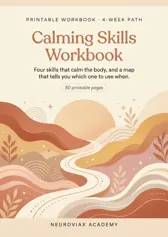
Go further: the printable Calming Skills Workbook
A printable PDF workbook with fill-in worksheets, trackers and a reading guide, in A4 and US Letter. Look inside before you decide.
See what is insideOr save 46% with the Calm and Cope Workbook Bundle: 4 workbooks for $14.99 instead of $27.96.