
Check Fraud Feelings With Facts
When a new role, praise, or promotion triggers the worry that you fooled everyone, it helps to slow down and test that thought on paper. Walk through eight short steps, watch your belief rating before and after on a live gauge, and print a clean summary card.
For professionals
This structured reflection tool follows a cognitive thought-record sequence tailored to imposter feelings. It pairs subjective 0 to 100 belief ratings with an attribution check (naming how accomplishments are discounted as luck, help, timing, or an easy task), a behavioural maintenance check, and one behavioural experiment for the coming week.
Imposter feelings are not a clinical diagnosis (Clance & Imes, 1978), though systematic review evidence notes frequent co-occurrence with anxiety and depression and limited treatment trials (Bravata et al., 2020). This page contains no scored scale and does not reproduce the Clance Impostor Phenomenon Scale.
neuroviaxacademy.com/tools/imposter-syndrome-worksheet.html
Your Imposter Thought Report
Academic Citations
Clance, P. R., & Imes, S. A. (1978). The imposter phenomenon in high achieving women: Dynamics and therapeutic intervention. Psychotherapy: Theory, Research & Practice, 15(3), 241-247. https://doi.org/10.1037/h0086006 Bravata, D. M., Watts, S. A., Keefer, A. L., Madhusudhan, D. K., Taylor, K. T., Clark, D. M., Nelson, R. S., Cokley, K. O., & Hagg, H. K. (2020). Prevalence, predictors, and treatment of impostor syndrome: A systematic review. Journal of General Internal Medicine, 35(4), 1252-1275. https://doi.org/10.1007/s11606-019-05364-1
How to Use This Imposter Syndrome Worksheet
Catch the moment
Name the trigger, write the exact fraud thought in plain words, and set your starting belief from 0 to 100 on the gauge.
Spot what you dismiss
Write three real achievements and notice how you explained each one away. Then mark the habits that keep self-doubt going.
Build a fairer view
Put the challenge and your real track record in one realistic statement, then re-rate your belief to compare before and after.
Pick one small step
Choose one concrete action for this week, such as accepting a compliment with "thank you" or asking one honest question.
Understanding Imposter Syndrome and How to Work Through It
What imposter syndrome is
Imposter syndrome is the stubborn belief that you are a fraud, even when your results show you are capable. Psychologists Pauline Rose Clance and Suzanne Imes first described this pattern in 1978 in a group of high-achieving women who felt they had fooled the people around them despite clear evidence of success (Clance & Imes, 1978). Later work showed that men and people across many careers and life stages describe the same experience. Imposter syndrome is not a medical or mental health diagnosis. It is a common thinking pattern in which you credit your wins to outside forces and view every small gap in knowledge as proof that you do not belong.
Common signs of fraud feelings
Fraud feelings often flare up right after good news, such as starting a new job, earning a promotion, passing a hard exam, or hearing warm praise. Instead of feeling steady relief, you may worry that people now expect more than you can deliver. Many adults notice a habit of explaining away achievements: calling a strong result luck, good timing, help from others, or an easy task. Day to day, this mindset shapes how you act. Some people over-prepare for hours to make sure no mistake slips through. Others procrastinate because starting feels risky, avoid asking sensible questions so nobody spots a gap, or turn down projects and roles they could genuinely handle.
How common it is and why studies disagree
People often ask how many adults experience imposter feelings, and the honest answer is that research estimates vary widely. A systematic review by Bravata and colleagues (2020) looked at 62 studies covering 14,161 people and found reported rates ranging from 9% to 82%. That wide spread does not mean researchers are guessing; it happens because studies used different questionnaires, different cut-off scores, and different groups of students or workers. The same review noted that imposter feelings are often found alongside depression and anxiety, and that there is still little research testing specific treatment approaches for imposter feelings on their own.
How imposter feelings link with perfectionism
Perfectionism and imposter feelings feed into each other easily. When your internal standard is flawless work without struggle, any normal learning curve feels like exposure. If you need help, take a second draft, or do not know an answer on the spot, an all-or-nothing rule turns that normal moment into "I am not really qualified." Over-preparing can also hide your real skill from yourself: when a project succeeds, you tell yourself it only worked because you stayed up late, not because you are competent. If high standards and putting things off keep pulling you into that loop, our Perfectionism and Procrastination Workbook offers practical ways to loosen rigid rules, and our Self-Compassion and Inner Critic Workbook focuses on building a steadier inner voice.
Imposter syndrome tests vs this worksheet
Several research questionnaires exist for measuring imposter feelings, and researchers use them to study how widespread the pattern is. Those questionnaires can tell you whether your answers look similar to other people who report fraud feelings, yet a score alone rarely changes how you think on Monday morning. This page is not a quiz or a scored test, and it does not reproduce copyrighted questionnaires. Instead, it is a reflection worksheet. Writing down one real moment, listing three achievements you brushed off, and testing a fairer thought gives you something concrete you can keep and use right away. If you want to examine a wider range of everyday worries beyond fraud feelings, you can also try our general CBT Thought Record Worksheet.
Practical ways to manage imposter feelings
Small, repeated habits usually shift fraud feelings more reliably than trying to force instant confidence. Start by separating feelings from facts: feeling unsure in a new role is a normal sign of learning, not proof that you tricked anyone. Keep a plain record of completed work, kind notes, and problems you solved, and check how you explain each one away. Watch your actions, too. Notice when you spend extra hours polishing work that is already good enough, or when you stay silent instead of asking a clear question. Picking one modest step each week, such as saying "thank you" without a disclaimer when praised, asking one honest question, or sharing one win with a peer, gives your brain fresh evidence that you can be human and capable at the same time.
When to ask for extra help
Occasional self-doubt during a career change, new course, or stretch assignment is part of adult life. Still, imposter feelings can become exhausting when they linger for months, drain your sleep, stop you from applying for work you want, or sit alongside low mood or heavy anxiety. Because research finds that fraud feelings often appear together with anxiety and depression (Bravata et al., 2020), talking with a doctor, counsellor, or qualified therapist is a sensible step if self-doubt is weighing on your daily life. A self-reflection worksheet supports your own thinking, and it does not replace personal care from a professional.
Frequently Asked Questions
What is this imposter syndrome worksheet for?
Is imposter syndrome a mental health diagnosis?
Does this page give me an imposter syndrome score or test result?
Why does Step 4 ask how I explained away my achievements?
Are my answers private and saved on my device?
Can I print or save my completed worksheet as a PDF?
When should I talk to a professional instead of relying on a worksheet?
Sources and credits
- Clance, P. R., & Imes, S. A. (1978). The imposter phenomenon in high achieving women: Dynamics and therapeutic intervention. Psychotherapy: Theory, Research & Practice, 15(3), 241-247. https://doi.org/10.1037/h0086006
- Bravata, D. M., Watts, S. A., Keefer, A. L., Madhusudhan, D. K., Taylor, K. T., Clark, D. M., Nelson, R. S., Cokley, K. O., & Hagg, H. K. (2020). Prevalence, predictors, and treatment of impostor syndrome: A systematic review. Journal of General Internal Medicine, 35(4), 1252-1275. https://doi.org/10.1007/s11606-019-05364-1
This page is an educational self-reflection worksheet. It does not provide therapy or a diagnosis, and the research cited covers general findings rather than this worksheet itself.
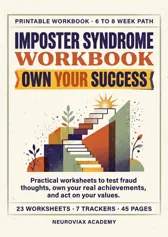
Go further: the printable Imposter Syndrome Workbook
A workbook with thought records, an evidence file, praise and help scripts, values work and a first-90-days plan, in A4 and US Letter. Look inside before you decide.
See what is insideOr save 45% with the Self-Worth Pack: 3 workbooks for $10.99 instead of $19.97.