

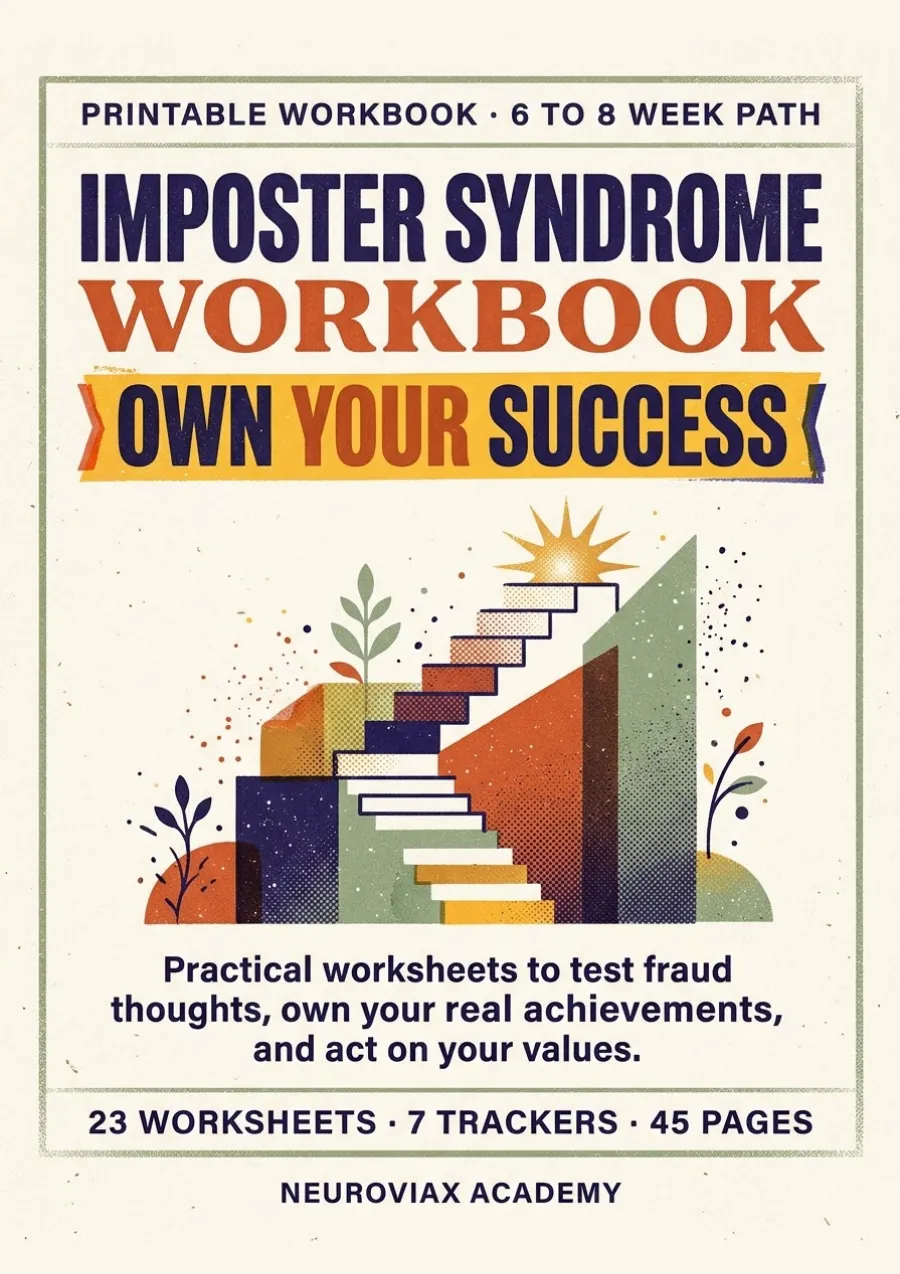
Cover
Samples are low resolution and watermarked. The PDF you download is full quality.
Printable workbook
Imposter Syndrome Workbook: Own Your Success
$5.99 PDF, A4 and US Letter · 45 pages · instant download
A calm 6-to-8-week printable workbook for adults who feel like a fraud despite real success: test imposter thoughts, keep an evidence file, accept praise and act on your values.
Secure payment by Whop on its own page. Right after paying you come straight back here to download your files, and we email you a personal link so you can return to them any time. No account needed.
Save with a bundle
- Self-Worth Pack · 3 workbooks for $10.99
$19.97save 45% - Complete Workbook Library · 128 workbooks for $69.99
$883.72save 92%
What is inside your workbook
- Cover 1 page
The cover of your workbook. - Start here 2 pages
What is inside, how to use the workbook and a simple path to follow. - Worksheets 26 pages
Fill-in pages that turn your result or your plan into small, concrete steps. - Trackers 7 pages
Repeatable pages to follow change over weeks. Print as many copies as you need. - Quick reference 2 pages
One-page cards to keep at hand: the scale at a glance, ranges and prompts. - Reading guide 4 pages
A short plain-English guide to what the result means and what it cannot tell you. - Professional guide 2 pages
Administration, interpretation and limits for counsellors, coaches and clinicians. - Credits and references 1 page
Full references and credit to the authors and rights holders.
What you receive: the complete workbook as one PDF of 45 pages, in A4 and in US Letter. The parts listed above are the sections inside that PDF, so you can print everything in one go or just the pages you need.
Who it is for
- Adults who feel like a fraud after promotions, career moves, study milestones or visible achievements
- Students and early-career professionals stepping into a new role, team or qualification
- Counsellors, coaches and workshop facilitators looking for plain-English, non-diagnostic client handouts
Want to try it first? Use the free online Imposter Syndrome Worksheet.
You earned the role, finished the qualification or delivered the project, yet a quiet voice still warns that you fooled everyone and will soon be found out. Imposter feelings are not a clinical diagnosis; psychologists Clance and Imes first described feeling like a fraud despite clear success in 1978. This 45-page printable workbook offers a calm six-to-eight-week path to test fraud thoughts against facts and act on your values.
You receive one merged PDF in A4 and one in US Letter. Across 45 pages you get the Cover (one page), Start Here (two pages), Worksheets (twenty-six pages: moments map, quick and full thought records, fair attribution, evidence file, over-preparing and procrastinating loops, perfectionism, mistakes, feedback, asking for help, accepting praise, comparison, values, workplace signals, mentor talks, first-90-days plan, bad-day and stuck sheets, and three fictional worked examples), Trackers (seven pages), Quick Reference cards (two pages), Reading Guide (four pages), Professional Guide with a 60-minute group plan (two pages) and Credits (one page).
A systematic review by Bravata and colleagues (2020) across 62 studies noted rates from 9% to 82%, frequent overlap with depression and anxiety, and little research on treatment. Ten repeatable sheets are marked Make copies to log weekly wins and track belief from 0 to 100 across six weeks. Every page is for education and self-reflection rather than therapy, omits copyrighted scales and includes an international crisis-line reminder.
What you get
- Map where fraud feelings hit hardest and test automatic imposter thoughts against observable facts with quick and full thought records.
- Build a factual achievement evidence file and rewrite luck, help or timing excuses so your real skills get fair credit.
- Interrupt the over-prepare and procrastinate loop with honest time caps, perfectionism checks, calm mistake recovery and balanced feedback triage.
- Practise asking clear questions early, accepting praise without shrinking, anchoring decisions in values and planning a grounded first 90 days.
- Track belief intensity from 0 to 100 across six weeks using seven repeatable logs, three fictional examples and clinician workshop notes.
What it is not
This workbook is for education and self-reflection. It is not a diagnosis, a treatment, or a substitute for professional care. If you are in danger or thinking about harming yourself, call your local emergency number now, or find a free crisis line in your country at findahelpline.com.
Questions people ask
Is imposter syndrome a clinical diagnosis?
No. Imposter feelings are an everyday description for feeling like a fraud despite clear competence and achievement, not a clinical diagnosis. A systematic review of 62 studies by Bravata and colleagues (2020) found reported rates from 9% to 82%, frequent links with depression and anxiety, and little research on treatment, so seek professional care if distress persists.
Does this workbook include a scored imposter test or quiz?
No. No copyrighted questionnaire or scored assessment, including the Clance Impostor Phenomenon Scale, is reproduced in these pages. Instead, you use a plain 0 to 100 personal belief rating on thought records and a six-week tracker to notice shifts over time, alongside practical worksheets on fair credit, realistic preparation, asking for help and checking real workplace signals.
Can counsellors, coaches or facilitators use these pages with clients or groups?
Yes. The workbook includes a two-page Professional Guide covering session pacing, scope limits, screening for low mood or anxiety, workplace context and a ready 60-minute group workshop plan. You may print and use the pages with your own clients, groups and students; you may not resell, share or publish the workbook or its pages online.