
Map One Anxious Situation and Build a Small Brave Plan
When anxiety shows up at school, with friends, on your phone, or at home, it can feel loud and messy. This worksheet breaks one tricky situation into eight calm steps so you can see what sets worry off, pick five small brave steps, practice a calm-body skill, and decide who can back you up.
Your answers stay in this browser and are never sent anywhere.
neuroviaxacademy.com/tools/teen-anxiety-coping-plan.html
My Teen Anxiety Coping Plan Card
For parents and carers
Your steady support makes a real difference when a teenager feels anxious. A few calm habits help most:
- Encourage small brave steps: celebrate effort and trying, not perfection or zero nerves.
- Do not take over: jumping in to cancel plans, answer for them, or remove every stressful moment gives quick relief but teaches the brain that the situation is unsafe.
- Notice when extra help is needed: reach out to a doctor, counsellor, or school team if you see ongoing school refusal, repeated panic attacks, big changes in sleep or eating, or any signs or thoughts of self-harm.
If your teenager is in danger or thinking about harming themselves, call your local emergency number now, or find a free crisis line in your country at findahelpline.com.
For professionals (counsellors, teachers, and school staff)
This page is an educational CBT-informed self-reflection worksheet for young people aged 13 to 17. It does not score symptoms or provide a clinical assessment. Teens may bring their printed card or screenshot to a session to talk through safety behaviours, gradual approach steps, calm-body skills, and parent or school support. All entries remain local in the browser. Medication questions belong with a doctor.
Research References (APA)
Merikangas, K. R., He, J.-P., Burstein, M., Swanson, S. A., Avenevoli, S., Cui, L., Benjet, C., Georgiades, K., & Swendsen, J. (2010). Lifetime prevalence of mental disorders in U.S. adolescents: Results from the National Comorbidity Survey Replication-Adolescent Supplement (NCS-A). Journal of the American Academy of Child & Adolescent Psychiatry, 49(10), 980-989. https://doi.org/10.1016/j.jaac.2010.05.017 James, A. C., Reardon, T., Soler, A., James, G., & Creswell, C. (2020). Cognitive behavioural therapy for anxiety disorders in children and adolescents. Cochrane Database of Systematic Reviews, 11, CD013162. https://doi.org/10.1002/14651858.CD013162.pub2 Walkup, J. T., Albano, A. M., Piacentini, J., Birmaher, B., Compton, S. N., Sherrill, J. T., Ginsburg, G. S., Rynn, M. A., McCracken, J., Waslick, B., Iyengar, S., March, J. S., & Kendall, P. C. (2008). Cognitive behavioral therapy, sertraline, or a combination in childhood anxiety. New England Journal of Medicine, 359(26), 2753-2766. https://doi.org/10.1056/NEJMoa0804633
Understanding Anxiety in Teenagers and How a Coping Plan Helps
Feeling nervous before a big match, a class talk, or a difficult conversation is part of being human. For many teenagers, though, worry stops fading once the moment passes and starts taking over everyday life. Anxiety is far more common in the teen years than most young people realise. In a large United States survey of 10,123 adolescents aged 13 to 18, Merikangas and colleagues (2010) found that anxiety disorders were the most common class of mental health conditions, affecting 31.9% of teenagers over their lifetime, while 8.3% experienced an anxiety disorder with severe impairment. The same survey noted that anxiety had the earliest median age of onset among major mental health groups, around 6 years old.
Common Signs of Anxiety in Teens
Anxiety does not always look like obvious fear. Sometimes it shows up in thoughts, sometimes in the body, and sometimes as quiet frustration or pulling back. Common signs in teenagers aged 13 to 17 include:
- Looping worry thoughts: expecting embarrassment, failure, or disaster, or replaying small moments over and over after they happen.
- Body signals: a racing heart, tight chest, stomach knots, shaky hands, a hot flushed face, headaches, or feeling worn out even after resting.
- Changes in daily habits: struggling to fall asleep, snapping at family members, avoiding lunchrooms or group chats, or putting off schoolwork out of fear of getting it wrong.
Putting plain names to these signals helps teenagers see anxiety as an overly loud alarm system rather than a personal flaw.
Why Avoidance and Safety Habits Keep Anxiety Going
When a situation sets off a strong alarm, the brain pushes hard for quick relief. A teenager might skip class, leave a noisy room early, scroll on a phone to avoid eye contact, ask a parent or friend for reassurance ten times in a row, or overthink every possible outcome. In the short term, those safety habits work: the wave of fear drops within minutes.
The catch is what happens next. Because the teenager left or relied on a safety habit, the brain never gets to find out that they could handle the moment without it. Instead, the fast relief convinces the brain that the situation really was dangerous. The next time a similar moment arrives, the alarm rings just as loudly or even sooner. Over weeks, the teenager's world can shrink around what they are trying to avoid.
How CBT and Small Brave Steps Help
Cognitive behavioural therapy (CBT) focuses on breaking that loop gently and steadily. Rather than forcing a young person straight into their hardest fear, CBT-informed coping plans break a goal into a fear ladder of small brave steps ordered from easiest to hardest. Alongside those steps, teenagers practice calm-body skills such as slow breathing and 5-4-3-2-1 grounding, check whether worry thoughts are telling the whole story, and notice which safety habits they can gradually ease off.
Clinical research supports CBT as a helpful option for young people, while also keeping expectations realistic. A Cochrane review by James and colleagues (2020) found that CBT was more helpful than waiting lists or no active intervention for anxiety disorders in children and adolescents, though many young people still had symptoms afterwards. In a 12-week trial involving 488 young people aged 7 to 17, Walkup and colleagues (2008) reported improvement in 59.7% of those who received CBT, 54.9% who received sertraline, 80.7% who received both together, and 23.7% who received placebo. Those figures come from supervised clinical care rather than an online worksheet. Medication questions belong with a doctor, and this free coping plan is an educational self-reflection tool for everyday practice.
How Parents and Carers Can Support Brave Steps
Watching a teenager struggle with worry is painful, and most parents naturally want to smooth away the discomfort. Still, answering every reassurance question, letting a teen skip every tough class, or speaking on their behalf can accidentally reinforce avoidance. A steadier approach is to acknowledge that the worry feels real, stay calm when anxiety spikes, and encourage one small brave step at a time. Praise the effort of showing up rather than expecting a spotless performance, and review the plan together during a relaxed moment rather than in the middle of a panic wave.
When to Get Extra Help
Self-reflection plans work best for mild to moderate everyday worries or alongside professional support. Talk with a doctor, school counsellor, or mental health specialist if anxiety leads to ongoing school refusal, repeated panic attacks, major changes in sleep or eating, withdrawal from friends for weeks, or any thoughts of self-harm. Encourage your teenager to tell a trusted adult whenever worry feels too big to handle alone. If you are in danger or thinking about harming yourself, call your local emergency number now, or find a free crisis line in your country at findahelpline.com.
Frequently Asked Questions
What is a teen anxiety coping plan?
Does this worksheet give a score or medical label?
Why does avoiding a scary situation make worry stronger?
How do I pick the five steps for my brave ladder?
Are my answers saved privately on this site?
How can parents use this coping plan without taking over?
When should a teenager get extra help for anxiety?
Sources and credits
- Merikangas, K. R., He, J.-P., Burstein, M., Swanson, S. A., Avenevoli, S., Cui, L., Benjet, C., Georgiades, K., & Swendsen, J. (2010). Lifetime prevalence of mental disorders in U.S. adolescents: Results from the National Comorbidity Survey Replication-Adolescent Supplement (NCS-A). Journal of the American Academy of Child & Adolescent Psychiatry, 49(10), 980-989. https://doi.org/10.1016/j.jaac.2010.05.017
- James, A. C., Reardon, T., Soler, A., James, G., & Creswell, C. (2020). Cognitive behavioural therapy for anxiety disorders in children and adolescents. Cochrane Database of Systematic Reviews, 11, CD013162. https://doi.org/10.1002/14651858.CD013162.pub2
- Walkup, J. T., Albano, A. M., Piacentini, J., Birmaher, B., Compton, S. N., Sherrill, J. T., Ginsburg, G. S., Rynn, M. A., McCracken, J., Waslick, B., Iyengar, S., March, J. S., & Kendall, P. C. (2008). Cognitive behavioral therapy, sertraline, or a combination in childhood anxiety. New England Journal of Medicine, 359(26), 2753-2766. https://doi.org/10.1056/NEJMoa0804633
This page is an educational self-reflection worksheet for teenagers and families. It does not replace professional care, the cited research studied structured clinical care rather than this worksheet, and medication questions belong with a doctor.
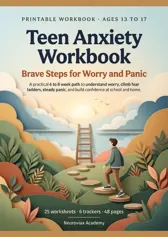
Go further: the printable Teen Anxiety Workbook
A workbook for ages 13 to 17 with fear ladders, brave-step logs, calm-body skills, a panic plan and pages for parents and school staff, in A4 and US Letter. Look inside before you decide.
See what is insideOr save 46% with the Teen Wellbeing Pack: 4 workbooks for $12.99 instead of $23.96.