
Free Guided Progressive Muscle Relaxation with a Timer
This page walks you through progressive muscle relaxation one group at a time. You tense a muscle group for 5 seconds, release it for 15 seconds, and the outline of a body on screen marks the group you are working on. Choose the full script of 16 groups or the short script of 7 groups, rate how tense your body feels before and after, and print the full script at the end.
Choose a version
Please choose the full or the short version first.Choose a number from 0 to 10. 0 means as relaxed as you can imagine, 10 means as tense as you can remember feeling. There is no right answer, only your own estimate.
Please choose a number from 0 to 10 for your tension before you start.Before you start: Skip any part of the body that is injured or painful. Do not tense hard enough to cause cramp or pain.
Your answers are saved in this browser on this device so you can continue later; they are not sent to Neuroviax Academy. Use Start fresh to clear them.
neuroviaxacademy.com/tools/progressive-muscle-relaxation.html
Progressive Muscle Relaxation Report
Practice summary
Tension rating
Your next step
Practice log
Last 7 sessions in this browser
| Date | Version | Groups | Before | After | Change |
|---|
Printable script
The full 16-group script
| Group | How to tense | Release cue |
|---|
Cite this worksheet
Neuroviax Academy. (2026). Progressive muscle relaxation: Free guided exercise [Online tool]. https://neuroviaxacademy.com/tools/progressive-muscle-relaxation.html
How to Use This Progressive Muscle Relaxation Script
Pick a version
The full script works through 16 muscle groups and takes about 6 minutes here. The short script covers 7 groups in about 3 minutes. Pick the one you will actually finish, then rate how tense you feel.
Set the tone
Tick the soft tone if you want a quiet beep when the phase changes. It is off by default. You can silence your phone and dim the lights before you begin.
Follow the cues
The page names one group at a time. Tense it for 5 seconds, let go for 15 seconds, and the body outline marks the area. Pause, skip a group, or stop whenever you want.
Rate again and print
At the end, rate your tension on the same 0 to 10 scale. The page shows the change, keeps a log in this browser, and prints the full script with your report.
What Is Progressive Muscle Relaxation?
Progressive muscle relaxation, usually shortened to PMR, is a way of learning what tension feels like in your own body and then letting it go. You tense one muscle group for a few seconds, release it, and move to the next group. Edmund Jacobson developed the method in the 1920s and 1930s and described it in Progressive Relaxation (1938). Bernstein and Borkovec (1973) later wrote a training manual built around 16 muscle groups, and that shorter format is the one many therapists still use.
The idea behind it is simple. Most people carry tension without noticing it: a shoulder riding high, a jaw clamped shut, a hand gripping a steering wheel. When you tense a muscle on purpose and then let it go, the difference between the two states becomes easier to feel. The release is the part that matters. You are not forcing your body to relax. You are practising the moment when effort stops.
McCallie, Blum and Hood (2006) reviewed PMR and describe its use for stress, anxiety, insomnia and some pain conditions. That research looks at structured training, with a therapist or a recorded guide, so nothing here proves that this page will work for you. Many people find a short practice calming, and that is a reasonable reason to try it.
Full or short version
The full script works through 16 groups: right hand and forearm, right upper arm, left hand and forearm, left upper arm, forehead, eyes and cheeks, mouth and jaw, neck, shoulders and chest, stomach, right thigh, right calf, right foot, then the same three parts of the left leg. At 5 seconds of tension and 15 seconds of release for each group, the practice runs a little over 5 minutes, and the page calls it about 6 minutes once you settle in.
The short version covers 7 groups: both hands and arms, face, neck and throat, shoulders and chest and back, stomach, both thighs and calves, both feet. It takes about 3 minutes. The short version suits a first try, a busy evening, or a body that finds long sequences tiring. The full version gives you more chances to notice small differences between one group and the next, and that is the point of the exercise. Try both and keep the one you will actually do.
Using PMR for sleep
Many people use progressive muscle relaxation at bedtime to wind down. Practise in bed with the lights low, work through the groups slowly, and let the last release be the end of the session rather than the start of a to-do list. Tense gently when you are lying down. A hard clench of the legs can leave you more awake than you were before.
Some people fall asleep during the practice, which is fine. Others find that a full 16-group run leaves them alert, and for them the short version tends to sit better. If poor sleep lasts for weeks, a relaxation script is a small tool and not the answer. CBT for insomnia (CBT-I) is a structured treatment for sleep problems that persist, and a sleep diary is usually where it starts. You can keep one with our sleep diary.
A worked example
Nadia is 34 and works in accounts. She rates her tension at 7 most evenings and blames the screen and the drive home. On a Tuesday she tries the full version in an armchair, with the soft tone switched on and the lights down. The first two groups are easy. At the shoulders she notices she has been holding them high since lunch, and the release feels like a small drop. She skips her neck, because an old strain there makes tensing uncomfortable. In the last groups her attention drifts, so she lets the tone bring her back. At the end she rates her tension at 4 and writes nothing else down. The next evening she runs the short version in bed with the lights off and falls asleep somewhere around the second group.
| Group | How to tense |
|---|---|
| 1. Right hand and forearm | Make a fist |
| 2. Right upper arm | Bend the elbow, press it into the chair |
| 3. Left hand and forearm | Make a fist |
| 4. Left upper arm | Bend the elbow, press it into the chair |
| 5. Forehead | Raise the eyebrows |
| 6. Eyes and cheeks | Squeeze the eyes shut |
| 7. Mouth and jaw | Press the teeth together, pull the corners of the mouth back |
| 8. Neck | Pull the chin down, gently |
| 9. Shoulders, chest and upper back | Take a breath, pull the shoulders back |
| 10. Stomach | Pull the stomach in |
| 11. Right thigh | Press the knee down |
| 12. Right calf | Point the toes up toward you |
| 13. Right foot | Curl the toes down, gently |
| 14. Left thigh | Press the knee down |
| 15. Left calf | Point the toes up toward you |
| 16. Left foot | Curl the toes down, gently |
Frequently Asked Questions
What is progressive muscle relaxation?
How long does progressive muscle relaxation take?
Can progressive muscle relaxation help me sleep?
How hard should I tense?
Who created progressive muscle relaxation?
Is my practice log saved?
Sources and credits
- Bernstein, D. A., & Borkovec, T. D. (1973). Progressive relaxation training: A manual for the helping professions. Research Press.
- Jacobson, E. (1938). Progressive relaxation (2nd ed.). University of Chicago Press.
- McCallie, M. S., Blum, C. M., & Hood, C. J. (2006). Progressive muscle relaxation. Journal of Human Behavior in the Social Environment, 13(3), 51–66. doi.org/10.1300/J137v13n03_04
Credit: Progressive muscle relaxation was developed by Edmund Jacobson. The 16-group short form follows Bernstein and Borkovec's training manual.
This page is an educational relaxation exercise. It does not provide treatment, and the research cited concerns structured training, not this page itself.
Cite this worksheet
Neuroviax Academy. (2026). Progressive muscle relaxation: Free guided exercise [Online tool]. https://neuroviaxacademy.com/tools/progressive-muscle-relaxation.html
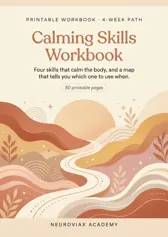
Go further: the printable Calming Skills Workbook
A printable PDF workbook with fill-in worksheets, trackers and a reading guide, in A4 and US Letter. Look inside before you decide.
See what is insideOr save 46% with the Calm and Cope Workbook Bundle: 4 workbooks for $14.99 instead of $27.96.