
Build Your Personal Habit Reversal Plan
Skin picking, hair pulling, nail biting, and cheek biting often happen before you even notice your hand moving. Habit reversal breaks the autopilot cycle in plain, practical steps: spot the early signs, hold a calm movement for about one minute, adjust your surroundings, and line up gentle support.
Your answers stay in this browser on your device and are never sent to Neuroviax Academy.
Medical note: If picked skin looks infected, or a wound will not heal, see a doctor.
Crisis support: If you are in danger or thinking about harming yourself, call your local emergency number now, or find a free crisis line in your country at findahelpline.com.
Your answers stay in this browser on your device and are never sent to Neuroviax Academy.
neuroviaxacademy.com/tools/habit-reversal-training-worksheet.html
Your Personal Habit Reversal Plan
Research References
Azrin, N. H., & Nunn, R. G. (1973). Habit-reversal: A method of eliminating nervous habits and tics. Behaviour Research and Therapy, 11(4), 619-628. https://doi.org/10.1016/0005-7967(73)90119-8 Bate, K. S., Malouff, J. M., Thorsteinsson, E. T., & Bhullar, N. (2011). The efficacy of habit reversal therapy for tics, habit disorders, and stuttering: A meta-analytic review. Clinical Psychology Review, 31(5), 865-871. https://doi.org/10.1016/j.cpr.2011.03.013 Grant, J. E., & Chamberlain, S. R. (2020). Prevalence of skin picking (excoriation) disorder. Journal of Psychiatric Research, 130, 57-60. https://doi.org/10.1016/j.jpsychires.2020.06.033
For professionals: clinical notes and between-session use
Classification context: Skin picking disorder (excoriation) and hair pulling disorder (trichotillomania) are listed in DSM-5 under obsessive-compulsive and related disorders. Nail biting and cheek biting are related body-focused repetitive behaviours that often respond to the same behavioural structure.
Core components included: This worksheet adapts the habit reversal sequence described by Azrin and Nunn (1973) and reviewed by Bate et al. (2011): awareness training (situational cues, hand involvement, antecedent affect), early warning signs, a physically incompatible competing response held for about one minute, environmental stimulus control, agreed social support, and a non-punitive slip protocol with a 7-day frequency tally.
Use in practice: Clients can complete the plan on screen and bring the printed one-page card and 7-day tally grid to their next appointment. This page does not generate a clinical score or assessment; use it alongside a full evaluation and medical review whenever skin damage or distress is present.
How to Use This Habit Reversal Worksheet
Pick Your Habit and Areas
Choose skin picking, hair pulling, nail biting, or cheek biting, and tap the body areas where your hands usually go.
Map Places and Feelings
Select the daily moments and feelings that show up right before the habit starts so you can spot patterns early.
Name Warning Signs
Notice the earliest clue, such as a rising urge, your hand lifting, scanning skin or hair, or looking for rough spots.
Practice 60 Seconds
Choose a gentle movement that blocks the habit and try holding it with the quiet visual one-minute ring timer.
Change the Setting
Add small everyday barriers like plasters, softer bathroom light, gloves, or a fidget item to slow autopilot.
Line Up Calm Support
Pick one trusted person and agree in advance on a quiet, kind cue they can use if they notice the habit starting.
Plan for Slips and Tally
Write a calm restart plan and print your one-page card with the 7-day tally grid to notice progress day by day.
Understanding Habit Reversal for Skin Picking and Hair Pulling
Skin picking, hair pulling, nail biting, and cheek biting belong to a group of habits often called body-focused repetitive behaviours, or BFRBs. Many adults do them without realizing it at first, such as while watching television, scrolling on a phone, reading in bed, or standing close to a bright bathroom mirror. In the fifth edition of the Diagnostic and Statistical Manual of Mental Disorders (DSM-5), skin picking disorder (excoriation) and hair pulling disorder (trichotillomania) are listed under obsessive-compulsive and related disorders. They are real, learned physical patterns, not a personal failing or a lack of willpower.
How Common Body-Focused Repetitive Behaviours Are
Because people often feel embarrassed by picked skin, thinned hair, or sore fingers, these habits can feel lonely. Research shows they are far more common than most people think. In a large survey of 10,169 US adults, Grant and Chamberlain (2020) found that 2.1% reported current skin picking disorder and 3.1% reported experiencing it at some point in their lifetime. Anxiety and depression were also common alongside skin picking in that survey. Knowing that millions of other adults deal with similar urges can take some of the shame out of starting a calm, practical plan.
What Habit Reversal Is and What Research Shows
Habit reversal is a structured behavioural method first described by Azrin and Nunn (1973). Instead of telling yourself to just stop, habit reversal brings together three clear elements: building awareness of each episode and its early warning signs, practicing a competing response (a gentle physical movement that cannot be done at the same time as the habit), and involving supportive people in a helpful way. Later clinical research examined how well habit reversal performs across different repetitive habits. In a meta-analytic review of 18 studies with 575 participants, Bate and colleagues (2011) found that habit reversal worked for a range of repetitive behaviours, including tics, nail biting, thumb sucking, and related habits. Those studies looked at structured habit reversal programs rather than this online worksheet, so this tool is best used as an everyday planning aid that helps you put the core steps into writing.
How the Seven Steps Work Together
Each step in this worksheet handles a different part of the habit loop. Naming your target habit and tapping the body areas involved brings the pattern into clear view. Logging when and where the habit happens, along with the feeling right before it, reveals your high-risk windows, such as late-night screen time, boredom, or stress. Spotting early warning signs like your hand drifting upward, fingertips scanning for a bump, or leaning toward a mirror lets you step in before the habit gets underway.
Next, you choose one competing response and hold it for about one minute whenever you notice a warning sign or urge. Making a gentle fist, sitting on your hands, folding your arms, or holding a stress ball keeps your hands safely occupied until the peak of the urge fades. Changing your setting adds simple physical friction: plasters over target fingers, light cotton gloves while reading, dimmer bathroom lighting, covering magnifying mirrors, trimmed smooth nails, and keeping a fidget item close by all make autopilot picking or pulling harder to start. Finally, choosing one trusted support person and writing a slip plan keeps you steady over the week ahead.
| Step | Focus | How it helps in daily life |
|---|---|---|
| 1. Habit and areas | Target habit and body map | Pinpoints where your hands travel most often without judgment. |
| 2. Awareness | Places, times, and feelings | Shows when urges spike, such as in bed, at a mirror, or under stress. |
| 3. Warning signs | Earliest hand or urge cues | Helps you catch the habit before picking, pulling, or biting begins. |
| 4. Competing response | 60-second incompatible move | Gives your hands a calm replacement until the urge passes. |
| 5. Setting barriers | Stimulus control changes | Slows down autopilot with gloves, plasters, lighting, or fidgets. |
| 6. Support person | Agreed quiet reminder | Replaces scolding with a gentle, helpful cue from someone you trust. |
| 7. Slip plan | Reset and 7-day tally | Treats a slip as useful information so you restart right away. |
Practical Tips for Everyday Practice
Practice your 60-second competing response once or twice when you feel relaxed, so your hands remember the motion before an urge hits. Keep your printed one-page plan and 7-day tally sheet near your main trigger spot, such as beside your desk or on your nightstand. On the tally sheet, count both the urges you noticed and the times you used your competing response. Even noticing an urge halfway through is a real awareness win. If you want to build steady daily follow-through over several weeks, pair this plan with our free Habit Tracker. If repetitive urges also overlap with intrusive thoughts or checking rituals, you can look inside our printable ERP Workbook for OCD.
When to Get Medical or Professional Help
Self-help pages support, and do not replace, a professional assessment. If skin picking, hair pulling, nail biting, or cheek biting causes ongoing distress, takes up a large part of your day, or keeps returning despite your best efforts, consider talking with a doctor or a qualified mental health professional familiar with habit reversal and cognitive behavioural approaches. If picked skin looks infected, or a wound will not heal, see a doctor. If you are in danger or thinking about harming yourself, call your local emergency number now, or find a free crisis line in your country at findahelpline.com.
Frequently Asked Questions
What are body-focused repetitive behaviours (BFRBs)?
What is habit reversal and how does this worksheet use it?
How long should I hold a competing response?
Can I use this worksheet for nail biting or cheek biting too?
What should I do if I have a slip?
Can I print my habit reversal plan and 7-day tally sheet?
Are my answers private, and does this worksheet replace professional care?
Sources and Credits
- Grant, J. E., & Chamberlain, S. R. (2020). Prevalence of skin picking (excoriation) disorder. Journal of Psychiatric Research, 130, 57-60. https://doi.org/10.1016/j.jpsychires.2020.06.033
- Azrin, N. H., & Nunn, R. G. (1973). Habit-reversal: A method of eliminating nervous habits and tics. Behaviour Research and Therapy, 11(4), 619-628. https://doi.org/10.1016/0005-7967(73)90119-8
- Bate, K. S., Malouff, J. M., Thorsteinsson, E. T., & Bhullar, N. (2011). The efficacy of habit reversal therapy for tics, habit disorders, and stuttering: A meta-analytic review. Clinical Psychology Review, 31(5), 865-871. https://doi.org/10.1016/j.cpr.2011.03.013
Credit: Habit reversal was developed by Nathan H. Azrin and R. Gregory Nunn (1973).
This page is an educational self-help worksheet. Self-help pages support, and do not replace, a professional assessment, and the research cited studied structured programs rather than this worksheet itself.
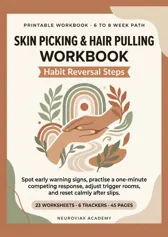
Go further: the printable Skin Picking and Hair Pulling Workbook
A workbook with awareness logs, high-risk maps, competing responses, room-by-room changes, a slip plan and an 8-week tracker, in A4 and US Letter. Look inside before you decide.
See what is insideOr save 44% with the Habits and Urges Pack: 3 workbooks for $9.99 instead of $17.97.