
Build Small Habits That Fit Real Days
Lasting habits rarely come from huge promises or perfect streaks. They grow when you choose a tiny action, attach it to a cue that already happens every day, and keep returning after an off day.
Use this tracker to plan one to three habits, tap each day on a 12-week grid as done, missed, or no chance (for illness or travel), rate how automatic it feels each week, and print a clean one-page sheet for your desk or fridge.
Your 12-Week Habit Tracker
Plan up to three small habits, tap days on the grid, and review once a week.
Could you do this on your worst day?
Think of a day when you are tired, stressed, or short on time. If the answer is no, pick a smaller starter version. You can always do more on good days.
12-Week Daily Grid
Tap any day to cycle statusHow Automatic Does It Feel? (Optional Weekly Check)
Once a week, rate from 1 (took effort to remember) to 10 (happened almost without thinking). Watch the line grow over the 12 weeks.
Weekly Review (Every 7 Days)
Pick a week to look back at what helped, what got in the way, and whether to keep, shrink, or grow the habit next week.
For professionals and coaches (method and research notes)
Cue, repetition, and automaticity
In everyday psychology, a habit is not just something you do often. It is a learned link between a stable context cue (a time, place, or preceding routine) and a simple action. Repeating the same action right after the same cue gradually shifts control from deliberate effort toward automaticity, so starting takes less thought and willpower.
What the 2010 study found, modestly
In a real-world 2010 study by Lally and colleagues, volunteers chose a daily eating, drinking, or activity habit paired with an everyday cue. Automaticity rose along a curve that gradually levelled off. Reaching a steady level took weeks to months, with wide variation across people depending on the person and the behaviour. Missing a single day did not undo the progress, while repeating the action consistently in the same context went with a stronger fit.
Using this tracker with clients
- Start with one habit rather than three, especially when mood, energy, or attention is stretched.
- Test the habit against a low-energy day using the "make it smaller" prompt before tracking begins.
- Anchor the habit to an existing daily event (such as brushing teeth or making tea) rather than relying on memory alone.
- Encourage clients to mark illness, travel, or unavoidable disruptions as "no chance" so real life does not register as failure.
- Use the weekly review and automaticity check to decide together whether to keep, shrink, or gently grow the habit.
12-Week Habit Tracker
Cite this tool
Neuroviax Academy. (2026). Habit tracker: Free printable and interactive 12-week grid [Online worksheet]. https://neuroviaxacademy.com/tools/habit-tracker.html
How to Use This Habit Tracker
Pick a tiny habit
Choose one to three actions so small you could finish them even on your hardest day. Use the make-it-smaller helper if it feels heavy.
Attach it to a cue
Complete the sentence "After I ..., I will ..." using a daily anchor like breakfast, brushing your teeth, or getting home.
Tap each day honestly
Mark done, missed, or no chance for sick or travel days. After a miss, aim to come back on the very next cue.
Review and print
Every seven days, rate how automatic it feels from 1 to 10, note what helped, and print a blank or filled 12-week sheet anytime.
How to Use a Habit Tracker That Actually Sticks
Most people do not abandon a habit because they stop caring. They stop because the plan was built for their best, most energetic day instead of an ordinary Tuesday. A good habit tracker keeps the bar realistic, links each action to a daily cue, and makes returning after a slip feel normal rather than like a failure.
How to use this habit tracker
Start with one habit, or at most three. Write the action in plain words, choose the everyday cue that comes right before it, and add where it happens and why it matters to you. Each day, tap the matching square on the 12-week grid to mark it done, missed, or no chance. Once a week, take two minutes to rate how automatic the habit feels from 1 to 10, jot down what made it easier and what got in the way, and decide whether to keep, shrink, or grow it for the next seven days.
How to pick a habit that sticks
Two choices matter more than willpower: size and cue. First, shrink the habit until you can finish it on your worst day. Reading one page, walking for three minutes, or washing three dishes sounds modest, yet repeating a tiny action keeps the routine alive when energy drops. On good days you are free to do more. Second, attach the habit to a stable cue that already happens every day. Saying "After I brush my teeth, I will drink one glass of water" tells your brain exactly when to act, whereas "I will drink more water" leaves the decision open all day.
How long does habit formation take?
Popular myths promise a fixed number of days, yet real-world studies paint a much more honest picture. In a well-known 2010 study by Lally and colleagues, 96 volunteers chose a daily eating, drinking, or activity behaviour to repeat in the same context for 12 weeks, and 82 provided enough data to model. Automaticity rose along a curve that gradually flattened out, and the time to reach 95% of each person's plateau ranged from 18 to 254 days. Simpler actions, like drinking water after breakfast, became automatic faster than harder ones, like daily exercise. Later guidance by Gardner, Lally, and Wardle in 2012 emphasised the same practical lesson: habits grow from repeating a simple action in a consistent context over weeks to months, and the timeline varies widely from person to person.
What to do after a miss
Missing one day does not erase the work you have already done. In the 2010 study, missing a single opportunity did not materially affect the habit formation process. The real danger is the all-or-nothing thought that says one blank square ruins the whole chart. Use the simple rule of never missing twice: make the next cue your comeback day. When illness, travel, or an unavoidable disruption makes the cue impossible, mark that square as "no chance" instead of missed. Counting comebacks alongside streaks reminds you that returning is the skill that lasts.
Simple habit ideas to try
If you are not sure where to begin, pick one tiny version from the table below and adjust the cue to match your own routine.
| Area | Everyday cue | Tiny starter habit |
|---|---|---|
| Health | After I brush my teeth in the morning | Drink one full glass of water |
| Study | After I sit down with my morning drink | Read one page or review two flashcards |
| Calm | When I sit on the bus or park the car | Take three slow breaths with loose shoulders |
| Home | After I finish dinner | Wash three dishes or clear one counter |
Printable habit tracker vs an app
Both paper and digital trackers have real strengths. A printed 12-week sheet taped beside the kettle, on the fridge, or on your desk acts as a physical cue every time you walk past it, and ticking a box with a pen takes one second with no phone distractions. An interactive browser tracker makes it easy to test cues, track comebacks automatically, and watch your weekly automaticity line grow. This page lets you use the interactive grid on your phone or computer and print either a filled copy or a blank one-page sheet whenever you prefer paper.
Connecting small habits with bigger plans
Small daily habits work best when they support a direction you care about. If you want to turn a wider aim into concrete milestones before choosing your daily cue, try the SMART Goal Planner. If low mood or low energy makes starting any routine feel heavy, the Behavioral Activation Planner can help you pick small, meaningful daily activities and build momentum gently.
Frequently Asked Questions
How does a 12-week habit tracker work?
How many habits should I track at once?
How long does it take to form a habit?
What should I do if I miss a day?
What is the no chance option for?
Can I print a blank or filled habit tracker PDF?
Is my habit tracker data saved privately?
Sources and credits
- Lally, P., van Jaarsveld, C. H. M., Potts, H. W. W., & Wardle, J. (2010). How are habits formed: Modelling habit formation in the real world. European Journal of Social Psychology, 40(6), 998-1009. https://doi.org/10.1002/ejsp.674
- Gardner, B., Lally, P., & Wardle, J. (2012). Making health habitual: The psychology of "habit-formation" and general practice. British Journal of General Practice, 62(605), 664-666. https://doi.org/10.3399/bjgp12X659466
This page is an educational worksheet. It does not provide therapy, diagnosis, or medical advice.
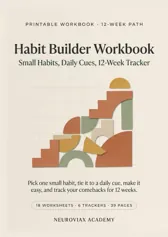
Go further: the printable Habit Builder Workbook
A workbook with a cue builder, a never-miss-twice plan, morning and evening routines and a 12-week tracker for three habits, in A4 and US Letter. Look inside before you decide.
See what is insideOr save 37% with the ADHD Life Pack: 3 workbooks for $9.99 instead of $15.97.