
Check how you have felt over the past week
The Geriatric Depression Scale (GDS-15) is a short set of 15 YES or NO questions developed by Sheikh and Yesavage (1986) for older adults. You can answer on your own, or a family member, carer, or professional can read each question aloud with you.
Take your time. You can view one question at a time or switch to all 15 questions on one page at any point.
1. Are you basically satisfied with your life?
This is a screening question set, not a diagnosis.
About memory (Question 10)
You answered YES to feeling you have more problems with memory than most. Memory worries are worth raising with a doctor on their own, whatever your total score is. Sleep, hearing, medicines, vitamin levels, and stress can all affect memory and are worth checking.
Answers that added a point
Each answer listed below added 1 point toward your total on this check.
Check again in 4 weeks
Mood in later life can shift with health, sleep, seasons, or life changes. Checking again in about 4 weeks helps you and your doctor see whether things are lifting or staying heavy. Up to 6 past results are saved in this browser and are never sent anywhere.
What helps next
1. Talk to a doctor
Bring this printed one-page result, a full list of your medicines and supplements, and brief notes on your sleep, appetite, and any memory worries.
2. One small step today
Choose one gentle action suited to your health: a short walk, ten minutes in morning daylight, or a brief phone call with someone you trust.
3. Later-life mood workbook
A printable later-life mood workbook is available for daily rhythm, pleasant activities, and planning doctor visits.
For professionals (source, scoring key, cut-offs, and limits)
Source: 15-item Geriatric Depression Scale (GDS-15), short form developed by Sheikh and Yesavage (1986) from the 30-item original by Yesavage, Brink, and colleagues.
Scoring key: Award 1 point for NO on items 1, 5, 7, 11, and 13. Award 1 point for YES on items 2, 3, 4, 6, 8, 9, 10, 12, 14, and 15. Total range: 0 to 15.
Scale owner's cut-off wording: For clinical purposes, a score above 5 is suggestive of depression and warrants a follow-up interview; a score above 10 is almost always depression (Stanford GDS owner page).
Evidence summary: A 2016 systematic review and meta-analysis by Pocklington and colleagues found the GDS-15 to be a well-studied screening question set that flags who should have a fuller talk with a doctor, while warning of possible selective reporting of cut-offs so results should be read with caution. It does not diagnose.
Memory problems and dementia: Results require a clinician's careful interpretation for people with memory problems or dementia, where impaired recall or insight may affect self-report answers and a fuller assessment is needed.
Public-domain status: The GDS is in the public domain (Yesavage and colleagues, Stanford University).
Safety: If you are in danger or thinking about harming yourself, call your local emergency number now, or find a free crisis line in your country at findahelpline.com.
Geriatric Depression Scale (GDS-15) Result
neuroviaxacademy.com
| # | Question (how you have felt over the past week) | Answer | Point |
|---|
Understanding the Geriatric Depression Scale (GDS-15)
The Geriatric Depression Scale short form, known as the GDS-15, is a 15-question screening tool designed specifically for older adults. It was developed in 1986 by Javaid I. Sheikh and Jerome A. Yesavage at Stanford University as a shorter version of the original 30-item scale. Because the scale was created with federal research support in the United States, the GDS is in the public domain and free for older adults, families, researchers, and health professionals to use. It asks plain YES or NO questions about how a person has felt over the past week, helping flag low mood that deserves a closer conversation with a doctor.
How to take the GDS-15 alone or with a helper
An older adult can complete the 15 questions alone in three to five minutes, or a family member, carer, or clinician can read each item aloud. When reading aloud, read each question gently and ask for the best YES or NO answer for the past week rather than a single afternoon. If a person hesitates, remind them to pick the answer that fits most of the week. You can switch between one question at a time and all 15 questions on one page at the top of the tool, and you can print a clean one-page copy to take to a medical appointment.
How scoring works and what the cut-offs mean
Every question adds either 0 or 1 point, giving a total from 0 to 15. Five positive questions (items 1, 5, 7, 11, and 13) add 1 point when answered NO. The remaining ten questions add 1 point when answered YES. All 15 questions must be answered before a total is shown. On this page, scores from 0 to 5 are grouped as few signs on this screen, scores from 6 to 10 as worth talking to a doctor, and scores from 11 to 15 as please talk to a doctor soon. On the Stanford scale owner page, Yesavage and colleagues state that for clinical purposes a score above 5 suggests depression and warrants a follow-up interview, while a score above 10 is almost always depression.
| # | GDS-15 question (over the past week) | Scores 1 point |
|---|---|---|
| 1 | Are you basically satisfied with your life? | NO |
| 2 | Have you dropped many of your activities and interests? | YES |
| 3 | Do you feel that your life is empty? | YES |
| 4 | Do you often get bored? | YES |
| 5 | Are you in good spirits most of the time? | NO |
| 6 | Are you afraid that something bad is going to happen to you? | YES |
| 7 | Do you feel happy most of the time? | NO |
| 8 | Do you often feel helpless? | YES |
| 9 | Do you prefer to stay at home, rather than going out and doing new things? | YES |
| 10 | Do you feel you have more problems with memory than most? | YES |
| 11 | Do you think it is wonderful to be alive now? | NO |
| 12 | Do you feel pretty worthless the way you are now? | YES |
| 13 | Do you feel full of energy? | NO |
| 14 | Do you feel that your situation is hopeless? | YES |
| 15 | Do you think that most people are better off than you are? | YES |
Why the YES or NO format suits older adults
Many adult mood questionnaires ask people to rank each statement across four to seven frequency choices, which can feel tiring when eyesight, attention, or energy is low. A simple YES or NO format keeps each choice clear and reduces fatigue. The GDS-15 also leaves out most physical complaints such as body aches, weight changes, or waking early. In later life, physical signs often come from arthritis, heart conditions, thyroid changes, or medicines rather than mood alone, so focusing on feelings and daily outlook avoids many false alarms.
What to do after a higher score
A total of 6 or more is a practical signal to book an appointment with a family doctor or geriatric clinician, especially if low mood has lasted more than two weeks. Print the one-page summary and bring a full list of current prescriptions, over-the-counter medicines, and supplements, along with short notes on sleep, appetite, hearing, eyesight, and any memory worries. Repeating the check in four weeks helps track whether mood is shifting. Between visits, steady small habits such as morning daylight, gentle movement suited to your health, and regular contact with one trusted person often support daily steadiness.
Limits of the GDS-15
This is a screening question set, not a diagnosis. A single score cannot separate low mood from grief after losing a partner, friend, or independence, nor can it pinpoint medical causes such as pain, infection, anaemia, or medicine side effects. For people living with memory problems or dementia, recalling the past week accurately can be difficult, so self-report results need a clinician's careful reading alongside input from family and a fuller clinical assessment.
The 30-item original scale
Before the short form existed, Brink, Yesavage, and colleagues published the 30-item Geriatric Depression Scale to give clinics a measure built specifically for older adults. Because 30 questions can take ten to fifteen minutes and feel long for people who tire easily or live with physical illness, Sheikh and Yesavage selected the 15 items most strongly linked with depressed mood in 1986, creating the brief version used widely in primary care and community settings today.
What the research shows
In a systematic review and meta-analysis covering 32 studies of brief versions of the Geriatric Depression Scale, Pocklington, Gilbody, Manea, and McMillan (2016) examined how accurately the GDS-15 identifies older adults who need further assessment. At a cut-off of 5, they found a pooled sensitivity of 0.89 and a pooled specificity of 0.77. The authors also warned of possible selective reporting of cut-offs across studies, so scores should always be read with caution. In short, the GDS-15 is a well-studied screening question set; it flags who should have a fuller talk with a doctor, and it does not diagnose.
Frequently Asked Questions
What is the Geriatric Depression Scale (GDS-15)?
How is the GDS-15 scored?
What do the GDS-15 score zones mean?
Can a family member or carer read the GDS-15 aloud?
What if I answered YES to question 10 about memory?
How is the GDS-15 different from the 30-item GDS?
Is this GDS-15 test free and private?
Sources and credits
- Sheikh, J. I., & Yesavage, J. A. (1986). Geriatric Depression Scale (GDS): Recent evidence and development of a shorter version. Clinical Gerontologist, 5(1-2), 165-173. https://doi.org/10.1300/J018v05n01_09
- Pocklington, C., Gilbody, S., Manea, L., & McMillan, D. (2016). The diagnostic accuracy of brief versions of the Geriatric Depression Scale: A systematic review and meta-analysis. International Journal of Geriatric Psychiatry, 31(8), 837-857. https://doi.org/10.1002/gps.4407
Credit: The GDS is in the public domain (Yesavage and colleagues, Stanford University). Credit to Sheikh and Yesavage for the 15-item short form and Brink and Yesavage for the 30-item original.
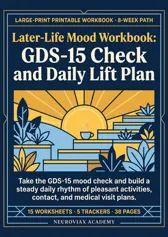
Go further: the printable Later-Life Mood Workbook
A large-print workbook with the GDS-15 and a score history, a daily rhythm planner, activity menus with seated options, a doctor visit planner and a bad-day plan, in A4 and US Letter. Look inside before you decide.
See what is insideOr save 37% with the Later Life and Caregiving Pack: 3 workbooks for $11.99 instead of $18.97.