

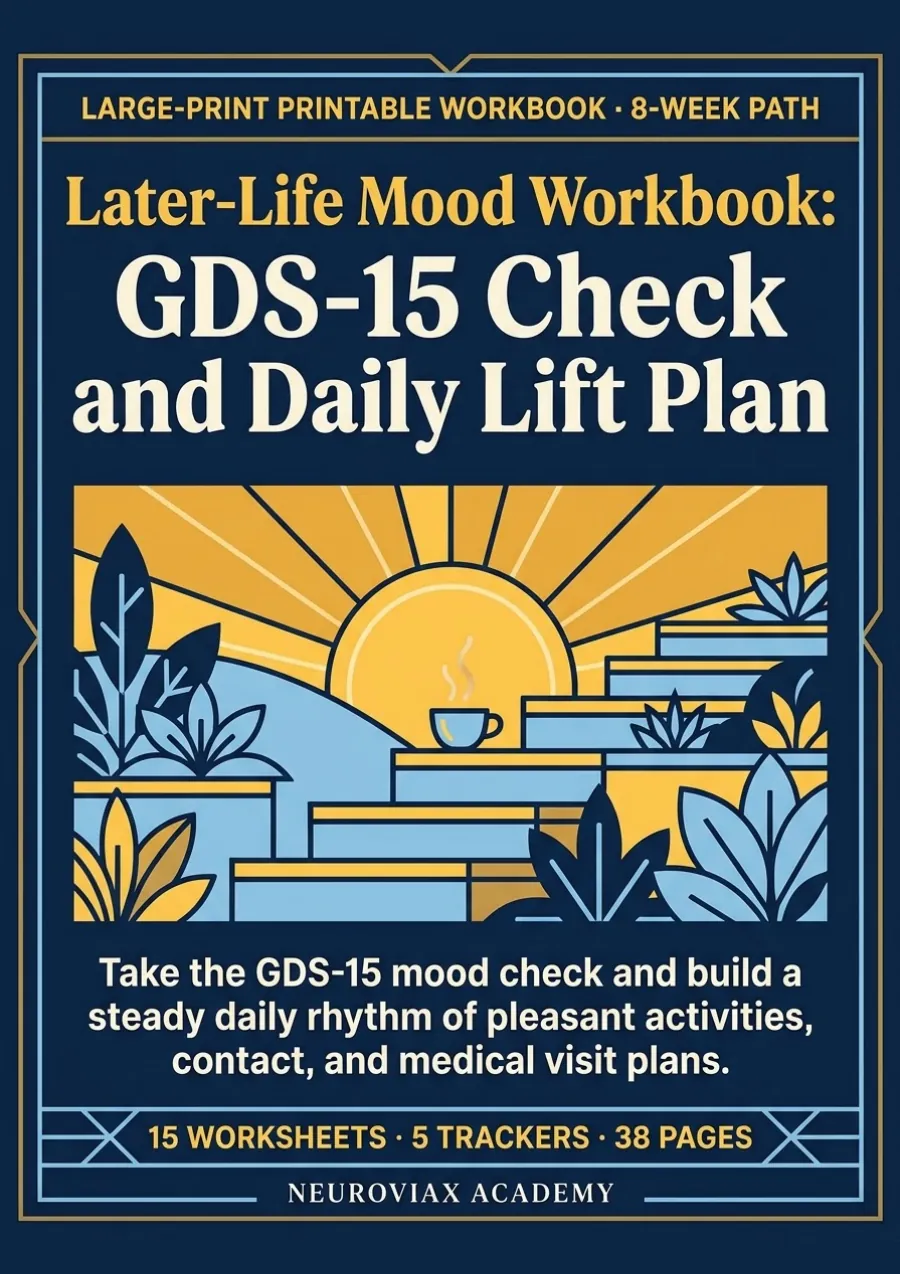
Cover
Samples are low resolution and watermarked. The PDF you download is full quality.
Printable workbook
Later-Life Mood Workbook: GDS-15 Check and Daily Lift Plan
$5.99 PDF, A4 and US Letter · 38 pages · instant download
A large-print workbook for adults over 65 and their families: the GDS-15 mood check, then a steady daily rhythm, small activities, daily contact and a doctor visit plan.
Secure payment by Whop on its own page. Right after paying you come straight back here to download your files, and we email you a personal link so you can return to them any time. No account needed.
Save with a bundle
- Later Life and Caregiving Pack · 3 workbooks for $11.99
$18.97save 37% - Complete Workbook Library · 118 workbooks for $69.99
$823.82save 92%
What is inside your workbook
- Cover 1 page
The cover of your workbook. - Start here 3 pages
What is inside, how to use the workbook and a simple path to follow. - The measure and scoring 4 pages
The items to answer on paper, step-by-step scoring and a worked example. - Worksheets 17 pages
Fill-in pages that turn your result or your plan into small, concrete steps. - Trackers 5 pages
Repeatable pages to follow change over weeks. Print as many copies as you need. - Quick reference 2 pages
One-page cards to keep at hand: the scale at a glance, ranges and prompts. - Reading guide 3 pages
A short plain-English guide to what the result means and what it cannot tell you. - Professional guide 2 pages
Administration, interpretation and limits for counsellors, coaches and clinicians. - Credits and references 1 page
Full references and credit to the authors and rights holders.
What you receive: the complete workbook as one PDF of 38 pages, in A4 and in US Letter. The parts listed above are the sections inside that PDF, so you can print everything in one go or just the pages you need.
Who it is for
- Adults over 65 who want to look after their mood
- Family members and carers of an older adult
- Primary care, home care and senior centre staff
Want to try it first? Use the free online Geriatric Depression Scale (GDS-15).
Low mood in later life is common and often missed, because it gets put down to age, illness or loss. This 38-page large-print workbook starts with the Geriatric Depression Scale (GDS-15), a short YES or NO mood check, then gives an older adult, alone or with a family member, small daily steps for the weeks after.
You receive one merged PDF in A4 and one in US Letter. Inside are Start Here (3 pages), the questionnaire and scoring (4 pages, with the full 15 items, the scoring key, the three bands and a worked example), Worksheets (17 pages: daily rhythm, pleasant and useful activity menus with seated options, a contact a day log, losses and what remains, a doctor visit planner, a bad-day plan and a page for family helpers), Trackers (5 pages), cards, a Guide, a professional page and Credits.
The GDS-15 is a public-domain screening scale by Sheikh and Yesavage, and a 2016 review found it a reasonable first check, not a diagnosis. The activity pages draw on activity scheduling, which a meta-analysis by Cuijpers and colleagues found helpful for low mood in adults.
What you get
- Take the GDS-15 on paper, score it with a clear key and repeat it every four weeks.
- Build a steady daily rhythm around waking, meals, daylight and gentle movement.
- Choose small pleasant and useful activities, with seated options for limited mobility.
- Prepare for the doctor with a planner for medicines, sleep, appetite, hearing and memory worries.
- Involve a family member with a page on how to help without taking over.
What it is not
This workbook is for education and self-reflection. The GDS-15 is a screening question set, not a diagnosis. If you are in danger or thinking about harming yourself, call your local emergency number now, or find a free crisis line in your country at findahelpline.com.
Questions people ask
What does a high GDS-15 score mean?
A score of 6 or more means it is worth talking to a doctor, and 11 or more means please talk to a doctor soon. The scale flags who needs a fuller talk; it does not diagnose depression.
Is the print large enough?
Yes. Every page uses large text, wide writing lines and high contrast, so it is easier to read and fill in by hand. A family member can also read the questions aloud.
Can a clinic use it?
Yes. The professional page explains how to use the GDS-15 and the workbook in primary care, home care or a senior centre. You may print pages for your own clients, but do not resell or share them.