
Pick a feeling
Tap the feeling you want to measure right now.
How big is the feeling?
Drag the thermometer, tap a coloured zone, or press minus and plus.
Right now: ideas for Calm (0 to 2)
Tap any step you want to try right now.
Did the feeling go down after trying something?
Pick your "after" number (0 to 10):
Both your Before (B) and After (A) marks will show on the thermometer.
Make it my thermometer
Pick a zone below to add what your body feels like and what helps at that level. Your picks appear right next to that zone on the thermometer.
Zone 0 to 2: Calm
For adults: how to use this with a child
How to introduce the thermometer
- Practise when calm first. Fill in the body signs and helpful steps on a quiet afternoon, not in the middle of an upset.
- Model it yourself. Share your own small check-ins out loud, such as "My frustrated feeling is at a 4 right now, so I am going to get a drink and take three slow breaths."
- Use the same simple words each time. Sticking to the same zone names and numbers makes it quick to point to the fridge chart when talking feels hard.
Why rating the size of a feeling helps
Cognitive behavioural work with children often pairs a simple feeling-size rating with body clues and a short coping list. Noticing when a feeling is still at a 3 or 4 gives a child a better chance to use a calming step before it climbs to a 9 or 10. This page is a self-rating and planning aid, not a score or a diagnosis.
Your answers stay in this browser and are never sent anywhere.
My Feelings Thermometer
Put this page on the fridge or wall so it is easy to point to.
| Zone | What my body feels like | What helps me |
|---|
My 7-Day Feelings Log
Note one moment each day. Write the feeling, the number before you tried something, what you tried, and the number after.
| Day | Feeling | Level before (0 to 10) | What I tried | Level after (0 to 10) |
|---|---|---|---|---|
| Day 1 | ||||
| Day 2 | ||||
| Day 3 | ||||
| Day 4 | ||||
| Day 5 | ||||
| Day 6 | ||||
| Day 7 |
How a Feelings Thermometer Helps Children and Teens
A feelings thermometer is a visual scale from 0 to 10 that turns a vague question like "Are you okay?" into something concrete a child can point to. Children often notice that a feeling is "huge" or "tiny" long before they can explain why it happened. Putting a number and a colour on the size of a feeling gives families and teachers a shared shorthand. Instead of guessing what might help, the child and adult look at the matching zone on the chart and pick one pre-agreed step.
How to use a feelings thermometer step by step
- Start when everyone is calm. Sit together during an ordinary, relaxed part of the day. Pick one common feeling, such as worried, angry or frustrated, and talk through what each zone feels like in the body.
- Keep the choices short. Two or three body clues and two or three helpful ideas per zone are plenty. Too many options feel hard to read when emotions rise.
- Print and post it where you can see it. Put the finished chart on the fridge, inside a bedroom door or near a classroom calm corner.
- Check in during small moments first. Practise pointing to a 2 or a 4 during everyday hiccups, like a tricky homework page or a loud room.
- Look at the "after" number. Once the child tries a step, check whether the number moved down by even one or two points. Small shifts count.
The five zones and what to do in each
Matching the action to the size of the feeling matters. A quiet chat works well at a 3, while a child at a 9 usually needs safety, movement or slow breathing before talking makes sense. The table below outlines the five zones used on this thermometer.
| Zone | Numbers | Common body clues | What often helps |
|---|---|---|---|
| Calm (green) | 0 to 2 | Calm breathing, relaxed shoulders, steady voice | Keep routines going, draw, talk or practise skills for harder days |
| A little (light blue) | 3 to 4 | Mild tummy ache, fidgeting, wanting a break | Get a drink, draw it, talk to someone early |
| Medium (yellow) | 5 to 6 | Faster heart, warm face, tight jaw or restless hands | Slow breaths, short movement break, draw or tell a trusted adult |
| Big (orange) | 7 to 8 | Hot face, tight fists, shaky hands, hard to listen | Go to a calm spot, squeeze and let go, move the body, ask an adult |
| Huge (red-orange) | 9 to 10 | Tears, shouting, freezing or feeling overwhelmed | Stay safe with a calm adult, quiet space, slow breaths, wait before talking |
Ideas for different ages
Ages 6 to 8: Keep the words brief and concrete. Focus on colours and simple body clues like "hot cheeks" or "wiggly legs". Let the child drag the thermometer on screen or point to the colour on the printed fridge sheet. Role-play one calming step together, such as squeezing a cushion and letting go.
Ages 9 to 12: Children in this age group can usually link specific situations to numbers and choose their own personalised ideas, such as shooting hoops, listening to music or writing a quick note to a parent. The 7-day feelings log helps them notice which steps actually bring the number down.
Teens: Many teenagers prefer private check-ins over a chart on the family fridge. They can use this page on a phone to rate stress before an exam or social event, pick one reset step and check whether the level dropped ten minutes later.
Feelings thermometer vs feelings wheel
Families sometimes ask how a feelings thermometer differs from a feelings wheel. They do two different jobs that pair well together. A feelings wheel helps a person find a more exact word for what they feel, such as realising "angry" is actually "left out" or "embarrassed". A feelings thermometer measures how strong that feeling is right now so you know what kind of support fits the moment. Use the wheel when the word is fuzzy, and the thermometer when the feeling is rising fast.
Where the idea comes from
Rating distress on a simple number scale grew out of behaviour therapy work by Joseph Wolpe (1969), who introduced a 0 to 100 scale called subjective units of distress. Child and school versions simplify that scale to 0 to 10 with colours and plain labels. Rating feeling size, noticing body signs and choosing coping steps are common building blocks in cognitive behavioural approaches for young people. A Cochrane review of 87 randomised trials involving 5,964 children and adolescents found that cognitive behavioural talking approaches helped many young people with anxiety, though not all, and the evidence compared with usual care or attention controls was low quality (James et al., 2020). This free online thermometer is an educational self-rating and planning tool, not clinical care, and it gives no score or diagnosis.
When to get more help
A feelings thermometer is useful for everyday worries, frustration and cooling down, yet some situations need a professional alongside family support. Speak with a family doctor, paediatrician, school counsellor or child psychologist if big feelings stay in the 7 to 10 range most days, interfere with sleep, school or friendships, or leave the child feeling stuck for several weeks. If a child is in danger or talks about hurting themselves, stay with them and contact your local emergency number or a doctor now.
Frequently Asked Questions
What is a feelings thermometer for kids?
What ages can use a feelings thermometer?
When is the best time to fill in a feelings thermometer?
What is the difference between a feelings thermometer and a feelings wheel?
Does a feelings thermometer give a score or diagnosis?
Can I print the feelings thermometer for the fridge or classroom?
Are my child's answers saved or sent anywhere?
Sources and credits
- James, A. C., Reardon, T., Soler, A., James, G., & Creswell, C. (2020). Cognitive behavioural therapy for anxiety disorders in children and adolescents. Cochrane Database of Systematic Reviews, 2020(11), CD013162. https://doi.org/10.1002/14651858.CD013162.pub2
- Wolpe, J. (1969). The practice of behavior therapy. Pergamon Press.
Credits: The feelings thermometer drawing, zone descriptions and child-friendly word lists on this page were created by Neuroviax Academy.
This page is an educational self-rating tool. It does not provide medical advice, diagnosis or clinical care.
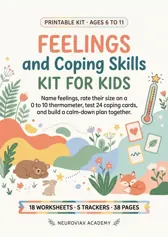
Go further: the printable Feelings and Coping Skills Kit for Kids
A printable kit with a fridge feelings thermometer, 24 cut-out coping cards, a calm-down plan and check-in logs, in A4 and US Letter. Look inside before you decide.
See what is insideOr save 39% with the Kids Coping Pack: 3 workbooks for $10.99 instead of $17.97.