
ERP Exposure Ladder for OCD
Exposure and response prevention (ERP) is the main behavioural treatment for obsessive-compulsive disorder. You face situations that trigger obsessions (exposure) while choosing not to do the compulsion or ritual (response prevention). Starting with lower-rated steps and moving up lets you learn that anxiety can fall and that the feared outcome is less likely or more bearable than it seemed (Foa & Kozak, 1986; Craske et al., 2014).
Reviews of controlled studies find cognitive behavioural treatment with exposure effective for OCD (Öst et al., 2015). This builder records your goal, your obsession theme, and a small set of exposure tasks with the distress each one causes and the ritual you will resist. It then orders them from the highest to the lowest rating and turns each step into a response prevention instruction.
Distress Ratings (SUDs 0–100)
Build Your ERP Ladder
State the goal, pick the obsession theme and describe at least three exposure steps with the ritual you will resist. The ladder sorts itself from the highest to the lowest distress rating. Auto-saved.
Each step needs an exposure task, a distress rating and the ritual or safety behaviour you will resist.
Please add at least 3 complete steps: exposure task and the ritual to resist for each.neuroviaxacademy.com/tools/erp-exposure-ladder.html
Your ERP Exposure Ladder
Steps are sorted from the highest to the lowest self-rated distress. Each step pairs the exposure with the ritual you will resist. Start with the lowest-rated step and repeat it before moving up.
Goal
Summary and response prevention plan
Ladder size:
Where to start:
Repeat each step until the urge to ritual drops, then move up one rung.
Safety and limits
ERP is most effective and safest with a trained therapist. Do not plan exposures that are dangerous or illegal. If your obsessions involve harming yourself or others and you feel you might act on them, call your local emergency number. Obsessions are unwanted thoughts; having them does not mean you will act on them.
Cite this worksheet
Neuroviax Academy. (2026). ERP exposure ladder for OCD: Free hierarchy builder [Online worksheet]. https://neuroviaxacademy.com/tools/erp-exposure-ladder.html
How to Use This ERP Exposure Ladder
Rate honestly
Give each exposure task the distress it causes you today, from 0 (none) to 100 (the most you can imagine). Honest ratings matter more than low ones.
Start low
Begin with the step or steps that carry the lowest rating. The ladder marks every step that shares that lowest number.
Stay with it
Stay in the situation until the urge to ritual drops, or for as long as you agreed with your therapist. Do not replace the ritual with a safety behaviour.
Repeat, then climb
Repeat a step more than once before moving up. Use the Y-BOCS worksheet to review your symptoms alongside the ladder.
Building an ERP Hierarchy for OCD
An ERP hierarchy is a list of exposure tasks ordered by how much distress each causes, and each task is paired with the ritual you intend to resist. The ladder gives a clear order, so the work starts at a rung you can actually manage rather than at the hardest situation you can imagine.
What is ERP?
Exposure and response prevention (ERP) is the main behavioural treatment for obsessive-compulsive disorder. You face situations that trigger obsessions (exposure) while choosing not to do the compulsion or ritual (response prevention). Starting with lower-rated steps and moving up lets you learn that anxiety can fall and that the feared outcome is less likely or more bearable than it seemed (Foa & Kozak, 1986; Craske et al., 2014). Reviews of controlled studies find cognitive behavioural treatment with exposure effective for OCD (Öst et al., 2015).
What are SUDs?
Subjective units of distress are your own ratings from 0 (none) to 100 (the most you can imagine). They are personal estimates, useful for ordering steps, and they are not clinical cut-offs.
In real life or in imagination
Most ERP steps happen in real life. Some tasks, such as an unwanted thought or a feared image, are worked on in imagination first. Mark each step with the type that fits it.
Safety and limits
ERP is most effective and safest with a trained therapist. Do not plan exposures that are dangerous or illegal. If your obsessions involve harming yourself or others and you feel you might act on them, call your local emergency number. Obsessions are unwanted thoughts; having them does not mean you will act on them.
Frequently Asked Questions
What is an ERP hierarchy?
What are SUDs?
Is my ladder saved?
Can I do ERP on my own?
Sources and credits
- Foa, E. B., & Kozak, M. J. (1986). Emotional processing of fear: Exposure to corrective information. Psychological Bulletin, 99(1), 20–35. doi.org/10.1037/0033-2909.99.1.20
- Öst, L.-G., Havnen, A., Hansen, B., & Kvale, G. (2015). Cognitive behavioral treatments of obsessive–compulsive disorder. A systematic review and meta-analysis of studies published 1993–2014. Clinical Psychology Review, 40, 156–169. doi.org/10.1016/j.cpr.2015.06.003
- Craske, M. G., Treanor, M., Conway, C. C., Zbozinek, T., & Vervliet, B. (2014). Maximizing exposure therapy: An inhibitory learning approach. Behaviour Research and Therapy, 58, 10–23. doi.org/10.1016/j.brat.2014.04.006
Credits: Exposure and response prevention derives from the behaviour therapy tradition of Joseph Wolpe and from the OCD treatment research summarised above; the citations describe treatment studies, not this worksheet.
This page is an educational worksheet. It does not provide therapy, diagnosis or a treatment plan.
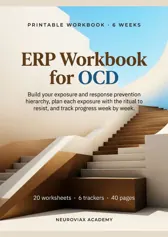
Go further: the printable ERP Workbook for OCD
A printable PDF workbook with fill-in worksheets, trackers and a reading guide, in A4 and US Letter. Look inside before you decide.
See what is insideOr save 50% with the Anxiety Toolkit Workbook Bundle: 4 workbooks for $13.99 instead of $27.96.
Print Your ERP Ladder
Enter your email to generate and print your exposure ladder with its response prevention plan.