
My own idea
Have a calm-down trick that is not on the board? Add your own card here.
Build your 6 stepping stones
Watch each stepping stone light up as you fill in your plan together.
Calm-down corner kit list (for adults)
You do not need a whole room or expensive gear. A small basket beside a cosy seat works well. Tick off the items you already have:
For adults: how to make this plan work
- Practise when the child is calm: Try two or three skills on a quiet afternoon. New skills are very hard to learn in the middle of tears or shouting.
- Model the skills yourself: Let your child see you use them ("I feel rushed right now, so I am taking three slow balloon breaths").
- Praise trying: Notice every effort, even small ones ("You went to your cushion before shouting, well done"), not just perfect calm.
- Keep the plan where they can see it: Put the printed plan on the fridge, bedroom door, or calm-down corner wall so nobody has to remember it from scratch.
- Review it after a week: Look over the menu together once a week. Swap out any card that did not help and keep the ones that did.
My Top 5 Coping Skills
My Calm-Down Plan
My Cut-Out Coping Cards
Cut along the dashed lines and keep these five cards in your calm-down corner, school bag, or pocket.
Coping Skills for Kids: A Practical Guide for Families and Schools
Coping skills for kids are simple, safe actions a child can use when big feelings like worry, anger, sadness, or frustration rise. They are not meant to stop feelings or force instant quiet. Instead, they give a child something concrete to do with their hands, breath, thoughts, or body while a wave of emotion passes. Having a small menu of familiar options makes hard moments less scary for children and adults alike.
No single skill fits every child or moment. A child who feels restless and heated may need a wall push or star jumps before sitting still feels possible. Another child who feels worried at bedtime may prefer slow balloon breaths or wrapping up in a soft blanket. Trying ideas together helps each child see what truly fits their body.
Five Groups of Coping Skills by Age
Sorting ideas into five clear groups makes them easy to scan: Breathe, Move, Senses, Think, and Connect. The same five groups look a little different as children grow.
| Skill group | Ages 4 to 6 (lots of adult help) | Ages 7 to 9 (gentle cues) | Ages 10 to 12 (more independent) |
|---|---|---|---|
| Breathe | Smell the flower, blow the candle together; blow one big pretend bubble. | Balloon breaths with hands on belly; five-finger breath tracing. | Quiet square breathing (4-4-4-4) at a desk or before a test. |
| Move | Shake hands and feet like a wet dog; stretch tall like a tree. | Ten star jumps; push flat palms against a wall for ten seconds. | Take a short walk with an adult; slow shoulder rolls and stretches. |
| Senses | Hold a soft blanket or cushion; take a cool sip of water. | Squeeze a soft stress ball; spot five blue things in the room. | Run cool water over hands; listen to a favourite calm song. |
| Think | Look at a picture book; scribble shapes with crayons. | Count slowly to 20; picture a cosy safe place; draw feelings. | Say a kind self-talk line; doodle in a notebook; pause before replying. |
| Connect | Ask a safe adult for a hug; sit next to a parent. | Tell a safe adult what happened; spend quiet time with a pet. | Check in with a trusted adult; play a quiet card game together. |
How to Build a Calm-Down Plan Step by Step
A menu of skills works best inside a clear calm-down plan. Before choosing skills, many children first notice how big a feeling is using our Feelings Thermometer for Kids. Once a child can spot early warning signs like hot cheeks, a fast heartbeat, or tight fists, walk through six steps together: name the warning signs, pick a calm spot, choose five favourite skills, list up to three safe adults, practise one short break sentence, and agree on how the child knows they are ready to return.
Keep the words short and in the child's own voice, and put the printed page where they can see it. Parents, carers, and teachers who want a grown-up version to model alongside their child can use our adult coping skills worksheet.
How to Set Up a Calm Down Corner
A calm down corner is a quiet, cosy spot at home or school where a child can take a short break and use their skills. You do not need special furniture: a floor cushion, a beanbag by a bookshelf, or a single quiet chair works well. Helpful items for a small calm corner kit include a soft cushion, a visual timer, a feelings chart, a fidget or stress ball, paper and crayons, and the child's printed Top 5 cards. Let the child help choose the spot so it feels like theirs.
Common Mistakes to Avoid
- Teaching skills only in the middle of a meltdown: When a child is crying or yelling, learning something new is very hard. Practise for two minutes during a calm afternoon instead.
- Using the calm down corner as a time-out punishment: Sending a child there in anger turns a safe tool into a place of shame. Offer it kindly and never threaten them with it.
- Expecting instant results: Skills take repetition. Praise trying a skill even if the child still needs steady adult help to finish calming down.
What the Research Says
Teaching children to notice body cues and practise concrete coping skills is a core part of cognitive behavioural work with young people. A Cochrane review of 87 randomised trials found that cognitive behavioural therapy is the most studied talking approach for anxiety in children and adolescents, helping many participants compared with waiting lists or no care, though not everyone, while evidence against usual care remained low quality (James et al., 2020). A meta-analysis of 40 studies of anger programmes for young people found that practising skills, with an adult modelling how and giving feedback, mattered more than simply talking about feelings (Sukhodolsky et al., 2004). This free page is an educational practice tool, not clinical care.
When to Get More Help
Every child has rough days and big emotions. Speak with a paediatrician, school counsellor, or child psychologist if intense worry, anger, or meltdowns happen almost every day, disrupt sleep, friendships, or school, or leave your family feeling stuck. If a child is in danger or talks about hurting themselves, stay with them and contact your local emergency number or a doctor now.
Frequently Asked Questions
What are coping skills for kids?
What age is this calm-down plan made for?
How is a calm down corner different from a time-out?
Why should we practise coping skills when my child is already calm?
How do I print the coping plan and cut-out cards?
Is my child's coping plan saved or sent anywhere?
Is this tool a diagnosis or medical advice?
Sources and credits
- James, A. C., Reardon, T., Soler, A., James, G., & Creswell, C. (2020). Cognitive behavioural therapy for anxiety disorders in children and adolescents. Cochrane Database of Systematic Reviews, 2020(11), CD013162. https://doi.org/10.1002/14651858.CD013162.pub2
- Sukhodolsky, D. G., Kassinove, H., & Gorman, B. S. (2004). Cognitive-behavioral therapy for anger in children and adolescents: A meta-analysis. Aggression and Violent Behavior, 9(3), 247-269. https://doi.org/10.1016/j.avb.2003.08.005
Credits: All coping cards, illustrations, and calm-down plan prompts on this page were created by Neuroviax Academy for educational family and school practice. This tool does not provide medical advice, diagnosis, or clinical care.
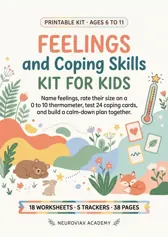
Go further: the printable Feelings and Coping Skills Kit for Kids
A printable kit with 24 cut-out coping cards, a six-step calm-down plan, a calm corner checklist and logs, in A4 and US Letter. Look inside before you decide.
See what is insideOr save 39% with the Kids Coping Pack: 3 workbooks for $10.99 instead of $17.97.