
Free Stages of Change Worksheet
This worksheet uses the stages of change from the transtheoretical model. You answer a few questions about one habit: whether you have changed it, and whether you plan to, and when. The tool names your likely stage, explains what tends to help at that stage, and points to one next step.
neuroviaxacademy.com/tools/stages-of-change-worksheet.html
Your Stage of Change
People often move back and forth between stages; a slip is a normal part of change, not a failure.
Cite this worksheet
Neuroviax Academy. (2026). Stages of change worksheet: Find your stage [Online worksheet]. https://neuroviaxacademy.com/tools/stages-of-change-worksheet.html
How to Use This Stages of Change Worksheet
Pick one habit
Choose a single habit from the list, or write your own. One habit per worksheet gives a clearer answer than several at once, and the questions only make sense about one change.
Describe the change in one line
Make it concrete. "Drink no more than twice a week" can be staged; "drink less" cannot. Write the smallest version of the change that you could actually measure.
Answer the timing questions
Two or three questions about whether you have changed and when you plan to. Answer for today, honestly. There is no mark for the stage you think you should be in.
Read your stage
You get one of five stages, a short note on what tends to help there, and a suggested next step. The optional reflection questions are worth the extra two minutes.
What are the stages of change?
The stages of change come from the transtheoretical model of James Prochaska and Carlo DiClemente. In a study of people who quit smoking on their own, they described stages that people pass through and the processes of change used at each stage (Prochaska and DiClemente, 1983). The five stages are precontemplation, contemplation, preparation, action and maintenance. Some versions add a sixth, termination, where the old habit no longer pulls at all.
The stages are not a ladder you climb once and leave behind. People move back and forth between them, and a return to an earlier stage is treated as part of the cycle rather than the end of the attempt. That is why a slip after three good months says something about the week before it, not about your character.
Why the stage matters
The same advice lands differently at each stage. Telling someone in precontemplation to make a plan often starts an argument, while the same person in preparation wants exactly that plan. A meta-analysis found that clients' stage of change before psychotherapy was linked to their outcomes: people further along tended to improve more (Krebs, Norcross, Nicholson and Prochaska, 2018). Said modestly, that finding suggests where someone starts matters. It does not mean a stage decides anyone's future.
| Stage | What it sounds like | What helps |
|---|---|---|
| Precontemplation | "It is not really a problem for me. I am not thinking about it." | Information, other people's stories, and time. Pressure usually makes the person defend the habit. |
| Contemplation | "Part of me wants to stop. Part of me does not." | Weighing the pros and cons, picturing life after the change, and naming what you value. |
| Preparation | "I am going to start soon. I have already done something about it." | A small plan with a start date, one person told, and easy triggers removed. |
| Action | "I have started. It takes a lot of my attention." | Rewards, support, a replacement activity, and staying out of high-risk situations. |
| Maintenance | "It is mostly part of my life now, and it still needs care." | A plan for risky moments, kept-up supports, and treating a slip as a lesson. |
Stages of change in addiction recovery
Most of the research behind the model came from addiction: smoking, alcohol, and other drugs. In practice the stages explain a pattern that families find confusing. One person is nowhere near ready to talk about the habit while a partner is already looking at treatment options. Neither is being stubborn or dramatic. They are simply in different stages, and each needs a different kind of conversation.
Recovery rarely runs in a straight line. A return to drinking or using after weeks or months of change is common, and the model treats it as a chance to look at what was happening in the days before, including sleep, stress, arguments and old routines. That look is what the reflection questions at the end of this worksheet are for.
Some habits carry medical risk. If you want to stop alcohol, benzodiazepines or some other drugs, talk to a doctor first. Stopping suddenly can be dangerous, and a supervised plan is safer than a determined one. None of that changes your stage. It only changes who should be part of the plan.
Stages of change and motivational interviewing
Motivational interviewing is a conversational style that draws reasons for change out of the person rather than pushing them in. It maps neatly onto the stages. With someone in precontemplation the work is to listen and share information without pressure. In contemplation the work is to hold both sides open and let the person hear their own arguments. In preparation the work is to help shape a plan the person owns, including the first step and the date. Our decisional balance worksheet is a simple way to do the contemplation work, and the Motivational Interviewing Kit goes further for anyone who wants to use these ideas in a conversation with someone else.
A fictional example: Daniel and Friday drinks
Daniel, 41, opened this worksheet about his drinking. He chose "Drinking less or stopping alcohol" and wrote one line: "Drink no more than twice a week". He had not made the change yet, and said he intended to in the next 30 days. He had taken a step in the past year, counting his drinks for two weeks, and the count showed four nights a week rather than the two he assumed. Asked what would be good about changing, he wrote "Better sleep and more money". Asked what would be hard, he wrote "Friday drinks with colleagues". He rated importance 8 and confidence 4.
The worksheet placed Daniel in preparation. It also flagged that his confidence sat four points below how much the change mattered, which is the gap a plan is meant to close. His next step was a goal with a start date, plus a written plan for Friday evenings. Nothing in the result asked him to want it more.
Frequently Asked Questions
What are the stages of change?
What is the transtheoretical model?
How do I know which stage I am in?
Is relapse part of the stages of change?
Is this a stages of change quiz?
Is my worksheet saved?
Sources and credits
- Prochaska, J. O., & DiClemente, C. C. (1983). Stages and processes of self-change of smoking: Toward an integrative model of change. Journal of Consulting and Clinical Psychology, 51(3), 390–395. doi.org/10.1037/0022-006X.51.3.390
- Krebs, P., Norcross, J. C., Nicholson, J. M., & Prochaska, J. O. (2018). Stages of change and psychotherapy outcomes: A review and meta-analysis. Journal of Clinical Psychology, 74(11), 1964–1979. doi.org/10.1002/jclp.22683
Credit: The stages of change come from the transtheoretical model described by Prochaska and DiClemente (1983). Our staging questions, layout and wording are our own.
This page is an educational self-help aid. It does not provide therapy, and the research cited concerns treatment in general, not this worksheet itself.
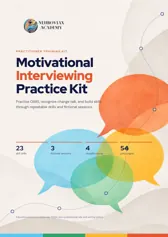
Go further: the printable Motivational Interviewing Practice Kit: OARS Drills
A printable PDF workbook with fill-in worksheets, trackers and a reading guide, in A4 and US Letter. Look inside before you decide.
See what is insideOr save 44% with the Recovery Bundle: 5 workbooks for $17.99 instead of $31.95.