
Notice the Pattern and Practice Saying No
Pick one recent moment when you said yes but really meant no. In seven short steps, you will look at what you did, what you feared, what it cost you, and what you needed, then write a calm script and a 5-step practice ladder.
neuroviaxacademy.com/tools/people-pleasing-worksheet.html
Your People-Pleasing Reflection and Plan
Research References
Helgeson, V. S., & Fritz, H. L. (1998). A theory of unmitigated communion. Personality and Social Psychology Review, 2(3), 173-183. https://doi.org/10.1207/s15327957pspr0203_2 Jack, D. C., & Dill, D. (1992). The Silencing the Self Scale: Schemas of intimacy associated with depression in women. Psychology of Women Quarterly, 16(1), 97-106. https://doi.org/10.1111/j.1471-6402.1992.tb00242.x Speed, B. C., Goldstein, B. L., & Goldfried, M. R. (2018). Assertiveness training: A forgotten evidence-based treatment. Clinical Psychology: Science and Practice, 25(1), e12216. https://doi.org/10.1111/cpsp.12216
For professionals
This worksheet is a structured self-reflection and behavioral rehearsal aid for adult clients working on over-accommodation, difficulty refusing requests, or chronic self-silencing. It is not a scored assessment and does not reproduce any copyrighted scale.
In sessions, Steps 1 through 5 map the functional chain (request, automatic response, predicted social cost, actual personal cost, and unmet need). Step 6 uses brief assertive phrasing modeled on standard assertiveness rehearsal (Speed et al., 2018), and Step 7 builds a graded 5-step hierarchy so the client starts with a low-stakes refusal before higher-stakes conversations. When working with clients in controlling or unsafe relationships, prioritize safety planning before suggesting verbal refusals.
How to Use This People-Pleasing Worksheet
Spot the moment
Pick one recent time you said yes but meant no. Write down who asked, what you did automatically, and what you worried would happen if you refused.
Measure the cost and need
Rate how much that yes cost your time, sleep, money, and mood from 0 to 10. Then name the real need or limit you pushed aside.
Build a short script
Choose clear no, partly yes, or later, and fill in a calm two-part sentence you can say aloud without long excuses.
Pick one small step
Fill the 5-step ladder from easiest at the bottom to hardest at the top, and choose one low-stakes step to try this week.
What People Pleasing Is and How to Practice Saying No
People pleasing is an everyday phrase, not a clinical diagnosis. It describes a habit of putting other people's wishes, comfort, or approval ahead of your own limits, even when saying yes leaves you drained or resentful. Being kind and helpful is healthy. People pleasing starts when you feel you cannot say no without upsetting someone, losing their warmth, or looking selfish.
Why People Pleasing Happens
Most adults pick up this habit for practical reasons. If you grew up in a home where keeping the peace felt safer than speaking up, agreeing quickly may have protected you from tension or anger. Workplaces and friendships can reinforce the same loop: people praise the colleague who always stays late or the friend who never complains. Some writers use the word "fawn" for a habit of soothing others to avoid conflict, though that term is not an established scientific category. Whatever started the pattern, it continues because saying yes brings quick relief from awkwardness, while the real cost shows up later.
Common Signs of People Pleasing
People pleasing looks different from person to person, but several everyday habits show up often:
- Saying yes before you have checked your calendar, energy, or budget.
- Apologising repeatedly when you have done nothing wrong.
- Hiding your real opinion, preference, or frustration to keep a room calm.
- Offering help before anyone asks, then feeling quietly resentful afterward.
- Spending hours worrying that someone is mad at you after a small boundary.
What Research Shows About the Costs
Psychologists have studied patterns closely related to people pleasing. Vicki Helgeson and Heidi Fritz (1998) described "unmitigated communion", which means focusing on other people to the exclusion of yourself. In their review, caring for others on its own was not the problem; rather, caring for others while leaving yourself out was linked with psychological distress, including depressive symptoms. Earlier, Dana Jack and Diana Dill (1992) studied "silencing the self", the habit of hiding your own needs and opinions to keep a close relationship safe. In the women they studied, silencing the self was linked with depression. These findings do not mean a single reluctant yes harms your health, but they do show why chronic self-neglect wears people down over time.
How to Stop People Pleasing Step by Step
Changing a long-standing habit works best in small, repeatable steps rather than dramatic confrontations:
- Notice the moment after it happens. Pick one recent time you said yes when you meant no, and write down who asked and what you feared.
- Name the real cost. Look honestly at what that yes took from your time, sleep, money, or mood. Seeing the cost clearly makes change concrete.
- Buy yourself a pause. Before answering a new request, try saying, "Let me check my week and get back to you." A short delay breaks the reflex to say yes.
- State your limit plainly. Use a short sentence without over-explaining. Long excuses invite debate.
- Climb from easy to hard. Practice on low-stakes moments first, such as declining a small extra favour, before tackling high-stakes family or work talks.
If you want more practice mapping limits across relationships, you can also try our Boundaries Worksheet. For longer guided exercises on relationship habits and self-respect, see our printable Codependency Recovery Workbook.
Assertiveness as a Learnable Skill
Many people assume that saying no means being cold or aggressive. In psychology, assertiveness means expressing your own needs and limits clearly while still respecting the other person. In a review of the field, Speed, Goldstein, and Goldfried (2018) noted that assertiveness training has solid research support yet is often under-used. That matters because assertiveness is a practical skill you can rehearse, not a personality trait you either have or lack. Expect a wave of guilt the first few times you say no. Guilt after breaking an old habit is normal and tends to ease as you see that most relationships survive an honest answer.
Short Scripts for Saying No
Having a simple sentence ready keeps you from freezing or over-apologising in the moment. Three everyday styles cover most situations:
| Style | When it fits | Example wording |
|---|---|---|
| Clear no | You do not have the time, energy, or wish to do it. | "Thanks for asking. I can't take on the extra project this month." |
| Partly yes | You want to help, but only in a smaller way. | "Thanks for asking. I can't host dinner, but I can bring dessert." |
| Later | You are open to it, just not right now. | "Thanks for asking. I can't talk tonight. I can call you on Thursday." |
You can adjust any script to sound like your own voice. Keep it brief, steady, and polite. If the other person is disappointed, remember that disappointment is a normal reaction to hearing no, not proof that you did something wrong.
Frequently Asked Questions
What is a people-pleasing worksheet?
Is people pleasing a mental health diagnosis?
Why do I feel so guilty after saying no?
How do the three saying-no script styles work?
What is the 5-step practice ladder for?
Are my worksheet answers private?
Can I print my finished plan?
Sources and credits
- Helgeson, V. S., & Fritz, H. L. (1998). A theory of unmitigated communion. Personality and Social Psychology Review, 2(3), 173-183. https://doi.org/10.1207/s15327957pspr0203_2
- Jack, D. C., & Dill, D. (1992). The Silencing the Self Scale: Schemas of intimacy associated with depression in women. Psychology of Women Quarterly, 16(1), 97-106. https://doi.org/10.1111/j.1471-6402.1992.tb00242.x
- Speed, B. C., Goldstein, B. L., & Goldfried, M. R. (2018). Assertiveness training: A forgotten evidence-based treatment. Clinical Psychology: Science and Practice, 25(1), e12216. https://doi.org/10.1111/cpsp.12216
This page is an educational self-reflection worksheet. It is not a diagnosis or a substitute for personal support from a qualified professional, and the cited studies examine broader research findings rather than this worksheet itself.
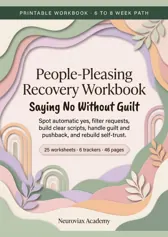
Go further: the printable People-Pleasing Recovery Workbook
A workbook with a decision filter, scripts for no, partly yes and later, an eight-step practice ladder and guilt and pushback pages, in A4 and US Letter. Look inside before you decide.
See what is insideOr save 48% with the Healthy Relationships Pack: 4 workbooks for $12.99 instead of $24.96.