
When to seek medical care right away: New, severe or different pain, or pain with fever, weakness, numbness or loss of bladder or bowel control, needs a doctor straight away.
Self-ratings and safety: This diary records your own daily ratings for reflection and clearer conversations with a doctor. It never gives advice on medicines. If you are in danger or thinking about harming yourself, call your local emergency number now, or find a free crisis line in your country at findahelpline.com.
Today's entry (about one minute)
Record how pain feels right now alongside sleep, mood, activity and what helped. All ratings are your own self-ratings.
Saved days (0)
30-day patterns
Pain, sleep and mood sit in the top chart, with daily activity bars directly underneath. Hover, tap or focus any logged day to read its full entry.
Steady baseline planner
Pick one everyday activity and enter how long you can do it on a bad day. Starting a little below that limit and building up slowly helps avoid boom and bust swings.
7-Day Pain Diary & Doctor Summary
1. Seven-Day Pain Diary Grid
| Date | Pain (0-10) | Where & felt like | Sleep / Mood | Activity | What I did, helped & note |
|---|
2. Doctor Appointment Summary
Medical warning: New, severe or different pain, or pain with fever, weakness, numbness or loss of bladder or bowel control, needs a doctor straight away. This diary records self-ratings only and never advises on medicines.
Crisis support: If you are in danger or thinking about harming yourself, call your local emergency number now, or find a free crisis line in your country at findahelpline.com.
Cite this tool
Neuroviax Academy. (2026). Pain diary: Free printable and interactive chronic pain log [Online worksheet]. https://neuroviaxacademy.com/tools/pain-diary.html
For professionals: evidence notes and using this diary with clients
Modest expectations from the research
Psychological approaches help people live alongside persistent pain rather than removing it. The Cochrane review of psychological therapies for chronic pain excluding headache (Williams et al., 2020) found small to very small benefits of cognitive behavioural therapy for pain, disability and distress, with moderate-quality evidence for most outcomes, while evidence for behavioural therapy and acceptance and commitment therapy (ACT) was moderate to very low quality and less certain. A dedicated review of ACT for chronic pain (Hughes et al., 2017) reported gains in pain acceptance and psychological flexibility and smaller gains in functioning, anxiety and depression, without a significant change in pain intensity or quality of life, and smaller effects at follow-up.
Pacing versus avoidance
In clinical practice, "pacing" is often misunderstood as stopping whenever pain increases. McCracken and Samuel (2007) found that activity avoidance was linked with greater disability and distress, and that client-reported pacing often overlapped with avoidance. In this tool, the steady baseline planner frames pacing around a repeatable time-based baseline set slightly below a bad-day limit, with gradual increases tied to valued activities rather than symptom elimination.
Using a pain diary with clients
Brief daily logging for one to two weeks helps replace recall bias with concrete patterns, especially boom-and-bust cycles and links with sleep or mood. Keep logging light so pain monitoring does not amplify hypervigilance; pause or stop tracking once patterns are clear or if daily rating increases distress. Encourage clients to bring the doctor summary to medical reviews for any new or changing symptoms, and keep all medication discussions with their prescribing clinician.
Safety and medical limits
New, severe or different pain, or pain with fever, weakness, numbness or loss of bladder or bowel control, needs a doctor straight away. If you are in danger or thinking about harming yourself, call your local emergency number now, or find a free crisis line in your country at findahelpline.com.
Understanding Your Chronic Pain Diary
Living with persistent pain often makes days blur together. When a doctor asks how the last month has been, most people remember their hardest flare or how they feel in the waiting room. A daily pain diary replaces guesswork with a simple record. Spending about a minute each day noting pain, sleep, mood, activity and what helped gives you a clearer picture of what changes from day to day and what supports steadier living.
Why keep a pain diary?
Chronic pain rarely stays at one flat number. It shifts with sleep, stress, movement, weather and how much you tried to fit into the day before. Without a written log, it is easy to miss quiet improvements or to blame the wrong trigger for a flare. A short log helps you spot links across two to four weeks rather than judging yourself on a single hard morning. It is also useful to keep entries brief. Recording a few clear ratings each day gives you helpful information without turning pain into the centre of your whole day. If tracking ever starts to feel heavy or stressful, step back and take a break.
What to record each day
A useful pain diary stays simple enough to repeat on bad days. Start with a 0 to 10 self-rating of pain right now, where 0 is no pain, 5 is moderate pain that is hard to ignore and 10 is the worst pain you can imagine. Mark where the pain sits on the body outline and pick plain words for what it feels like, such as aching, burning, stabbing, throbbing, tingling or stiff. Next, rate last night's sleep and your mood from 0 to 10, choose how active you were, jot down what you did and tick anything that helped, such as heat, gentle movement, pacing a task, distraction or talking to someone. These are self-ratings only, not a medical score.
Reading patterns: boom and bust, sleep and mood
Once you have logged a week or two, look at the 30-day chart as a whole rather than day by day. One common pattern is the boom and bust cycle. On a lower-pain day, it is tempting to catch up on everything at once, from housework to long errands. That extra push is often followed by two or three days of stronger pain and enforced rest. When the flare eases, the cycle starts again. Watching your sleep and mood lines alongside pain also tells an important story. Poor sleep often makes the nervous system more sensitive the next day, while higher pain can drain sleep and lower mood in return. Seeing those links written down takes away self-blame and points to small, practical levers you can adjust, such as protecting your bedtime or noticing which helpers show up on days when pain eases.
Pacing and building a steady baseline
Many people hear the word pacing and think it means stopping every time pain rises. Research by McCracken and Samuel (2007) with 276 people living with chronic pain found that avoiding activity went with greater disability and distress, and that the way people often describe pacing can overlap with avoidance. Helpful pacing works differently. It means planning steady, repeatable activity based on time or a small task rather than waiting for pain to disappear. Pick one everyday activity, such as walking, standing, housework or computer work, and estimate how long you can do it on a bad day without triggering a flare. Start a little below that limit, keep that steady baseline on both easier and harder days, and increase it slowly, for example by 5% or 10% a week, holding steady whenever a week feels heavier.
Taking your diary to the doctor
Appointments are short, and it is hard to summarise weeks of daily life in a few minutes. Before your visit, open the Doctor summary tab to gather your average pain, best and worst days, sleep and mood averages, common pain areas and what helped most. Add two or three short questions you want answered so you do not walk out wishing you had asked them. Print the summary alongside your 7-day diary grid and bring it on paper. Remember that this diary never advises on medicines. New, severe or different pain, or pain with fever, weakness, numbness or loss of bladder or bowel control, needs a doctor straight away.
How psychological approaches help, modestly
Psychological approaches do not remove chronic pain, and no worksheet or diary can take it away. What they can offer is modest, practical help with how much pain limits daily life and how much distress it causes. A 2020 Cochrane review by Williams and colleagues examined 75 trials involving 9,401 adults with persistent pain (excluding headache) and found that cognitive behavioural therapy gave small to very small benefits for pain, disability and distress, based on moderate-quality evidence for most outcomes, while evidence for behavioural therapy and acceptance and commitment therapy was moderate to very low quality and less certain. A 2017 review of 11 trials by Hughes and colleagues found that acceptance and commitment therapy helped pain acceptance and flexibility, with smaller gains in functioning, anxiety and depression, though pain intensity and quality of life did not change significantly and effects were smaller at follow-up.
Frequently Asked Questions
How long should I keep a pain diary?
What is the boom and bust cycle in chronic pain?
How do I set a steady baseline for an activity?
Is pacing the same as resting whenever pain increases?
Can I print a blank pain diary or take my summary to a doctor?
Does a pain diary give medical advice or replace seeing a doctor?
Is my pain diary saved or shared with anyone?
Sources and credits
- Williams, A. C. de C., Fisher, E., Hearn, L., & Eccleston, C. (2020). Psychological therapies for the management of chronic pain (excluding headache) in adults. Cochrane Database of Systematic Reviews, 2020(8), CD007407. https://doi.org/10.1002/14651858.CD007407.pub4
- Hughes, L. S., Clark, J., Colclough, J. A., Dale, E., & McMillan, D. (2017). Acceptance and commitment therapy (ACT) for chronic pain: A systematic review and meta-analyses. The Clinical Journal of Pain, 33(6), 552-568. https://doi.org/10.1097/AJP.0000000000000425
- McCracken, L. M., & Samuel, V. M. (2007). The role of avoidance, pacing, and other activity patterns in chronic pain. Pain, 130(1-2), 119-125. https://doi.org/10.1016/j.pain.2006.11.016
This page is an educational self-monitoring tool written for Neuroviax Academy. It records self-ratings only and never advises on medicines.
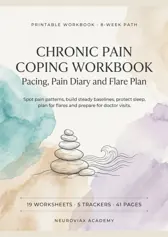
Go further: the printable Chronic Pain Coping Workbook
A workbook with a weekly pain diary, a boom and bust map, a steady baseline planner, a flare plan and a doctor visit planner, in A4 and US Letter. Look inside before you decide.
See what is insideOr save 92% with the Complete Workbook Library: 118 workbooks for $69.99 instead of $823.82.