
Build Your Recovery Plan at Your Own Pace
When a partner controls, belittles, or frightens you, it can feel hard to trust your own memory or know what to do next. This worksheet walks through eight short steps, starting with your safety right now, and ends with a one-page plan card you can keep or print.
Your Steadiness Map updates as you answer each step.
neuroviaxacademy.com/tools/emotional-abuse-recovery-plan.html
Your Emotional Abuse Recovery Plan Card
Research Citations
Dokkedahl, S. B., Kirubakaran, R., Bech-Hansen, D., Kristensen, T. R., & Elklit, A. (2022). The psychological subtype of intimate partner violence and its effect on mental health: A systematic review with meta-analyses. Systematic Reviews, 11, 163. https://doi.org/10.1186/s13643-022-02025-z Dutton, D. G., & Painter, S. (1993). Emotional attachments in abusive relationships: A test of traumatic bonding theory. Violence and Victims, 8(2), 105-120. https://doi.org/10.1891/0886-6708.8.2.105
For professionals: clinical notes and boundaries
This page is a structured educational self-reflection tool for adults recovering from, or considering leaving, a psychologically abusive relationship. It intentionally avoids scoring, clinical labels for either partner, and confrontational advice. Browser storage is opt-in (off by default) to reduce risk on shared devices. When working with a client in active danger or post-separation escalation, prioritize individualized safety planning alongside local specialist domestic abuse services.
How to Use This Emotional Abuse Recovery Plan
Check Safety and Name Patterns
Start by checking whether you feel safe right now. Then put words to what happened and mark any recurring patterns you noticed.
Steady Yourself and Set Safe Limits
Notice why letting go can feel hard, list safe people and places, and choose no-contact or low-contact rules only where they are safe.
Reclaim Daily Life and Print
Pick three small things that belong to you again, write your "What I know now" reminder card, and print your one-page plan if it is safe to keep a copy.
Understanding Emotional Abuse and Planning Your Recovery
Emotional abuse is an ongoing pattern in which a partner controls, belittles, or frightens you. Unlike a one-off disagreement between equals, it wears down your confidence, your sense of reality, and your freedom to make everyday choices. Many people looking for answers online search for "narcissistic abuse" to describe this experience. That is a popular phrase rather than a formal label, and you do not need to name a condition in another person to take your own safety and recovery seriously. What matters is how their behaviour affects you and what helps you stay steady.
Common Signs of Emotional Abuse
Because emotional abuse leaves no visible bruise, people often doubt themselves for months or years before recognizing a pattern. Seeing repeated behaviours side by side can bring clarity. Common patterns include repeated put-downs, controlling money or work choices, checking your phone or messages without consent, cutting you off from friends or family, long stretches of silent treatment used as punishment, direct or veiled threats, and cycles of on-off kindness that keep you guessing what mood comes next.
| Pattern | How it can show up | Why it makes daily life harder |
|---|---|---|
| Put-downs and blame | Mocking your feelings, calling you names, or blaming you for their anger | Slowly erodes self-trust so you second-guess clear facts |
| Controlling access | Controlling money, checking your phone, or cutting you off from friends | Leaves you isolated and makes practical leaving steps feel daunting |
| Coldness and fear | Silent treatment, shouting, or threats about leaving, children, or harm | Keeps your body on edge trying to avoid the next blow-up |
| On-off kindness | Warm apologies or affection right after harsh criticism or fear | Creates hope that the good version of the partner will stay |
Why Leaving and Letting Go Can Feel So Hard
Friends and family sometimes wonder why a person stays, returns, or still feels attached after leaving. Research helps explain why letting go is rarely a simple switch. In a study by Dutton and Painter (1993) of 75 women who had recently left abusive partners, on-off (intermittent) abuse combined with a power imbalance predicted a strong lingering attachment to the former partner. The authors found that this attachment fell by about 27% after six months. In plain words, alternating warmth and fear can tighten an emotional bond even when you know the relationship hurt you. Feeling pulled back during the first weeks or months is common, and it tends to ease with time, distance, and steady support.
How Emotional Abuse Affects Mental Health
Long-term psychological harm affects the whole nervous system, not just your thoughts during arguments. A large systematic review and meta-analysis by Dokkedahl et al. (2022), drawing on 194 studies, reported that psychological abuse by a partner was strongly linked with PTSD, depression, and anxiety. In that review, coercive control showed the strongest link with PTSD in women, and men were affected too. The researchers rated the certainty of the evidence as low, which means studies vary in how they measure abuse and individual outcomes differ. Even so, the overall picture matches what many survivors notice: trouble sleeping, constant alertness, low mood, and self-doubt are common reactions to prolonged stress, not signs that something is wrong with you.
Practical Steps for Recovery After a Controlling Relationship
Recovery works best when you take small, safe steps in order rather than forcing everything at once. Start with safety: check whether you are safe right now, protect your privacy on shared phones or computers, and avoid confronting a partner who frightens or controls you, because confrontation can raise risk. Next, put the pattern into plain words for yourself. You do not need your partner to agree with your version of events. Build a small circle of safe people and places where you do not have to walk on eggshells. Where it is safe, decide on clear no-contact or low-contact rules that protect your energy, especially if you must stay in touch over children or practical matters. Finally, reclaim three small parts of daily life that belong only to you: a hobby, a supportive friend, and a simple routine. Keeping a short written reminder of what you know now can help steady you on days when old doubts return.
When and Where to Get Help
You do not have to carry this alone. If you are in danger or thinking about harming yourself, call your local emergency number now, or find a free crisis line in your country at findahelpline.com. If you need concrete steps for staying safe at home, at work, or during a separation, start with our free Personal Safety Plan Builder or review the printable Safety Plan Workbook. If you also notice habits of putting everyone else first at the cost of your own wellbeing, our guide on codependency and healthy boundaries offers calm next steps. When you feel ready, a licensed therapist, doctor, or local domestic abuse advocate can support you at a pace that fits your life.
Frequently Asked Questions
What is an emotional abuse recovery plan?
Is it safe to use this worksheet on a shared phone or computer?
Why do I still miss someone who hurt or controlled me?
Should I confront my partner or ex-partner about their behaviour?
Do I have to choose complete no-contact to recover?
Is this worksheet a medical or legal service?
Where can I find free help if I feel unsafe right now?
Sources and Credits
- Dokkedahl, S. B., Kirubakaran, R., Bech-Hansen, D., Kristensen, T. R., & Elklit, A. (2022). The psychological subtype of intimate partner violence and its effect on mental health: A systematic review with meta-analyses. Systematic Reviews, 11, 163. https://doi.org/10.1186/s13643-022-02025-z
- Dutton, D. G., & Painter, S. (1993). Emotional attachments in abusive relationships: A test of traumatic bonding theory. Violence and Victims, 8(2), 105-120. https://doi.org/10.1891/0886-6708.8.2.105
This page is an educational self-reflection worksheet. The cited studies examine partner psychological abuse and post-separation attachment in general, not this worksheet itself.
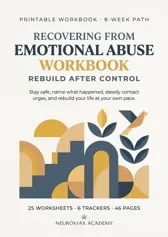
Go further: the printable Recovering From Emotional Abuse Workbook
A safety-first workbook with pattern pages, contact-urge pauses, support rebuilding, values and an 8-week tracker, in A4 and US Letter. Look inside before you decide.
See what is insideOr save 48% with the Healthy Relationships Pack: 4 workbooks for $12.99 instead of $24.96.