
Free Couples Conflict and Repair Worksheet
Work through 6 guided steps on your own or side by side with your partner. Look back at one recent argument, see which communication patterns showed up most often, and build a clear repair plan for next time.
Your answers stay in this browser and are never sent anywhere. No account needed.
neuroviaxacademy.com/tools/couples-conflict-patterns-worksheet.html
Your Couples Conflict and Repair Report
Research References (APA)
Gottman, J. M., & Levenson, R. W. (1992). Marital processes predictive of later dissolution: Behavior, physiology, and health. Journal of Personality and Social Psychology, 63(2), 221-233. https://doi.org/10.1037/0022-3514.63.2.221 Gottman, J. M., Coan, J., Carrere, S., & Swanson, C. (1998). Predicting marital happiness and stability from newlywed interactions. Journal of Marriage and the Family, 60(1), 5-22. https://doi.org/10.2307/353438 Christensen, A., Atkins, D. C., Berns, S., Wheeler, J., Baucom, D. H., & Simpson, L. E. (2004). Traditional versus integrative behavioral couple therapy for significantly and chronically distressed married couples. Journal of Consulting and Clinical Psychology, 72(2), 176-191. https://doi.org/10.1037/0022-006X.72.2.176
For professionals: clinical notes on using this worksheet
Safety screening before conjoint work: Step 1 screens for perceived safety with the partner before any communication exercise begins. When intimate partner violence, coercive control, or fear of retaliation is present, standard conjoint conflict exercises are contraindicated. Individual safety planning and specialist support take priority.
Non-scored reflection format: The 0 to 4 ratings on criticism, contempt, defensiveness, and stonewalling are descriptive prompts only. They are not a psychometric instrument, produce no composite score or cutoff, and are intended to anchor discussion around one specific recent conflict episode and its repair options.
Clinical framing: The worksheet pairs communication-pattern awareness (informed by observational research by John Gottman and colleagues) with both behaviour-change steps and acceptance-oriented framing (informed by behavioural and integrative couple therapy research). Clients may complete it individually between sessions or review it together with a clinician.
How to Use This Couples Conflict Worksheet
Check safety and pick one topic
Start by confirming that you feel safe with your partner. Then choose one specific recent disagreement instead of trying to solve every issue at once.
Notice the opening and patterns
Look at whether the talk began gently or sharply. Rate how often criticism, contempt, defensiveness, and stonewalling showed up for each of you on a 0 to 4 scale.
Build matching repairs
The worksheet opens the repair builder for whichever pattern you rated highest, and shows every tied repair if two or more patterns tie.
Keep one small next step
Pick one realistic action to try in your next disagreement and print your compact Next-Argument Card so both of you can glance at it when calm.
Couples Therapy Worksheets: Understanding Conflict Patterns and Repair
Every couple disagrees about money, chores, time, or expectations. What hurts a relationship is rarely the disagreement itself, but the habit of getting pulled into the same tense loop without a clear way out. Couples therapy worksheets give one partner or both together a calm structure to pause after a hard talk, put plain words to what happened, and plan a steadier response for next time. Because this worksheet is an educational self-reflection tool, it does not score your relationship, place you in a risk category, or replace working with a trained counsellor.
The Four Conflict Patterns and Their Repairs
The patterns and repairs in this worksheet draw on research by John Gottman and colleagues. In an observational study of married couples, Gottman and Levenson (1992) found preliminary support that couples who kept more positive than negative behaviours during conflict talks were more likely to stay stable, while a sequence moving from complaints and criticism to defensiveness, contempt, and withdrawal went with later separation. In a later study of newlyweds, Gottman et al. (1998) found that how a conflict discussion started, and whether partners accepted influence and calmed each other, related to later happiness and stability.
In everyday language, four common habits tend to escalate an argument, and each one has a direct repair you can practice:
- Criticism and the gentle start-up: Criticism turns a specific complaint into a verdict about your partner's character ("You never care about this house"). The repair is a gentle start-up that names your feeling, the specific situation, and a clear request: "I feel ... about ... and I need ...".
- Contempt and specific appreciation: Contempt shows up as eye-rolling, mocking, sarcasm, or talking down from a higher moral ground. The repair is deliberately noticing and naming real things you respect or appreciate about your partner, so small frustrations do not crowd out warmth.
- Defensiveness and taking responsibility: Defensiveness tries to block hurt with quick excuses or counter-attacks ("Only because you did it first"). The repair is looking for even a small piece of the situation you can own honestly ("You are right that I snapped instead of asking calmly").
- Stonewalling and a 20-minute break plan: Stonewalling happens when a partner feels overwhelmed, goes silent, or walks off without explanation. The repair is agreeing on a pause of at least 20 minutes to calm the body, paired with a specific return time so the other partner knows the talk is not abandoned.
| Pattern | How it sounds or looks | Practical repair to try |
|---|---|---|
| Criticism | "You always leave everything to me." | Gentle start-up: "I feel ... about ... and I need ..." |
| Contempt | Sarcasm, mocking, name-calling, or eye-rolling. | Build a habit of naming specific appreciation and respect. |
| Defensiveness | Instant excuses, blaming back, or denying any part. | Name one honest part you can take responsibility for. |
| Stonewalling | Shutting down, going silent, or walking out without a plan. | Take a 20-minute calming break with an agreed return time. |
Balancing Acceptance and Change
Not every couples disagreement disappears with better wording. Research by Christensen et al. (2004) tested two forms of behavioural couple therapy in a randomized trial of 134 seriously distressed couples: one centred mainly on behaviour change and one combining change with emotional acceptance. Both approaches helped many couples improve. In daily life, this means some issues call for a clear practical adjustment, such as splitting tasks differently, while steady differences in pace or personality often soften when both partners feel heard rather than pushed to become someone else.
How to Use This Worksheet Together or Alone
Set aside ten quiet minutes when neither of you is hungry, exhausted, or rushing out the door. If emotions are still high, complete the sheet alone first so you can sort out what you feel and pick one realistic habit to practice. When both partners feel safe and open, compare your two bar charts with curiosity rather than blame, and print the Next-Argument Card so you have your agreed phrases ready before tension rises again. Pairing these steps with steady listening makes repair much easier; see our Active Listening Skills guide for a clear sequence you can try. If you want to look at how closeness and distance habits shape your arguments, you can also explore the ECR-RS Relationship Structures Attachment Test or the printable Relationships and Attachment Workbook Bundle.
When to See a Couples Counsellor, and When Couples Work Is Not Safe
A self-help worksheet can help you spot habits, yet it has real limits. Consider meeting with a qualified couples counsellor if the same arguments repeat for months without relief, if trust has been broken, or if contempt and withdrawal have become your default tone. Most importantly, couples communication exercises are only for relationships where both people feel safe. If you are afraid of your partner, feel controlled or belittled, or worry that raising a concern will lead to retaliation or harm, joint couples exercises are not the right step. Put your personal safety first with our Safety Plan Template. If you are in danger or thinking about harming yourself, call your local emergency number now, or find a free crisis line in your country at findahelpline.com.
Frequently Asked Questions About the Couples Conflict Worksheet
What is a couples conflict worksheet and how does it help?
Can I complete this worksheet on my own if my partner is not ready?
What are the four conflict patterns and their repairs?
Does this worksheet calculate a score or predict whether a relationship will last?
Why does the worksheet start with a safety check?
How does the 20-minute break plan work when an argument gets heated?
Are my answers saved or shared with anyone?
Sources and Credits
- Gottman, J. M., & Levenson, R. W. (1992). Marital processes predictive of later dissolution: Behavior, physiology, and health. Journal of Personality and Social Psychology, 63(2), 221-233. https://doi.org/10.1037/0022-3514.63.2.221
- Gottman, J. M., Coan, J., Carrere, S., & Swanson, C. (1998). Predicting marital happiness and stability from newlywed interactions. Journal of Marriage and the Family, 60(1), 5-22. https://doi.org/10.2307/353438
- Christensen, A., Atkins, D. C., Berns, S., Wheeler, J., Baucom, D. H., & Simpson, L. E. (2004). Traditional versus integrative behavioral couple therapy for significantly and chronically distressed married couples. Journal of Consulting and Clinical Psychology, 72(2), 176-191. https://doi.org/10.1037/0022-006X.72.2.176
Credit: The four conflict patterns and repair ideas draw on research by John Gottman and colleagues (1992, 1998) and behavioural couple therapy research by Andrew Christensen and colleagues (2004).
This page is an educational self-reflection worksheet. It does not replace couples counselling, and the cited studies concern observational research or structured therapy rather than this worksheet itself.
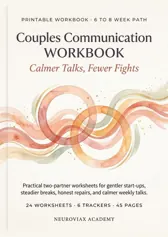
Go further: the printable Couples Communication Workbook
A workbook for two with gentle start-ups, break and return plans, repair lists, hard-topic planners and weekly couple meetings, in A4 and US Letter. Look inside before you decide.
See what is insideOr save 48% with the Healthy Relationships Pack: 4 workbooks for $12.99 instead of $24.96.