
Draft a Clear, Child-Focused Co-Parenting Plan
Use this step-by-step builder on your own or alongside the other parent to sketch practical arrangements after separation. It begins with a safety check, includes a live 14-day two-colour schedule calendar, and turns your choices into a clean printable plan with a review date.
neuroviaxacademy.com/tools/co-parenting-plan-builder.html
Your Draft Co-Parenting Plan
Research References
Amato, P. R. (2001). Children of divorce in the 1990s: An update of the Amato and Keith (1991) meta-analysis. Journal of Family Psychology, 15(3), 355-370. https://doi.org/10.1037/0893-3200.15.3.355 Harold, G. T., & Sellers, R. (2018). Annual Research Review: Interparental conflict and youth psychopathology: An evidence review and practice focused update. Journal of Child Psychology and Psychiatry, 59(4), 374-402. https://doi.org/10.1111/jcpp.12893
For professionals: counsellors, mediators, and family support staff
This worksheet helps separated parents organize practical details before mediation, legal consultation, or family support sessions. It does not produce a score, a clinical evaluation, or a legal agreement.
- Screen for safety first: Step 0 asks directly about fear or abuse. When coercive control, intimidation, or violence is present, joint co-parenting sessions are generally inappropriate. Support individual safety planning using the Safety Plan Template and discuss low-contact parallel parenting options with qualified legal or domestic abuse services.
- Use one section at a time: Parents under stress can draft just the 14-day calendar and handover details first, then return later to holidays, expenses, and house rules.
- Local privacy: Entries save only in local browser storage. If using a shared office or clinic device, select Start Again after printing so the next visitor starts with a blank screen.
How to Use This Co-Parenting Plan Builder
Check Safety First
Pause to consider whether joint planning feels safe. If there is fear or abuse, review the parallel parenting and safety options before deciding how to proceed.
Map Time and Handovers
List each child, build a visual 14-day schedule, set calm handover details, and sketch out holidays and birthdays before they arrive.
Agree Daily Practicalities
Clarify major decision areas, written communication boundaries, how child costs are shared and logged, and a few shared house routines.
Set a Review Date
Pick a date to revisit the draft as children grow, write a cool-down rule for disagreements, and print a clean copy for your records.
Understanding Co-Parenting Plans After Separation
A co-parenting plan is a written, practical document that sets out how separated parents will care for their children across two homes. Instead of renegotiating every weekend, school holiday, or doctor visit by text message, parents put the main routines in one place. A clear draft covers the regular parenting time schedule, handover times and locations, holidays, major decisions, communication rules, child expenses, shared house routines, and a review date. You can draft a plan alone to prepare for mediation or a lawyer visit, or build it together with the other parent when communication is workable.
Why Lowering Conflict Matters for Children
Research on separation helps keep expectations realistic and focused on what parents can actually control. In an updated meta-analysis of studies from the 1990s, Amato (2001) reported that, on average, children with divorced parents scored somewhat lower on academic achievement, conduct, psychological adjustment, self-concept, and social relations than children with continuously married parents. Those differences were modest, and most children of divorce do well.
Later research highlights why day-to-day parental behaviour makes such a difference. In a major review, Harold and Sellers (2018) showed that how parents express and handle conflict, ranging from cold silence to open hostility, affects children's emotional, behavioural, social, and school outcomes whether parents live together or apart. Writing down predictable routines cannot remove every disagreement, but it removes dozens of avoidable flashpoints around pick-up times, school holidays, and sudden schedule changes. If you want to look more closely at everyday family support or map the people around your children, the Family APGAR assessment and our interactive genogram maker can help you reflect on your wider support network.
Common Parenting Time Schedules Explained
No single parenting schedule suits every child or work rota. Age, travel distance between homes, school hours, and how smoothly children handle transitions all matter. This builder lets you compare common two-week patterns visually on a live 14-day calendar and adjust any day to fit your family.
| Schedule Pattern | How the 14 Days Work | When Families Consider It |
|---|---|---|
| Alternating weeks | 7 consecutive days with one parent, then 7 days with the other. | Fewer weekly handovers; often easier for older children and teens when homes are farther apart. |
| 2-2-3 schedule | 2 days with Parent A, 2 days with Parent B, 3-day weekend with A, then reversed in Week 2. | Short gaps away from each parent; often considered for younger children when parents live close by. |
| 2-2-5-5 schedule | Same two weekdays each week (Mon-Tue with A, Wed-Thu with B) plus alternating 3-day weekends. | Predictable school nights every week paired with alternating full weekends. |
| Weekdays / Weekends | Monday to Friday with one parent and weekends with the other. | Used when long commutes, shift work, or school logistics make mid-week handovers difficult. |
| Custom schedule | Any day-by-day mix tailored to work shifts, care needs, or local agreements. | Helpful for rotating shifts, step-up plans, or families with uneven schedules. |
Communication Tips That Protect Children
Children feel the strain quickly when they are used as messengers or asked to carry adult tension between homes. Clear communication rules keep adult logistics separate from childhood. Choose one primary written channel, such as email or a dedicated co-parenting app, so dates and agreements stay easy to find. Keep messages brief, factual, and child-focused. Set a realistic response window for everyday questions, such as 24 or 48 hours, while reserving phone calls for urgent child matters. Never pass messages, questions, or money through the child, and avoid discussing schedule disagreements at the handover door.
Parallel Parenting When Conflict Is High or Safety Is a Concern
Collaborative co-parenting depends on basic safety and mutual respect. If you feel afraid of the other parent, or if there has been emotional, physical, or financial abuse, safety comes first. In high-conflict or unsafe situations, many professionals recommend parallel parenting instead of frequent joint negotiation. Parallel parenting limits direct contact between adults, relies on clear written schedules, uses a parenting app or trusted third party for necessary updates, and keeps handovers at school or a neutral supervised location. Each parent manages everyday routines in their own home without trying to control the other household. If safety is a concern, review the Safety Plan Template and speak with a domestic abuse advocate or family lawyer. If you are in danger or thinking about harming yourself, call your local emergency number now, or find a free crisis line in your country at findahelpline.com.
How to Review the Plan as Children Grow
A parenting plan that fits a five-year-old often needs adjustment by age ten or fourteen. Setting a scheduled review date every six or twelve months, or ahead of each school year, turns updates into a normal routine rather than a crisis. Pair your review date with a simple cool-down rule for disagreements, such as waiting 24 hours before answering a heated message and bringing unresolved issues to a mediator. When changes are agreed, tell the children together or in calm, age-appropriate words so they know what to expect. For structured exercises on calm communication and everyday family routines, see the Parenting Skills Workbook.
Educational Tool, Not Legal Advice
This builder is an educational self-reflection and planning worksheet. It does not replace legal representation, formal mediation, or court forms, and it cannot determine child support or custody rights. Check your local family court or a family lawyer for legal requirements in your area before signing or relying on any parenting plan.
Frequently Asked Questions
What is a co-parenting plan and who is this builder for?
Is this co-parenting plan legally binding?
Which parenting time schedule works best for children?
What if I am afraid of the other parent or there has been abuse?
How can separated parents keep communication low-conflict?
Are my answers private and saved safely?
How often should we review and update our co-parenting plan?
Sources and Credits
- Amato, P. R. (2001). Children of divorce in the 1990s: An update of the Amato and Keith (1991) meta-analysis. Journal of Family Psychology, 15(3), 355-370. https://doi.org/10.1037/0893-3200.15.3.355
- Harold, G. T., & Sellers, R. (2018). Annual Research Review: Interparental conflict and youth psychopathology: An evidence review and practice focused update. Journal of Child Psychology and Psychiatry, 59(4), 374-402. https://doi.org/10.1111/jcpp.12893
This page is an educational planning worksheet. It does not provide legal advice, mediation, or therapy, and the research cited describes general findings on separation and interparental conflict rather than testing this worksheet itself.
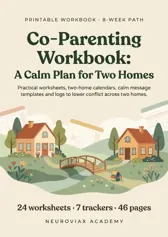
Go further: the printable Co-Parenting Workbook
A workbook with two-home calendars, handover and holiday plans, calm message templates, cost logs and review sheets, in A4 and US Letter. Look inside before you decide.
See what is insideOr save 44% with the Family Life Pack: 3 workbooks for $9.99 instead of $17.97.