

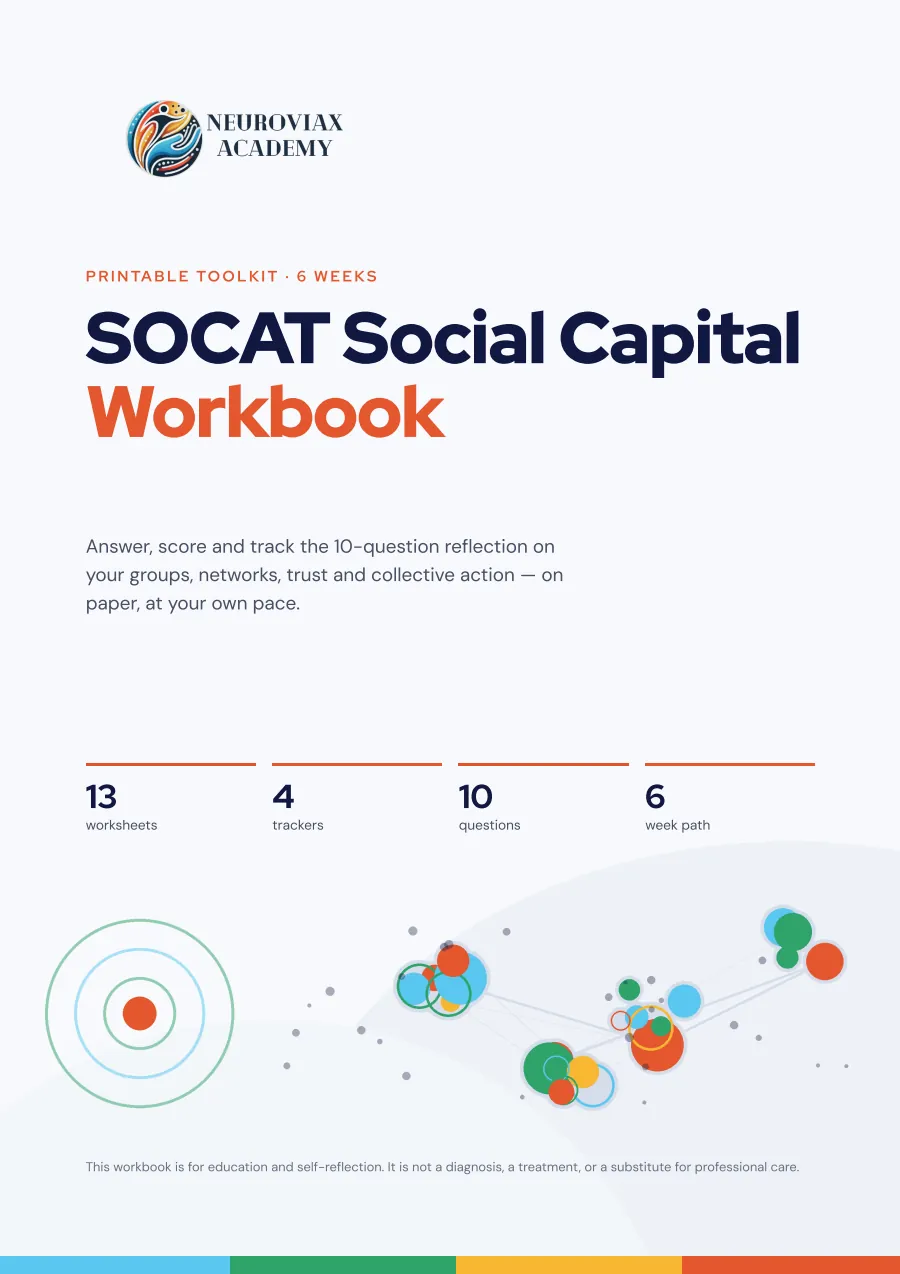
Cover
Samples are low resolution and watermarked. The files you download are full quality.
Printable workbook
SOCAT Social Capital Workbook
$5.99 PDF, A4 and US Letter · 32 pages · instant download
Reflect on the groups, networks, trust, and cooperation in your life with a 10-question workbook, four scoring dimensions, practical worksheets, and repeatable trackers.
Secure payment by Whop on its own page. Right after paying you come straight back here to download your files, and we email you a personal link so you can return to them any time. No account needed.
What is in the pack
- Cover 1 page
The cover of your workbook. - Start here 2 pages
What is inside, how to use the workbook and a simple path to follow. - The measure and scoring 4 pages
The items to answer on paper, step-by-step scoring and a worked example. - Worksheets 13 pages
Fill-in pages that turn your result or your plan into small, concrete steps. - Trackers 4 pages
Repeatable pages to follow change over weeks. Print as many copies as you need. - Quick reference 2 pages
One-page cards to keep at hand: the scale at a glance, ranges and prompts. - Reading guide 3 pages
A short plain-English guide to what the result means and what it cannot tell you. - Professional guide 2 pages
Administration, interpretation and limits for counsellors, coaches and clinicians. - Credits and references 1 page
Full references and credit to the authors and rights holders.
Also included: the complete workbook. Every file above merged into one PDF of 32 pages, in A4 and in US Letter, so you can print it in one go.
Who it is for
- Adults reflecting on groups and relationships
- People exploring trust and cooperation in daily life
- Counselors and coaches supporting adult reflection
- Community educators seeking a conversation worksheet
Want to try it first? Use the free online .
Wondering what support your connections offer, or where you might want more connection? The SOCAT Social Capital Workbook helps you put that question on paper. Its 10 custom reflection questions cover group participation, network diversity, trust, and collective action. A scoring table and worked example help you calculate four averages from 0 to 100, then a profile page and reading guide explain what those numbers can and cannot say. They are prompts for your own reflection, not validated measures or grades.
The 32-page pack comes as PDF files in both A4 and US Letter. The questionnaire and scoring pages introduce the reflection; 13 worksheets help you map your circle, list groups, consider bonding, bridging, and linking ties, and plan one small step. Four repeatable trackers include a weekly connection grid, six-week habit grid, monthly review, and score history chart. The Quick Reference keeps the four dimensions and reflection limits at hand; a three-page Guide explains social capital. A two-page Professional Guide and one-page Credits and References complete the set.
Use the six-week path at your own pace: answer and score first, then explore networks, trust, and cooperation in the weeks that follow. Skip or pause any part that does not fit. Reuse the marked worksheets and trackers, and repeat the questions later if you want to compare your own answers under similar conditions. You will have a written snapshot of your connections, notes on what matters, and a small next step to revisit, without treating a score as a label or a measure of your community.
What you get
- Score the 10 reflection questions with a step-by-step table and worked example, then record four averages on Your Four Numbers.
- Map your circle of connections and use the Groups and Memberships Inventory to note where you participate.
- Sort relationships with the Bonding, Bridging, Linking Audit and reflect on network diversity without treating it as a grade.
- Use the weekly connection grid, six-week habit grid, monthly review, and score history chart to revisit your own notes.
- Keep the Quick Reference nearby for dimension prompts, tie definitions, and reminders about what the averages cannot show.
What it is not
This is educational self-reflection, not a diagnosis or treatment; it credits the SC-IQ authors Christiaan Grootaert, Devika Narayan, Veronica Nyhan Jones, and Michael Woolcock. Personal use and reuse for your own clients are allowed; wider group or institutional use requires a separate license.
Questions people ask
How do I score the SOCAT Social Capital Workbook?
Answer the 10 questions as things are today, then use the included scoring table and worked example to calculate four averages: group participation, network diversity, trust, and collective action. The Quick Reference and Guide explain the dimensions and limits. There are no validated ranges, norms, or cutoffs.
Can I print the workbook on A4 or US Letter paper?
Yes. The pack includes PDF versions in both A4 and US Letter. The 32-page total is consistent across both sizes, with the same nine files: cover, Start Here, questionnaire and scoring, worksheets, trackers, Quick Reference, Guide, Professional Guide, and Credits and References.
Who should not rely on these scores alone?
The averages are custom reflection prompts, not validated indices, a diagnosis, or a measure of a community. They cannot be compared with World Bank survey results or used as a community program outcome measure. If loneliness or isolation is causing distress, the pack suggests contacting a doctor, counselor, or local support service.