

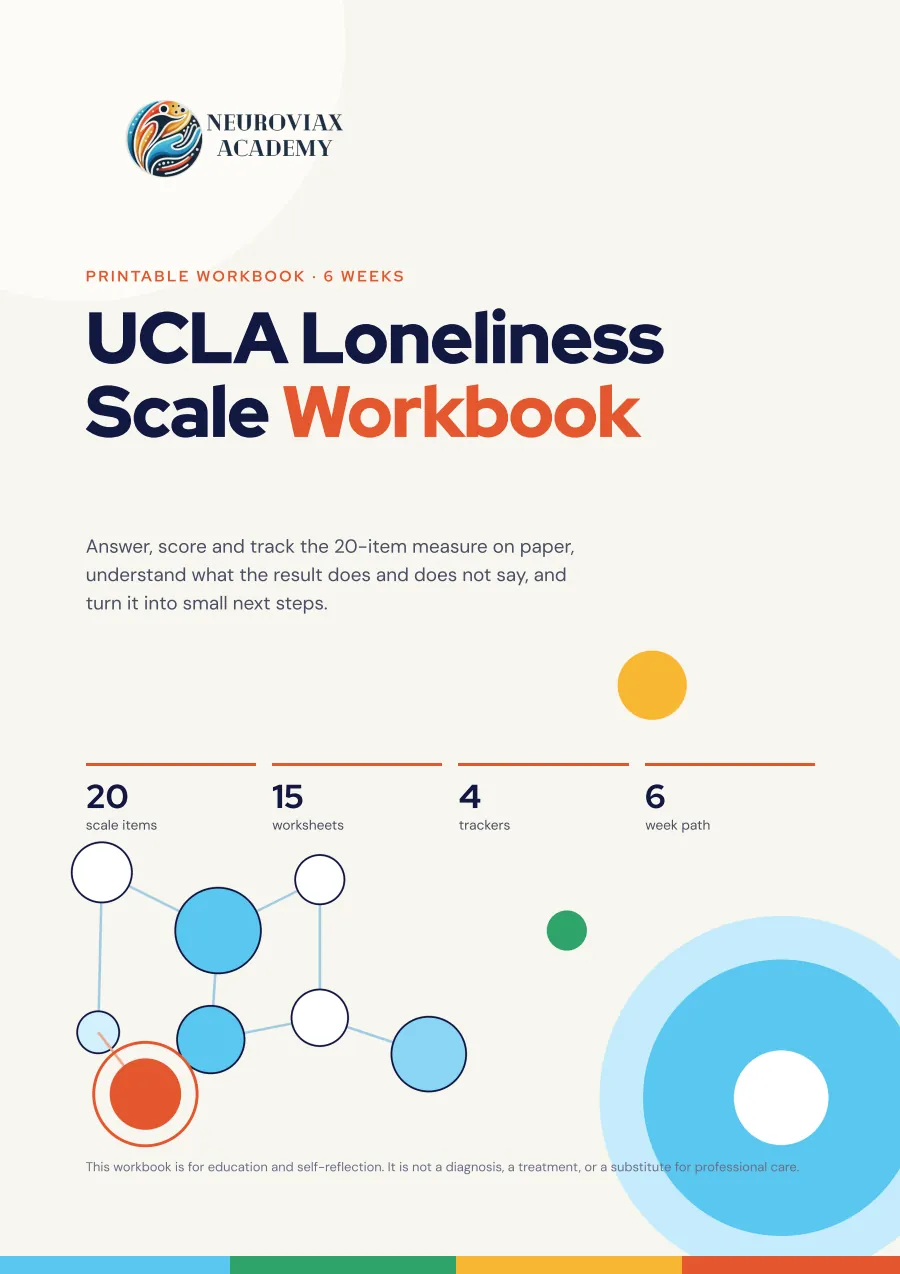
Cover
Samples are low resolution and watermarked. The files you download are full quality.
Printable workbook
UCLA Loneliness Scale Workbook
$5.99 PDF, A4 and US Letter · 34 pages · instant download
Answer the 20-item UCLA Loneliness Scale, work through its scoring, and use reflection pages and six-week trackers to note your own patterns. A4 and US Letter PDFs.
Secure payment by Whop on its own page. Right after paying you come straight back here to download your files, and we email you a personal link so you can return to them any time. No account needed.
What is in the pack
- Cover 1 page
The cover of your workbook. - Start here 3 pages
What is inside, how to use the workbook and a simple path to follow. - Worksheets 15 pages
Fill-in pages that turn your result or your plan into small, concrete steps. - Trackers 4 pages
Repeatable pages to follow change over weeks. Print as many copies as you need. - Quick reference 3 pages
One-page cards to keep at hand: the scale at a glance, ranges and prompts. - Reading guide 4 pages
A short plain-English guide to what the result means and what it cannot tell you. - Professional guide 3 pages
Administration, interpretation and limits for counsellors, coaches and clinicians. - Credits and references 1 page
Full references and credit to the authors and rights holders.
Also included: the complete workbook. Every file above merged into one PDF of 34 pages, in A4 and in US Letter, so you can print it in one go.
Who it is for
- Adults reflecting on how connected they feel
- Adults tracking their own answers over time
- Counselors, therapists, and coaches in one-to-one practice
Want to try it first? Use the free online .
Wondering how connected you feel, or how to make sense of a loneliness score? This workbook puts the UCLA Loneliness Scale, Version 3 on paper: 20 statements about connection and isolation, four response choices, and a total from 20 to 80. Its guide explains that the total is a self-report summary, not a count of friends or a verdict. Because published sources disagree on cut-offs, the pages do not sort results into low, moderate, or high bands.
The 34-page pack contains eight PDFs: a 1-page cover, 3-page Start Here, 15-page Worksheets, 4-page Trackers, 3-page Quick Reference, 4-page Guide, 3-page Clinician Guide, and 1-page Credits and References. The worksheets include the questionnaire, scoring grid, score line, reflection prompts, connection ladder, support circles, and hard-day plan. Quick Reference gives the scoring steps and cut-out cards; the Guide explains the scale and its limits. Trackers provide a score history, weekly connection log, weekly review, and six-week review. Every file comes in A4 and US Letter PDF format.
Begin with a baseline in a quiet moment, answering for your typical experience rather than one unusually hard or easy day. Over six weeks, choose one small step, log connection once a week, and complete the weekly review. The pack advises waiting at least two weeks between scale administrations; at week six, repeat the questionnaire, plot the total, and complete the review. You end with a record of your answers, score history, reflections, and notes that you can revisit or bring to a professional.
What you get
- Answer all 20 questionnaire items and use the Worksheets scoring grid to calculate a total from 20 to 80.
- Mark your total on the score line, then copy it into the Trackers score history chart for later comparison.
- Use the connection ladder, support circles, and hard-day plan to write down a small next step and people to contact.
- Log weekly connection and complete the weekly and six-week reviews with repeatable pages you can print again.
- Keep the Quick Reference scoring steps and cut-out cards nearby, with a Guide and Clinician Guide explaining limits and use.
What it is not
For educational self-reflection only; this workbook is not a diagnosis or treatment. The UCLA Loneliness Scale, Version 3 was developed by Daniel W. Russell. Personal use and one-to-one professional client use are permitted; group, classroom, or institutional use needs a separate license.
Questions people ask
How is the UCLA Loneliness Scale scored?
Choose 1 (Never), 2 (Rarely), 3 (Sometimes), or 4 (Always) for each of 20 items. Reverse-score items 1, 5, 6, 9, 10, 15, 16, 19, and 20 by subtracting each answer from 5, then add all responses. The total ranges from 20 to 80; higher totals mean more self-reported loneliness.
Can I print this workbook on A4 or US Letter paper?
Yes. Each of the eight included PDFs is supplied in both A4 and US Letter size. The files total 34 pages: cover, Start Here, Worksheets, Trackers, Quick Reference, Guide, Clinician Guide, and Credits and References.
Who should not rely on a loneliness score alone?
The score is a self-report summary, not a diagnosis, formal assessment, or explanation of why you feel lonely. The workbook is written for adults. If loneliness persists or affects health, mood, or daily life, the pages suggest speaking with a doctor, mental health professional, or trusted person.