

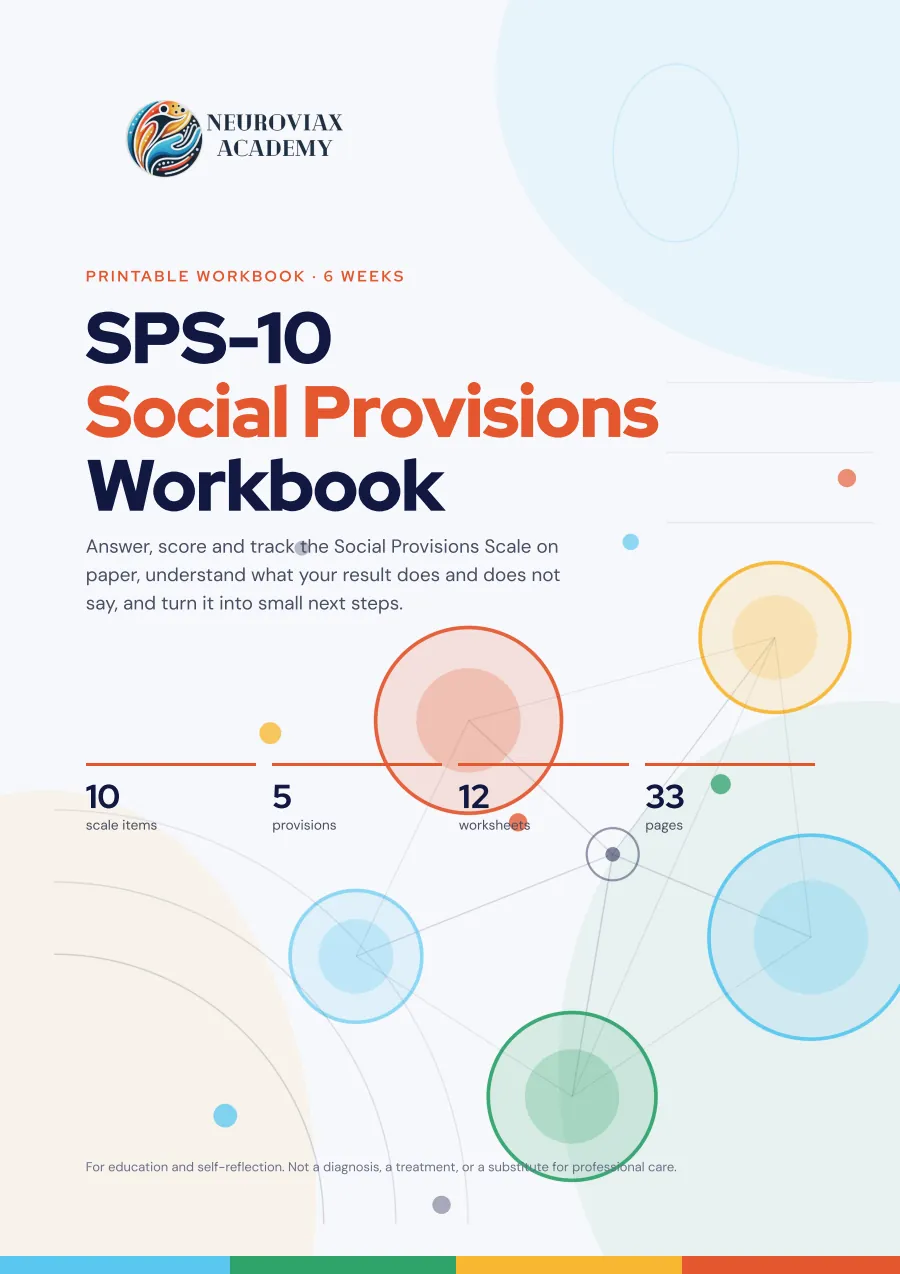
Cover
Samples are low resolution and watermarked. The files you download are full quality.
Printable workbook
SPS-10 Social Provisions Workbook
$5.99 PDF, A4 and US Letter · 33 pages · instant download
Answer and score the ten-item SPS-10, reflect across five kinds of perceived support, and follow a six-week path with worksheets and repeatable trackers. Includes A4 and US Letter PDFs.
Secure payment by Whop on its own page. Right after paying you come straight back here to download your files, and we email you a personal link so you can return to them any time. No account needed.
What is in the pack
- Cover 1 page
The cover of your workbook. - Start here 3 pages
What is inside, how to use the workbook and a simple path to follow. - The measure and scoring 3 pages
The items to answer on paper, step-by-step scoring and a worked example. - Worksheets 12 pages
Fill-in pages that turn your result or your plan into small, concrete steps. - Trackers 4 pages
Repeatable pages to follow change over weeks. Print as many copies as you need. - Quick reference 2 pages
One-page cards to keep at hand: the scale at a glance, ranges and prompts. - Reading guide 4 pages
A short plain-English guide to what the result means and what it cannot tell you. - Professional guide 3 pages
Administration, interpretation and limits for counsellors, coaches and clinicians. - Credits and references 1 page
Full references and credit to the authors and rights holders.
Also included: the complete workbook. Every file above merged into one PDF of 33 pages, in A4 and in US Letter, so you can print it in one go.
Who it is for
- Adults reflecting on perceived social support
- Counselors and coaches using one-to-one reflection pages
- Group facilitators guiding support-focused reflection
- Students exploring the SPS-10 for personal insight
Want to try it first? Use the free online .
Wondering how supported you feel, or what kind of support you might want to build? The SPS-10 Social Provisions Workbook lets you answer the ten statements on paper and reflect on your responses. Its total ranges from 10 to 40, with higher scores indicating more perceived support. The five provision areas are attachment, social integration, reassurance of worth, reliable alliance, and guidance. The score describes your perception, not the help you have actually received or the size of your network, and there is no universal cut-off.
The 33-page pack comes as PDF files in both A4 and US Letter. It includes a 1-page cover, 3-page Start Here, 3-page measure and scoring file, 12-page worksheet set, 4-page tracker file, 2-page quick reference, 4-page reading guide, 3-page professional guide, and 1-page credits and references. The measure shows the items, scoring steps, and provision profile; worksheets explore each provision, support mapping, asking for help, and small steps. Trackers record score history and weekly connections, while the quick reference has a five-provision summary and cut-out cards.
Use the suggested six-week path at your own pace: make a starting note, complete a weekly reflection or small step, then answer the SPS-10 again and compare with your own first score. You can reprint pages marked for copies as needed. At the end, you will have a personal record of your responses, provision profile, observations, and steps to discuss or revisit. The guide explains what the score can and cannot tell you, so you can treat it as reflection data rather than a label.
What you get
- Score the ten SPS-10 statements with the three-page measure, step-by-step instructions, and a worked example.
- Map attachment, social integration, reassurance of worth, reliable alliance, and guidance on the provision profile.
- Use Worksheets 2 through 7 to map support and reflect on each of the five provisions.
- Record score history and weekly connections in four tracker pages, including a six-week review.
- Keep the Quick Reference's provision summary and cut-out asking cards nearby between workbook sessions.
What it is not
For educational self-reflection only; this is not a diagnosis or treatment, and it does not replace professional care. The SPS-10 was developed by Carolyn Cutrona and Daniel Russell and validated by Jean Caron. Personal use and one-to-one use with your own clients are permitted; resale, redistribution, and sharing are not permitted without written permission.
Questions people ask
How is the SPS-10 scored?
Rate each of the ten statements from 1 to 4 and add the answers for a total from 10 to 40. The items are positively worded, so none is reverse-scored. The workbook also shows a five-provision profile. Higher totals mean more perceived support; the guide says there is no universal cut-off.
Can I print the SPS-10 workbook on A4 or US Letter paper?
Yes. The pack includes printable PDF files in both A4 and US Letter, with matching page counts. It contains 33 designed pages across the cover, Start Here, measure, worksheets, trackers, quick reference, reading guide, professional guide, and credits.
How often should I repeat the SPS-10?
The workbook offers a six-week path: complete an initial score, spend five weeks reflecting and trying small steps, then answer it again and compare with your own starting score. The guide suggests repeating in a few weeks under similar conditions and watching your personal trend, not treating one score as a label.