

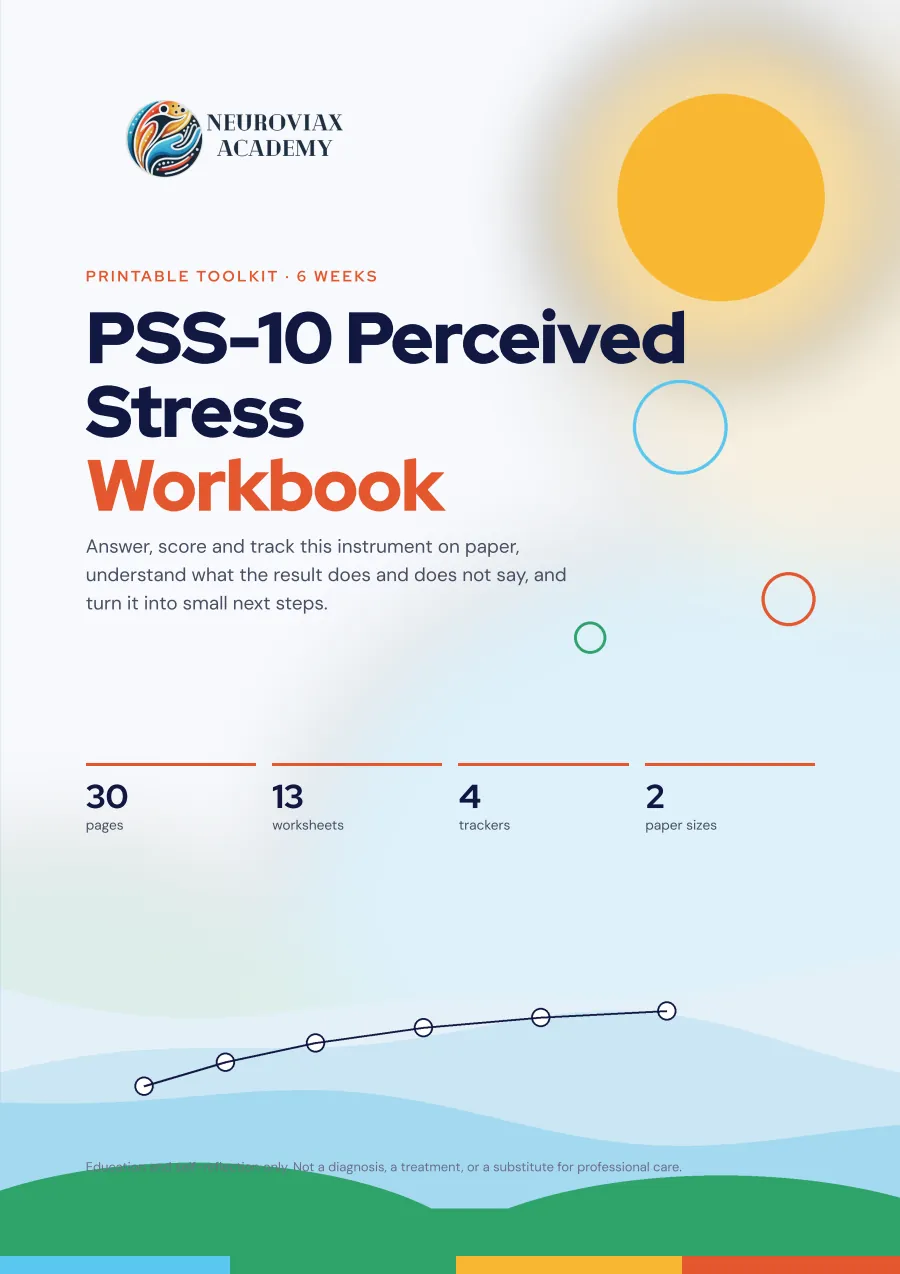
Cover
Samples are low resolution and watermarked. The PDF you download is full quality.
Printable workbook
PSS-10 Perceived Stress Workbook
$4.99 PDF, A4 and US Letter · 30 pages · instant download
Answer and score the PSS-10 for the past month, then use reflection worksheets, repeatable trackers, and a six-week path to record what you notice. A4 and US Letter PDFs included.
Secure payment by Whop on its own page. Right after paying you come straight back here to download your files, and we email you a personal link so you can return to them any time. No account needed.
What is inside your workbook
- Cover 1 page
The cover of your workbook. - Start here 2 pages
What is inside, how to use the workbook and a simple path to follow. - The measure and scoring 2 pages
The items to answer on paper, step-by-step scoring and a worked example. - Worksheets 13 pages
Fill-in pages that turn your result or your plan into small, concrete steps. - Trackers 4 pages
Repeatable pages to follow change over weeks. Print as many copies as you need. - Quick reference 2 pages
One-page cards to keep at hand: the scale at a glance, ranges and prompts. - Reading guide 3 pages
A short plain-English guide to what the result means and what it cannot tell you. - Professional guide 2 pages
Administration, interpretation and limits for counsellors, coaches and clinicians. - Credits and references 1 page
Full references and credit to the authors and rights holders.
What you receive: the complete workbook as one PDF of 30 pages, in A4 and in US Letter. The parts listed above are the sections inside that PDF, so you can print everything in one go or just the pages you need.
Who it is for
- Adults reflecting on a demanding month
- People who want a paper PSS-10 record
- Counselors supporting individual adult clients
- Coaches using client-facing reflection pages
Want to try it first? Use the free online tests, for example .
Has the past month felt unpredictable, hard to control, or like too much at once? The PSS-10 gives you a structured way to reflect on those experiences across ten questions. This workbook helps you record your answers, calculate a total, and consider what that snapshot does and does not describe. Its score is about your appraisal of the last month, not a diagnosis or a forecast.
The pack contains nine PDFs with 30 pages total, with matching A4 and US Letter versions. Start-Here lays out a six-week path; Measures includes the ten items, scoring steps, and a worked example. Thirteen worksheets guide a result debrief, naming situations, mapping control, checking appraisals, and choosing a small next step. Four tracker pages include a score history chart, weekly load log, daily stress peek, and practice log. Quick-Reference provides a one-page summary and keep card, while the Guide explains score limits and when to seek support. A separate professional guide and Credits-References page complete the set.
You can begin with the measure and one debrief page, then return to a worksheet or tracker when it feels useful. The suggested path spreads activities over six weeks and invites you to repeat the PSS-10 near the end, using the same past-month window. The score history chart lets you place totals side by side, while the logs help you note context. You finish with a written record of your responses, observations, and possible next steps; scores may vary, and the path is for noticing rather than reaching a target.
What you get
- Score all ten PSS-10 items with the Measures pages, including reverse-scoring instructions and a worked example.
- Use Worksheet 2 to name situations behind your score, then sort what feels within your control.
- Track totals on the score history chart and add context with the weekly load log.
- Keep the Quick-Reference card nearby for scoring steps, convention bands, and reminders about score limits.
- Follow the six-week path in Start-Here, with space to date steps and record your own additions.
What it is not
This is an educational self-reflection workbook, not a diagnosis, treatment, or substitute for professional care. The Perceived Stress Scale was developed by Sheldon Cohen, Carnegie Mellon University, who retains the rights to the scale; personal and individual-client printing is permitted, while resale, redistribution, and institution-wide reproduction require separate permission.
Questions people ask
How is the PSS-10 scored in this workbook?
Rate each of the ten items from 0 to 4 for the past month. Reverse-score items 4, 5, 7, and 8, then add all ten values for a total from 0 to 40. The guide says there are no official cut-offs; the shown bands are conventions, not diagnoses.
Can I print this workbook on A4 or US Letter paper?
Yes. The pack includes PDF files in both A4 and US Letter, and its Credits-References page says the page counts are identical in the two sizes. The nine files contain 30 pages total, including the cover, worksheets, trackers, guides, and references.
How often should I repeat the PSS-10?
The suggested path has you fill it in at the start and again in week six, keeping the questions focused on the past month. You can plot both totals on the score history chart. The workbook describes comparison with your own earlier results as its most meaningful use.