

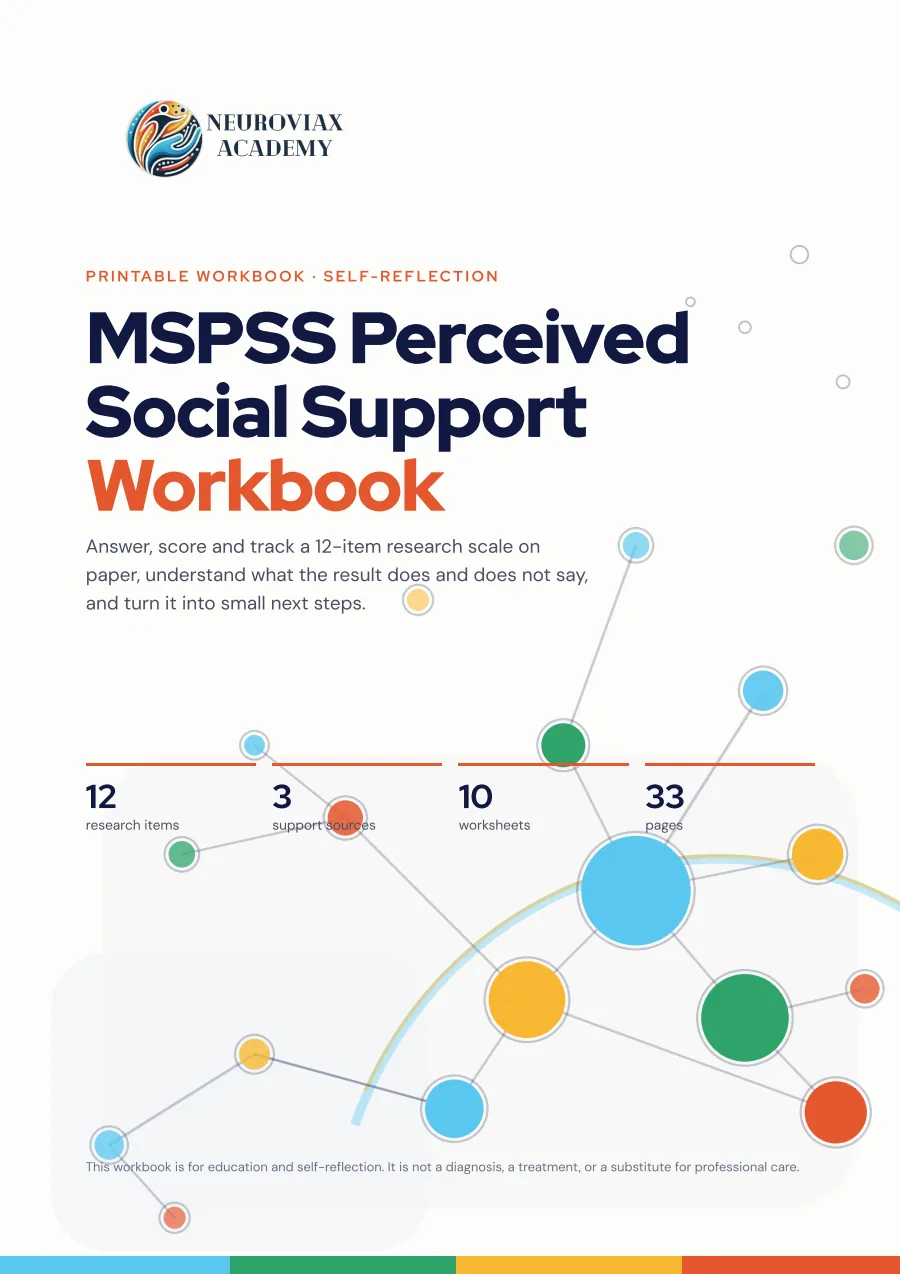
Cover
Samples are low resolution and watermarked. The files you download are full quality.
Printable workbook
MSPSS Perceived Social Support Workbook
$5.99 PDF, A4 and US Letter · 33 pages · instant download
Use the MSPSS Perceived Social Support Workbook to answer 12 items, compare three sources of perceived support, and plan small steps with worksheets and six-week trackers.
Secure payment by Whop on its own page. Right after paying you come straight back here to download your files, and we email you a personal link so you can return to them any time. No account needed.
What is in the pack
- Cover 1 page
The cover of your workbook. - Start here 3 pages
What is inside, how to use the workbook and a simple path to follow. - The measure and scoring 5 pages
The items to answer on paper, step-by-step scoring and a worked example. - Worksheets 10 pages
Fill-in pages that turn your result or your plan into small, concrete steps. - Trackers 4 pages
Repeatable pages to follow change over weeks. Print as many copies as you need. - Quick reference 3 pages
One-page cards to keep at hand: the scale at a glance, ranges and prompts. - Reading guide 3 pages
A short plain-English guide to what the result means and what it cannot tell you. - Professional guide 3 pages
Administration, interpretation and limits for counsellors, coaches and clinicians. - Credits and references 1 page
Full references and credit to the authors and rights holders.
Also included: the complete workbook. Every file above merged into one PDF of 33 pages, in A4 and in US Letter, so you can print it in one go.
Who it is for
- Adults reflecting on perceived social support
- Counselors and clinicians preparing client worksheets
- Coaches and social workers supporting reflection
- Students learning the MSPSS scoring workflow
Want to try it first? Use the free online .
Are you wondering which people feel available to you, or how your sense of support differs across family, friends, and a significant other? The MSPSS Perceived Social Support Workbook offers a calm way to put those reflections on paper. The 12-item measure asks how available support feels; it does not measure the help you actually receive. A single score is a snapshot, not a verdict about your relationships or needs.
The 33-page pack comes as PDFs in both A4 and US Letter. Start-Here lays out a suggested six-week path. Questionnaire and Scoring includes the 12 items, a scoring grid, and a worked example; Quick-Reference summarizes item groups, descriptive score bands, and steps for re-scoring. The Guide explains what results can and cannot tell you. Ten Worksheets include a support map, an inventory, a page for what feels missing, and prompts for one connection or small request. Trackers provide a weekly connection log, habit grid, and score-history chart. Credits and References names the instrument's authors and sources.
You can complete the first questionnaire and reflection at your own pace, then revisit the repeatable pages over six weeks and answer the items again if you choose. Date your entries and use the history chart to place your first and later scores side by side. You finish with a written record of which support sources feel stronger or less present, what you noticed, and a small next step to consider. The suggested schedule is flexible; you can slow down, skip, or repeat a week.
What you get
- Questionnaire and Scoring provides the 12 items, scoring grid, and a worked example for recording your answers.
- Compare Family, Friends, and Significant Other averages using the item map in Quick-Reference.
- Map people you can talk to and note what feels missing in the ten Worksheets pages.
- Use the weekly connection log, habit grid, and score-history chart across the suggested six-week path.
- Keep cut-out request cards nearby, with sample words for listening, practical help, or company.
What it is not
For educational self-reflection, not diagnosis or treatment. The instrument was developed by Gregory Zimet, Nancy Dahlem, Sara Zimet, and Gordon Farley; credit for the measure, items, and structure belongs to them and the publishing journals. Personal use by the buyer; professionals may reproduce pages for their own clients.
Questions people ask
How do I score the MSPSS in this workbook?
Rate each of the 12 items from 1 to 7. Add the four items in each source group and divide each sum by four for its average; add all items for a total, or divide that total by 12 for the mean. The pack labels its score bands descriptive, not clinical cut-offs.
Can I print this workbook on A4 or US Letter paper?
Yes. The download includes PDF files in both A4 and US Letter, with matching page counts. The complete pack is 33 pages: Start-Here is 3 pages, Questionnaire and Scoring is 5, Worksheets is 10, and Trackers is 4, alongside the guides and reference pages.
Is the MSPSS workbook a diagnosis or a measure of help received?
No. It is for education and self-reflection, not diagnosis or treatment. The MSPSS records how available support feels to you; it does not assess a mental health condition or measure the assistance you actually receive. Consider speaking with a health professional if support concerns affect your wellbeing.