

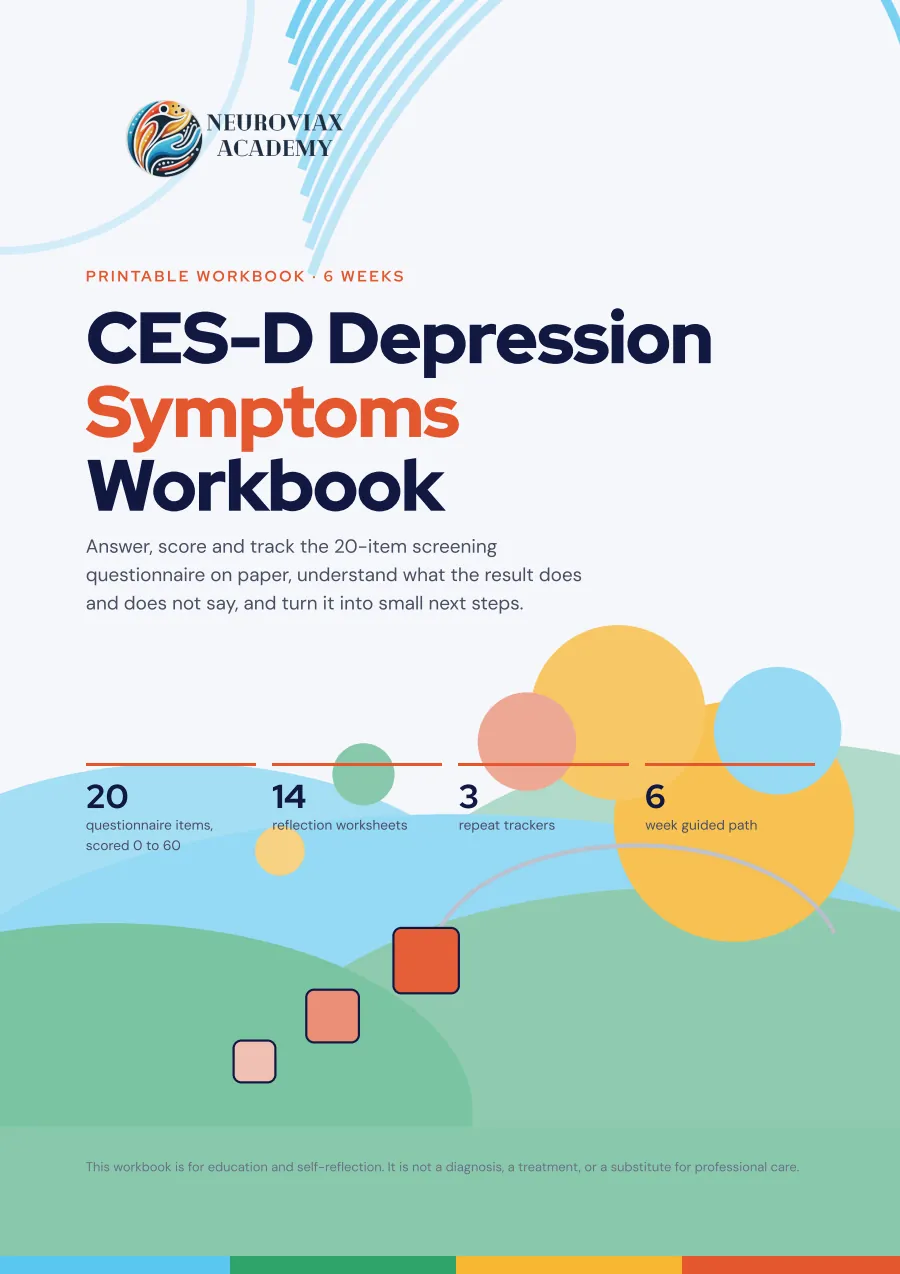
Cover
Samples are low resolution and watermarked. The files you download are full quality.
Printable workbook
CES-D Depression Symptoms Workbook
$4.99 PDF, A4 and US Letter · 33 pages · instant download
Answer and score the 20-item CES-D for the past week, then use focused worksheets and repeat trackers to note patterns and prepare for a conversation with a professional.
Secure payment by Whop on its own page. Right after paying you come straight back here to download your files, and we email you a personal link so you can return to them any time. No account needed.
What is in the pack
- Cover 1 page
The cover of your workbook. - Start here 3 pages
What is inside, how to use the workbook and a simple path to follow. - The measure and scoring 3 pages
The items to answer on paper, step-by-step scoring and a worked example. - Worksheets 14 pages
Fill-in pages that turn your result or your plan into small, concrete steps. - Trackers 3 pages
Repeatable pages to follow change over weeks. Print as many copies as you need. - Quick reference 2 pages
One-page cards to keep at hand: the scale at a glance, ranges and prompts. - Reading guide 4 pages
A short plain-English guide to what the result means and what it cannot tell you. - Professional guide 2 pages
Administration, interpretation and limits for counsellors, coaches and clinicians. - Credits and references 1 page
Full references and credit to the authors and rights holders.
Also included: the complete workbook. Every file above merged into one PDF of 33 pages, in A4 and in US Letter, so you can print it in one go.
Who it is for
- Adults reflecting on a difficult week
- People organizing notes before seeking support
- Counselors and therapists using printable client pages
- Coaches supporting structured self-reflection
Want to try it first? Use the free online .
Are you trying to make sense of a difficult week? The CES-D asks about how often you felt or behaved in certain ways during the past seven days. This printable workbook gives you a paper-based way to answer its 20 items, score the total from 0 to 60, and treat the result as a prompt for reflection rather than a label. Four items are reverse-scored, and the guide explains the common screening threshold and its limits.
The pack has 33 pages across nine PDFs in A4 and US Letter. Start Here offers a first-evening checklist and six-week path. The questionnaire and scoring pages include the response scale, reverse-scoring steps, band bar, and worked example. Fourteen worksheets help you describe your result, notice item-group patterns, plan a small step, and prepare for a conversation. Three repeatable trackers cover score history, mood and sleep, and weekly rhythm. The four-page Guide explains the score limits, the two-page Clinician Guide supports professional use, and Quick Reference includes a scoring card and cut-out fridge card.
You can begin with one evening and continue at a pace that fits your week. The suggested path repeats the CES-D weekly for six weeks, with room to use only the worksheets that feel relevant and to make copies of the trackers. As you fill them in, you build a dated score history, notes about the week and its patterns, and questions or observations you may want to bring to a professional. The pages help organize what you notice; they do not decide what it means.
What you get
- Answer the 20 CES-D items using the past-week window and four response choices shown on the questionnaire pages.
- Follow the scoring page and Quick Reference card to reverse items 4, 8, 12, and 16 before adding your total.
- Use the band bar and worked example to record a 0-to-60 total while keeping the screening threshold in context.
- Compare item-group sums with Worksheet 2's table and chart to see which descriptive areas contributed to your total.
- Track check-ins with the score-history, mood-and-sleep, and weekly-rhythm pages, then prepare notes for a professional conversation.
What it is not
For educational self-reflection only; this workbook is not a diagnosis or treatment. The CES-D was developed by Lenore S. Radloff at the U.S. National Institute of Mental Health. Personal use is licensed to the buyer; professionals may print and reuse pages with their own clients, while wider group, clinic, or institution use requires a separate license.
Questions people ask
Is the CES-D free, and what am I paying for?
This pack credits the CES-D to Lenore S. Radloff and identifies the questionnaire material and scoring rules as reproduced from its supplied source page. The purchase is for the organized printable workbook pages, worksheets, trackers, guides, and reference cards, not a diagnosis or treatment.
Can I print the CES-D workbook on A4 or US Letter paper?
Yes. The 33-page pack is provided as PDF files in both A4 and US Letter sizes. The page counts match in both versions. You can print the pages you need, and the repeatable tracker pages can be copied for additional check-ins.
How often should I repeat the CES-D in this workbook?
The suggested path uses the questionnaire once a week for six weeks, on the same day if possible. Weeks are guides rather than deadlines, and the workbook says to compare entries without judgment. Its score history and other pages help you record the weeks between check-ins.