

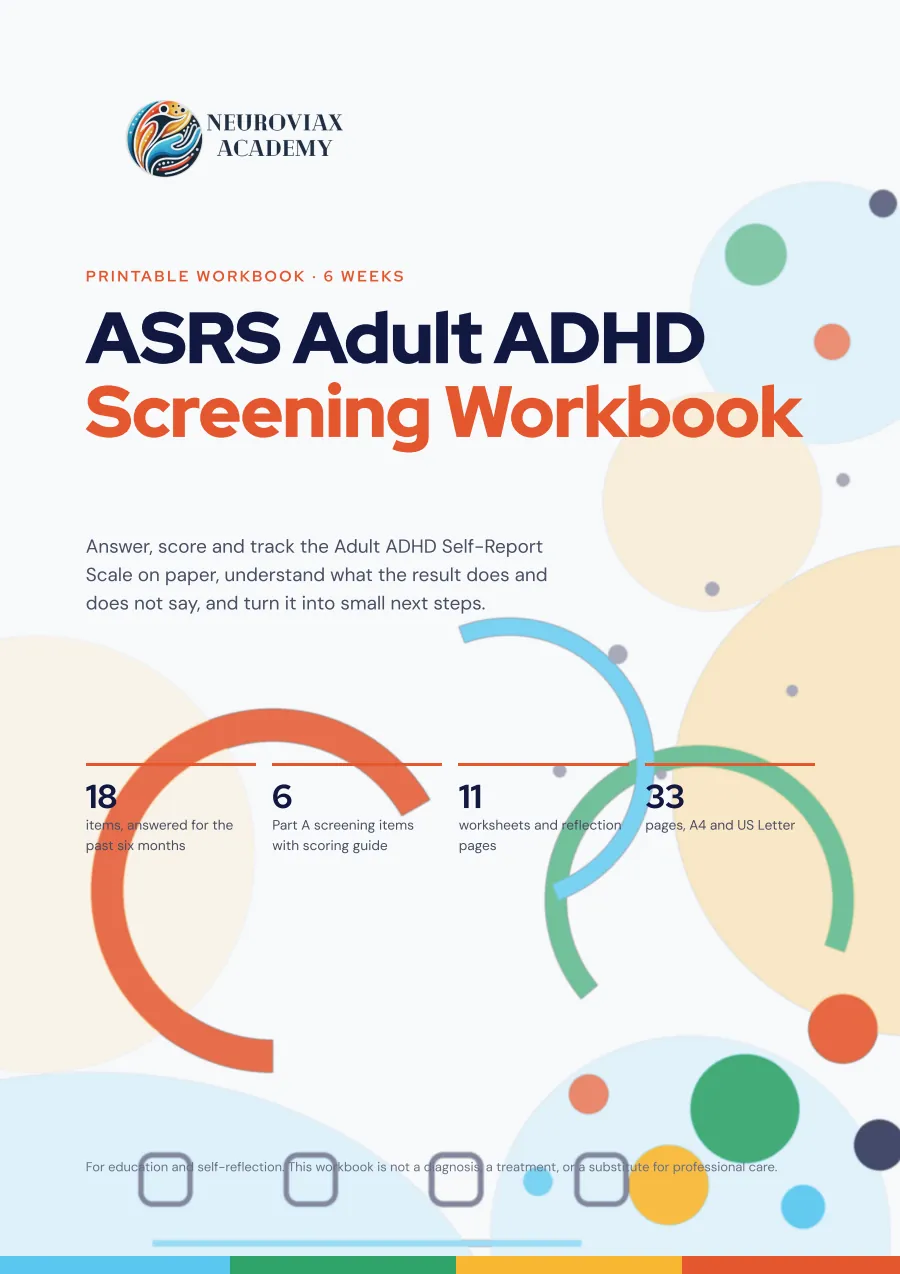
Cover
Samples are low resolution and watermarked. The files you download are full quality.
Printable workbook
ASRS Adult ADHD Screening Workbook
$4.99 PDF, A4 and US Letter · 33 pages · instant download
A paper-based guide to answering and scoring the ASRS, with reflection worksheets and trackers to organize your six-month experiences and prepare for a professional conversation.
Secure payment by Whop on its own page. Right after paying you come straight back here to download your files, and we email you a personal link so you can return to them any time. No account needed.
What is in the pack
- Cover 1 page
The cover of your workbook. - Start here 3 pages
What is inside, how to use the workbook and a simple path to follow. - The measure and scoring 4 pages
The items to answer on paper, step-by-step scoring and a worked example. - Worksheets 11 pages
Fill-in pages that turn your result or your plan into small, concrete steps. - Trackers 4 pages
Repeatable pages to follow change over weeks. Print as many copies as you need. - Quick reference 2 pages
One-page cards to keep at hand: the scale at a glance, ranges and prompts. - Reading guide 4 pages
A short plain-English guide to what the result means and what it cannot tell you. - Professional guide 3 pages
Administration, interpretation and limits for counsellors, coaches and clinicians. - Credits and references 1 page
Full references and credit to the authors and rights holders.
Also included: the complete workbook. Every file above merged into one PDF of 33 pages, in A4 and in US Letter, so you can print it in one go.
Who it is for
- Adults recording attention and activity experiences
- People preparing for a professional conversation
- Adults who want a structured paper screener
- Therapists, counselors, and coaches supporting adult clients
Want to try it first? Use the free online .
Want a clear way to record attention and activity experiences over the past six months? The ASRS Adult ADHD Screening Workbook gives adults a paper format for the 18-item self-report questionnaire, with space to answer at your own pace. Its scoring pages explain the six-item Part A shaded-box thresholds and include a worked example. The reading guide explains what the screening flag can say and where its limits are, so a number is not mistaken for a diagnosis.
The 33-page pack comes as PDFs in both A4 and US Letter. Start-Here lays out a six-week path; Measures holds the questionnaire and scoring; 11 Worksheets include a six-month map, daily impact check, task-start ladder, and small-step plan. Four Trackers provide a score history chart and weekly logs, while Quick-Reference includes an at-a-glance page and cut-out appointment and bad-day cards. The Reading Guide covers the result and its limits, the Professional Guide describes administration and interpretation, and Credits-References names the instrument's authors and sources. Print the pages you need, and make copies of repeatable trackers.
Use the measure first, then work through a page or two as your time and energy allow. The suggested path spreads the pages across six weeks, including a two-week small step and a review with optional retesting. You can also move at your own pace: note where experiences affect daily life, record context and questions, and bring completed pages to a qualified professional. You end with a written record of your answers, reflections, and tracker history that can support a more concrete conversation, whatever your score.
What you get
- Answer all 18 ASRS items and follow the Part A shaded-box thresholds with a worked scoring example.
- Read the Guide's 0-3 and 4-6 screening bands alongside clear limits on what the score means.
- Use the six-month map, daily impact check, and task-start ladder among 11 reflection worksheets.
- Record repeat administrations and weekly observations with the score history chart and four Trackers.
- Bring the Quick-Reference appointment prep card, your questions, and completed pages to a professional conversation.
What it is not
For educational self-reflection only; this workbook is not a diagnosis or treatment. The ASRS was developed by the World Health Organization with Ronald C. Kessler, Lenard Adler, and colleagues; © World Health Organization 2003.
Questions people ask
How do I score the ASRS in this workbook?
Count Part A threshold responses: items 1-3 count from Sometimes, and items 4-6 count from Often. A total of 0-3 is below the screening flag; 4-6 meets it. The guide explains that neither band diagnoses ADHD, and the other item groups are descriptive only.
Can I print the ASRS workbook on A4 or US Letter?
Yes. The 33-page workbook is provided as PDFs in both A4 and US Letter, with all 33 pages included in each size. Print the pages you need, and make additional copies of repeatable tracker pages for your own use.
How often should I repeat the ASRS?
The six-week path includes an optional review and retest in week six. The Professional Guide says the history trackers assume retests at intervals of two weeks or more, and notes that answers may vary with context. Retesting is not a substitute for professional assessment.