

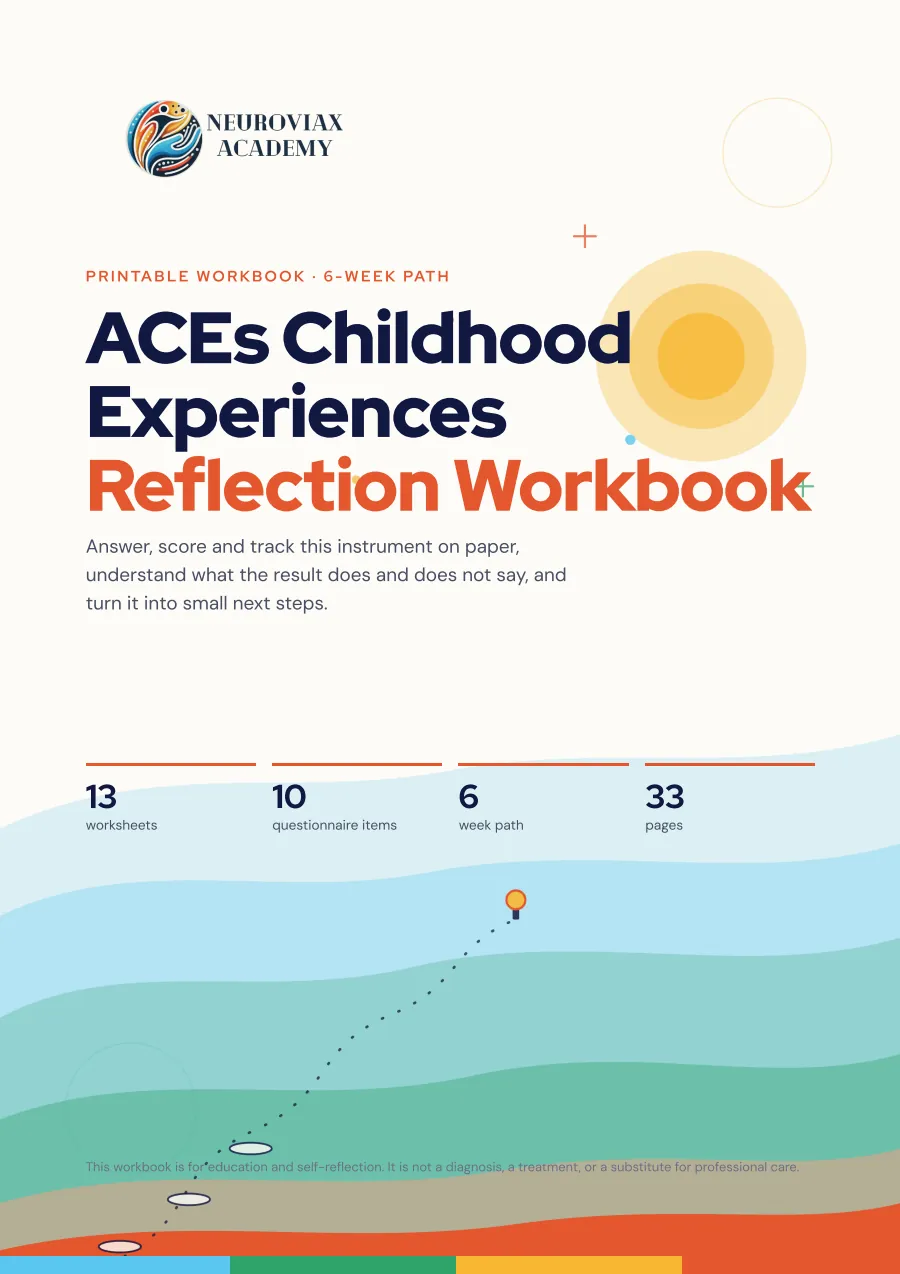
Cover
Samples are low resolution and watermarked. The files you download are full quality.
Printable workbook
ACEs Childhood Experiences Reflection Workbook
$5.99 PDF, A4 and US Letter · 33 pages · instant download
A printable guide to answering and reflecting on the 10-item ACEs questionnaire, with scoring context, worksheets, repeatable trackers, and take-along cards in A4 and US Letter PDFs.
Secure payment by Whop on its own page. Right after paying you come straight back here to download your files, and we email you a personal link so you can return to them any time. No account needed.
What is in the pack
- Cover 1 page
The cover of your workbook. - Start here 3 pages
What is inside, how to use the workbook and a simple path to follow. - The measure and scoring 3 pages
The items to answer on paper, step-by-step scoring and a worked example. - Worksheets 13 pages
Fill-in pages that turn your result or your plan into small, concrete steps. - Trackers 4 pages
Repeatable pages to follow change over weeks. Print as many copies as you need. - Quick reference 3 pages
One-page cards to keep at hand: the scale at a glance, ranges and prompts. - Reading guide 3 pages
A short plain-English guide to what the result means and what it cannot tell you. - Professional guide 2 pages
Administration, interpretation and limits for counsellors, coaches and clinicians. - Credits and references 1 page
Full references and credit to the authors and rights holders.
Also included: the complete workbook. Every file above merged into one PDF of 33 pages, in A4 and in US Letter, so you can print it in one go.
Who it is for
- Adults reflecting on their own childhood
- Adults who want a paced, paper-based reflection
- Therapists supporting adult clients
- Counselors and clinicians preparing handouts
Want to try it first? Use the free online .
If you are wondering what an ACE score can tell you about childhood experiences, this workbook gives you room to answer at your own pace and read the count with care. The 10-item questionnaire covers categories reported before age 18; each Yes adds one point, while a skipped item adds none. The score is a count, not a diagnosis, prediction, or measure of severity, and the guide explains what it leaves out, including strengths and support.
The 33-page pack comes as separate PDF files in both A4 and US Letter. Start-Here offers a safety note and suggested six-week path; Measures contains the questionnaire, scoring steps, and a worked example. Thirteen worksheets help you reflect on what the count includes and omits, identify supports, make a pause plan, consider sharing, and choose a small step. Four trackers can be reprinted. Quick-Reference includes a one-page summary and wallet and fridge cards, while the three-page Guide explains the measure and its limits. A two-page Clinician Guide and one-page Credits and References file complete the set.
Use the suggested path over six weeks or move at a pace that feels manageable: answer and score when ready, pause or skip questions, then return to reflection, supports, and planning. Revisit the repeatable trackers if useful, and fill in the summary if you choose to bring notes to a doctor, therapist, or another person. You finish with your own written reflections, a small-step plan, and a record you can keep or share selectively.
What you get
- Answer the 10-item questionnaire in Measures with Yes, No, or Prefer not to answer, then count Yes responses from zero to ten.
- Read the three-page Guide for context on descriptive bands, skipped items, and what a category count cannot tell you.
- Use the My pause plan and support worksheets to note what steadies you and identify people or places that help.
- Return to the four repeatable Trackers for a revisit log, weekly reflection, small steps, and a monthly overview.
- Fill out the Quick-Reference summary and wallet or fridge card to keep selected notes and support details close.
What it is not
For educational self-reflection only, not a diagnosis or treatment. The ACE questionnaire is in the public domain from the CDC-Kaiser Permanente study conducted by Vincent J. Felitti, Robert F. Anda, and colleagues; the pack credits these authors and the study, and its personal-use license allows professionals to print pages for their own clients.
Questions people ask
Is the ACE questionnaire free, and what does this workbook include?
The ACE questionnaire is in the public domain from the CDC-Kaiser Permanente study. This purchase is for the printable workbook files: 33 pages of questionnaire and scoring, reflection worksheets, trackers, quick-reference cards, guides, and credits, supplied as PDFs in A4 and US Letter.
How is the ACE score calculated and interpreted in this workbook?
The questionnaire has 10 categories of experiences before age 18. Each Yes adds one point, for a count from zero to ten; Prefer not to answer adds nothing. The Guide presents descriptive bands and explains they are not validated clinical cutoffs or personal risk estimates.
Can I print the ACEs workbook on A4 or US Letter paper?
Yes. The pack includes separate PDF files in A4 and US Letter, with identical page counts. There are 33 pages total across the files, including the 13-page Worksheets file and four-page Trackers file.